Build Your HOA Website Free
Running an HOA is a big job for a volunteer.
Neighborhood.online gives your community a modern website, document storage, and communication tools in minutes.
No technical skills required.
Volunteer Opportunities for HOA's

Updated August 24, 2026
Plenty of residents want to help their community. Very few of them want to join a committee for a year to do it. That gap, between genuine willingness and the size of the ask most HOAs make, is where volunteer programs quietly fail. The fix is not recruiting harder. It is creating HOA volunteer opportunities that are clearly defined, sized to fit real schedules, and easy to say yes to.
Done well, this does two things at once. It saves the board real time by spreading work that currently sits on one or two people, and it strengthens the community by giving more neighbors a genuine, low-pressure way to be part of it. This guide walks through how to build that kind of program from the ground up.
Identify What Your HOA Actually Needs
Before asking anyone for help, get specific about what help actually looks like. Review the tasks that come up every month, ask each committee leader where they are stretched thin, and pay attention to any job that currently depends entirely on one board member's goodwill. It also helps to separate essential administrative work, the things that must get done, from community-building activities that make the neighborhood a nicer place to live, since they attract different kinds of volunteers.
From there, build a simple list of opportunities for the next three, six, and twelve months. A few examples worth watching for:
- Planning an event
- Welcoming new residents
- Updating the HOA website
- Photographing community activities
- Reviewing landscaping needs
- Organizing documents
- Helping with surveys
- Gathering vendor estimates
Most of this work already exists informally. The list simply gives it a name.
Ask Residents What They Want to Do
Once you know what the community needs, find out what residents actually want to give. A short interest survey does this far better than guessing. Ask about skills, interests, availability, and preferred level of commitment, and include everyday skills and hobbies alongside professional experience, since a resident who loves photography or spreadsheets may never mention it unless asked directly. It also helps to give people room to propose their own project rather than only choosing from a fixed list, and to avoid assuming that an interested neighbor has time for a permanent seat on a committee.
A few questions worth including:
- What types of projects interest you?
- What skills would you be comfortable sharing?
- How much time could you contribute?
- Would you prefer an individual task or a group activity?
- Would you consider leading a short-term project?
Create Different Types of Volunteer Opportunities
The single biggest reason volunteer programs stall is offering only one size of commitment. A real program offers several, so people can pick the one that fits their life right now.
Ongoing roles suit residents who want consistent involvement: committee member, website editor, welcome coordinator, event calendar manager, or neighborhood photographer. These are the roles covered in depth in our guide to building effective HOA committees.
Short-term projects give a clear goal and a completion date, which appeals to people who want to help without an open-ended obligation: updating the resident welcome packet, organizing a community cleanup, comparing landscaping proposals, creating an emergency contact list, or planning the annual meeting.
One-time opportunities let residents pitch in without any continuing commitment at all: checking people in at an event, delivering flyers, setting up tables, photographing an activity, or helping clean up afterward.
Micro-volunteering covers tasks that take fifteen minutes to an hour: proofreading an announcement, answering a resident survey, uploading meeting minutes, calling a local vendor, or watering newly planted flowers. These tiny tasks matter more than they seem, because a neighbor who says yes to something small and enjoys it is far more likely to say yes to something bigger next time.
How to Design Opportunities People Actually Want
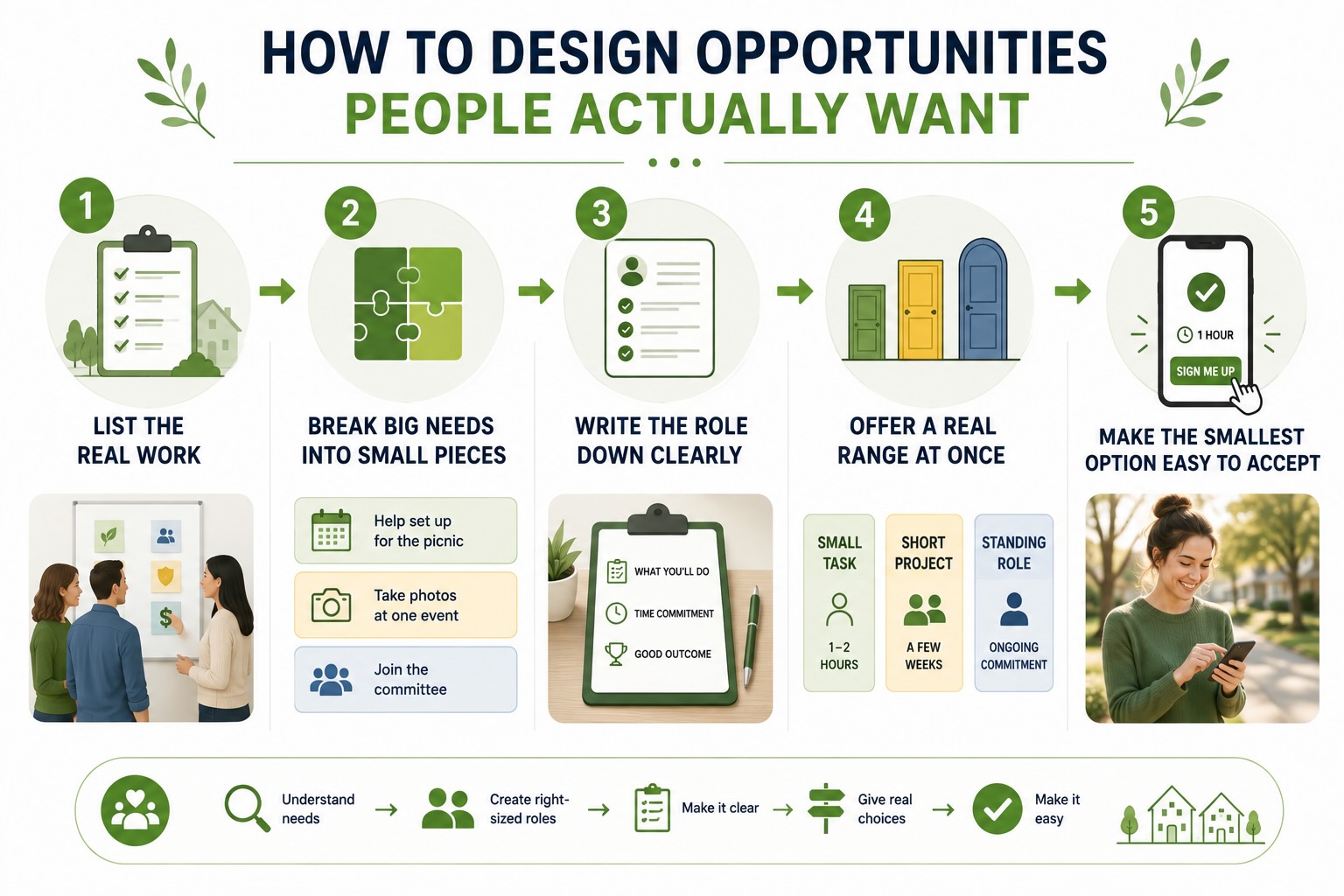
Knowing the four types is only half the job. Designing a good opportunity means deliberately matching a real community need to the right-sized ask, rather than defaulting to whatever size role happens to be open. A simple design process ties it together:
- Start from the needs list. Take one item from what your HOA actually needs and ask how small it can be broken down before it stops being useful.
- Offer it at more than one size. The same underlying need, say, community photography, can become a micro task ("photograph one event"), a short-term project ("build a photo archive for the year"), or an ongoing role ("neighborhood photographer"). Present more than one size side by side so residents self-select the level that fits their life.
- Check it against resident interest. Use what you learned from the survey to shape the offer. If several residents mentioned photography or design, that is a signal to create that opportunity rather than wait for someone to volunteer for something vaguer.
- Write it down before you offer it. An opportunity is not real until it has a name, a time estimate, and an owner, which is exactly what the template below is for.
Applying this to a single need shows the pattern clearly. Community photography, for example, can become a micro task ("photograph one event"), a short-term project ("build a photo archive for the year"), or an ongoing role ("neighborhood photographer"), all from the same underlying need. Use that same breakdown when you work through your own list.
Write a Clear Description for Each Opportunity
A role only becomes an opportunity once it is written down clearly enough that someone can say yes without a long back-and-forth. Every listing should cover the purpose of the role, what the volunteer will actually do, the expected time commitment, whether the work is remote or in person, the start and end dates, who provides instructions, whether any special skills are needed, and how to sign up.
A simple reusable template covers all of it:
- Role name: [short, specific title]
- Purpose: [why this role exists]
- What you'll do: [one to three concrete tasks]
- Time commitment: [hours and duration]
- Format: [remote or in person]
- Timeline: [start and end date, or "ongoing"]
- Point of contact: [name and how to reach them]
- Skills needed: [if any, or "none required"]
- How to sign up: [link or contact method]
Our volunteer role descriptions download uses this same structure across common HOA roles, so you rarely have to start from scratch.
Match Opportunities to Residents' Strengths
People stay engaged with work that feels meaningful to them personally, not just useful to the association. When you know a resident's professional background, hobbies, or interests, offer them a role that connects to it rather than assigning them wherever a gap happens to be. Offering choices, rather than a single fixed assignment, respects people's time and produces better matches. It is also worth deliberately inviting new residents to participate, since volunteering is one of the fastest ways to help someone meet their neighbors, and resisting the pull to lean on the same small group of reliable volunteers every time.
Remove Common Barriers to Participation
Even a well-designed opportunity goes unfilled if it is hard to fit into real life. Offer evening, weekend, and remote options wherever the work allows, break large responsibilities into smaller tasks, and set deadlines that are realistic rather than aspirational. Make sure older adults and residents with disabilities have accessible ways to take part, avoid scheduling unnecessary meetings just because a role exists, and say plainly that volunteering for one small thing does not automatically commit someone to more. That last point alone removes a surprising amount of hesitation.
Promote Opportunities in Multiple Places
A great opportunity that nobody sees does not exist in practice. Share open roles everywhere residents already look: the HOA website, the member portal, the email newsletter, the community calendar, meeting announcements, new-resident welcome materials, and printed flyers or bulletin boards. Frame the message around the difference a volunteer will make, not just the task that needs doing. People respond to impact far more than to a chore list.
Make Signing Up Simple
The easier the yes, the more yeses you get. Use a short online form that asks only for what you truly need, let residents select more than one area of interest, and send an immediate confirmation so nobody wonders if their submission went through. Explain briefly what happens next, and give every volunteer a clear board or committee contact so they are never left waiting to hear from someone.
Provide a Simple Volunteer Onboarding Process
Once someone signs up, a short onboarding sets the tone for everything that follows. Send a welcome message, explain the project's goal and scope, and share whatever documents or instructions the role requires. Introduce the volunteer to their main point of contact, review any expectations around privacy, communication, and decision-making, and give them the access they need without exposing confidential association information. Our full guide to volunteer onboarding walks through this in more depth.
Give Volunteers Ownership Without Losing Oversight
Volunteers do their best work when they are trusted with real ownership, and the board stays comfortable when that ownership has clear edges. Define which decisions a volunteer can make on their own and when board approval is required, assign one point of contact rather than a committee of overseers, and schedule brief progress updates instead of constant check-ins. Document important decisions and completed work as you go, so knowledge does not walk out the door when the volunteer's project ends. This same balance, authority paired with clarity, is exactly what a good committee charter puts in writing for ongoing roles.
Track Participation and Progress
Keep a simple, current list of active opportunities and who is doing what, along with deadlines and completed projects. Keep volunteer contact information private, and record the skills and interests people share along the way so you have them on hand for future opportunities rather than starting from zero each time. Centralizing this on the HOA website, updates, documents, and sign-ups in one place, saves far more time than it costs to set up. A simple volunteer tracking spreadsheet makes this painless even without dedicated software.
Recognize and Retain HOA Volunteers
Recognition is what turns a one-time favor into a long-term relationship. Thank volunteers promptly and specifically, share completed projects with the wider community, and call out contributions in newsletters and meetings. Ask volunteers for feedback on their experience, invite proven volunteers to future projects without applying pressure, and celebrate the impact of the work rather than only the hour count behind it. People remember how appreciation felt long after they forget the task itself.
Avoid Common Volunteer Program Mistakes
Most volunteer programs fail for a small, predictable set of reasons: posting vague requests for help, treating every opportunity as a long-term commitment, failing to respond when someone actually volunteers, giving unclear authority or instructions, holding too many meetings, overloading the same reliable few, letting one person control an important function with no backup, and simply forgetting to say thank you. Most of these are easy to avoid once you know to watch for them.
Create a Repeatable Volunteer Program
The strongest programs are not one good push, they are a habit. Run the resident interest survey annually, keep a set of reusable role descriptions on hand, and publish upcoming opportunities on a regular cadence rather than only when a crisis hits. Review which opportunities draw the most interest and do more of what works, build simple handoff instructions for recurring roles, and use short-term projects deliberately as a way to spot future committee chairs and board members before you need them.
How Neighborhood.online Helps
Running a program like this by hand, spreadsheets, email threads, and paper sign-up sheets, works for a while, but it is exactly the kind of administrative load that burns out the volunteers running it. Neighborhood.online brings the whole cycle into one place: publish volunteer opportunities and interest surveys, promote events, share project documents, coordinate committees, keep residents informed, and recognize volunteer accomplishments, all from one HOA website instead of five disconnected tools.
Make Volunteering Easier
Publish open roles, collect interest forms, and keep every volunteer organized in one place with Neighborhood.online.
Get Started With Neighborhood.onlineTurn Willing Residents Into Active Neighbors
Flexible roles, clear expectations, and easy communication are what make volunteering appealing rather than intimidating. The goal was never to fill every resident's calendar. It is to give people practical, right-sized ways to contribute when they can, so more of the community's real needs get met by more of its neighbors.
Your one next step: pick three small, one-hour tasks your community needs this month and post them alongside your usual committee ask. For the full picture on building a community that runs on many hands, our HOA volunteer playbook pulls it all together.