Build Your HOA Website Free
Neighborhood.online gives your community a modern website, document storage, and communication tools in minutes. No technical skills required.
The HOA Volunteer Playbook

Updated August 26, 2026
A community association is only as strong as the neighbors willing to give it their time. This HOA volunteer playbook is a strategic guide for turning that willingness into something lasting: a steady base of volunteers and well-run committees that share the work, instead of a handful of exhausted people holding everything together. It is written to be adopted and used, so replace the bracketed details with your community's specifics and review the final version against your governing documents and local laws before it becomes policy.
1. Welcome and Purpose
Almost everything residents value about their community, the tidy common areas, the summer gatherings, the sense that someone is looking out for the place, exists because volunteers make it happen. Recognizing that openly is the first strategic move, because volunteers who feel their contribution matters tend to give more of it. The purpose of this playbook is to turn goodwill into a system: to make volunteering easy to start, clear to carry out, and rewarding enough that people stay. Everything that follows serves that single aim.
Above all, volunteers act in service of [HOA NAME]'s mission to maintain shared spaces, protect property values, and support a good quality of life for everyone who lives here. They are expected to carry the community's values of fairness, respect, and neighborliness into everything they do on the association's behalf, because a volunteer program only works when the people in it reflect the community they serve.
2. Understanding the HOA
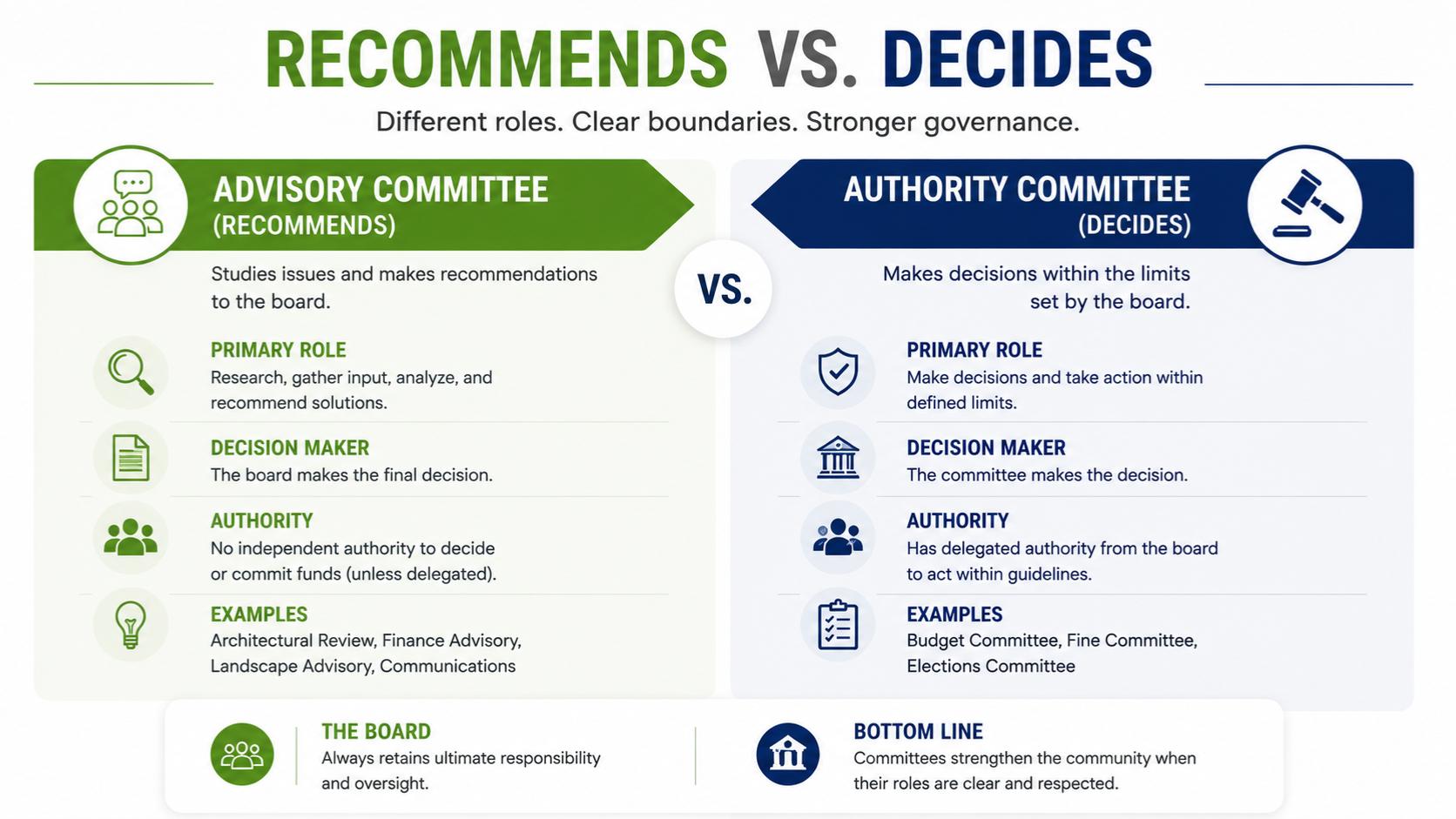
Volunteers work best when they understand the structure they are part of. The board, elected by the homeowners, makes the association's official decisions and sets its direction. Where a management company is involved, it handles day-to-day operations such as billing, maintenance coordination, and records as a professional partner rather than a decision-maker. Committees sit between the board and the wider community, doing focused work and bringing recommendations forward, and individual volunteers power those committees, events, and projects. Underneath all of it are the governing documents, the declaration or CC&Rs, the bylaws, and the community's rules, which serve as the association's operating system and have the final word.
The practical lesson for any volunteer is to know the edges of their authority. Volunteers carry out their assigned role and make recommendations, but they do not sign contracts, make official decisions, or speak for the board unless specifically authorized. Just as important is the instinct to escalate. When a matter falls outside a volunteer's role, involves money beyond an approved limit, or touches anything legal, safety-related, or formally contested, it belongs with the board liaison or community manager rather than with the volunteer trying to solve it alone. Knowing where your authority ends is not a limitation. It is what lets you act with confidence inside it.
3. Volunteer Opportunities
One of the most effective things an association can do is offer more than one way to help. People opt out of volunteering not because they do not care, but because the only option on the table feels too big. A strategic community presents a spectrum instead. Standing committees, focused on areas like landscaping, events, finance, or safety, suit neighbors ready for an ongoing role and usually ask one to two hours a month, a little more for a chair. Event and project teams form around a single purpose and dissolve when it is done, which appeals to people who want a clear beginning and end. Neighborhood ambassadors do nothing more structured than welcoming new residents and helping people feel connected.
The quietest but most valuable category is the short-term or remote role: a one-hour task, a single event shift, a thirty-day project, a newsletter edited from a kitchen table. These low-commitment on-ramps matter far more than they appear, because a neighbor who helps once and enjoys it often becomes the committee member you were struggling to find. Clear volunteer role descriptions for each opportunity let people picture themselves in the work before they commit.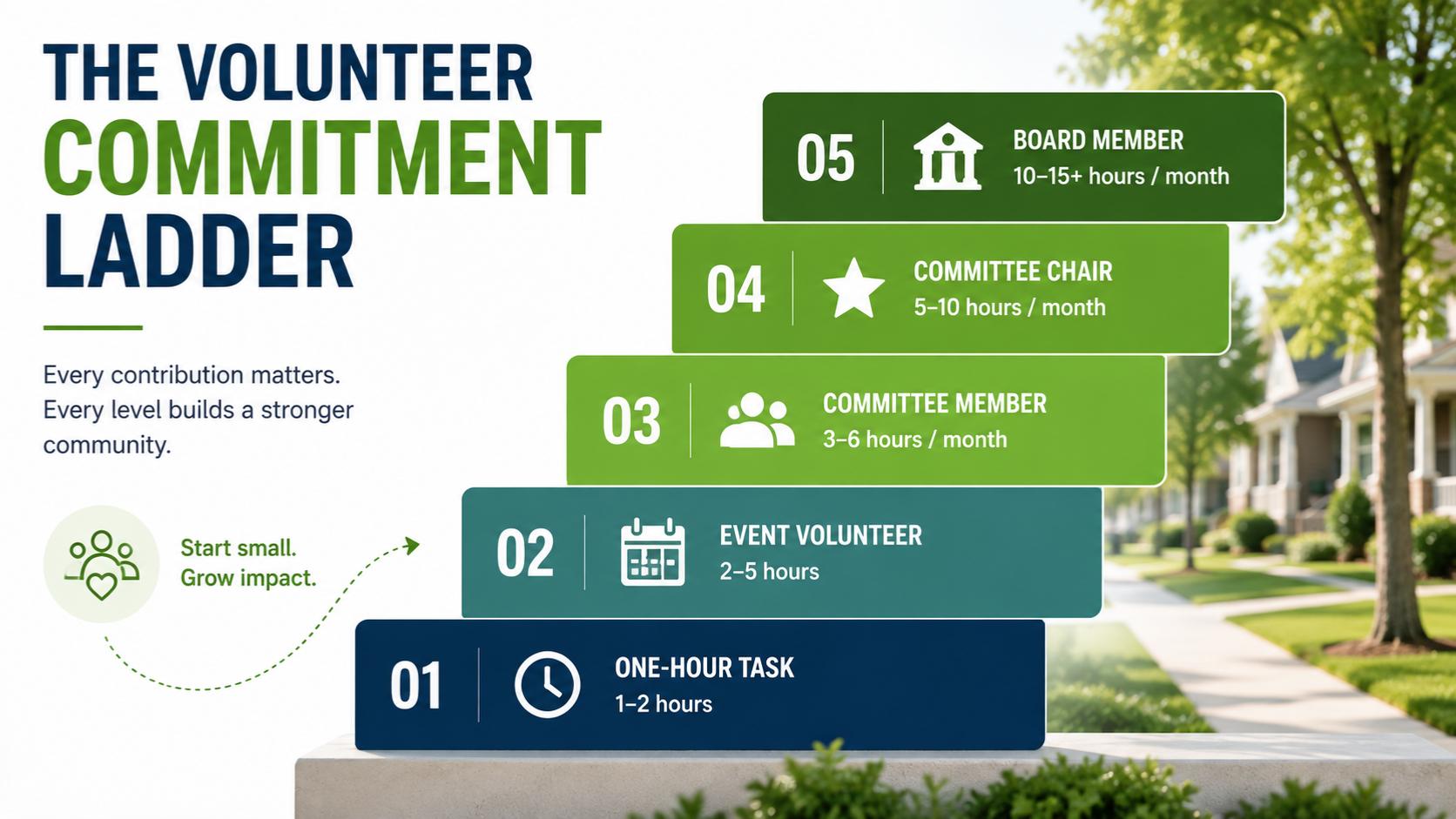
4. Recruitment and Selection
Recruitment succeeds or fails on clarity long before it depends on enthusiasm. Start by naming the real work that needs doing and breaking it into defined roles, because a specific need is far easier to fill than a general appeal for help. Each role should make plain what the person will do, how much time and how long a term it involves, any skills it requires, who they report to, and the difference it makes to the community. With that in hand, the most effective recruiting is personal and specific. A direct invitation to a neighbor who already shows the right instincts will outperform any mass email, which tends to feel addressed to everyone and therefore to no one.
Aim to invite a broad and representative mix of neighbors rather than the same familiar faces, and keep screening proportional to the role. A friendly conversation is enough for most positions, though roles that touch money, records, or vulnerable residents warrant more care. Ask volunteers to disclose any personal or financial stake in matters they help decide and to step back where a conflict exists, which protects both the volunteer and the association's credibility. Our full guide to recruiting HOA volunteers develops this further, and for broader best practices the Head Start volunteer recruitment guide and the University of Kansas Community Tool Box are strong, free references.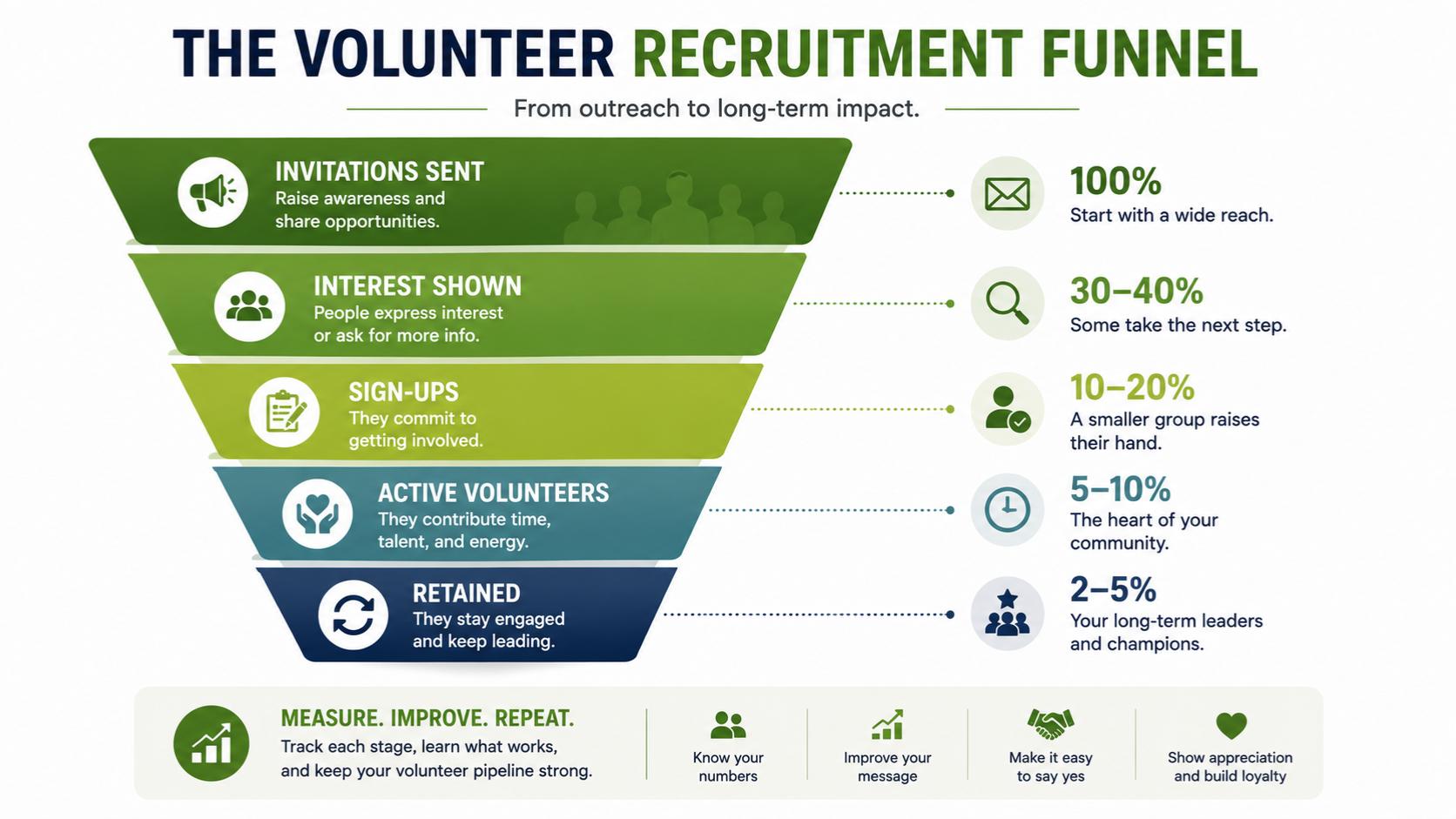
Free Download: Volunteer Recruitment Kit
Fill-in-the-blank emails, flyers, website copy, and social posts to invite neighbors onto committees.
Get the Kit5. Orientation and Onboarding
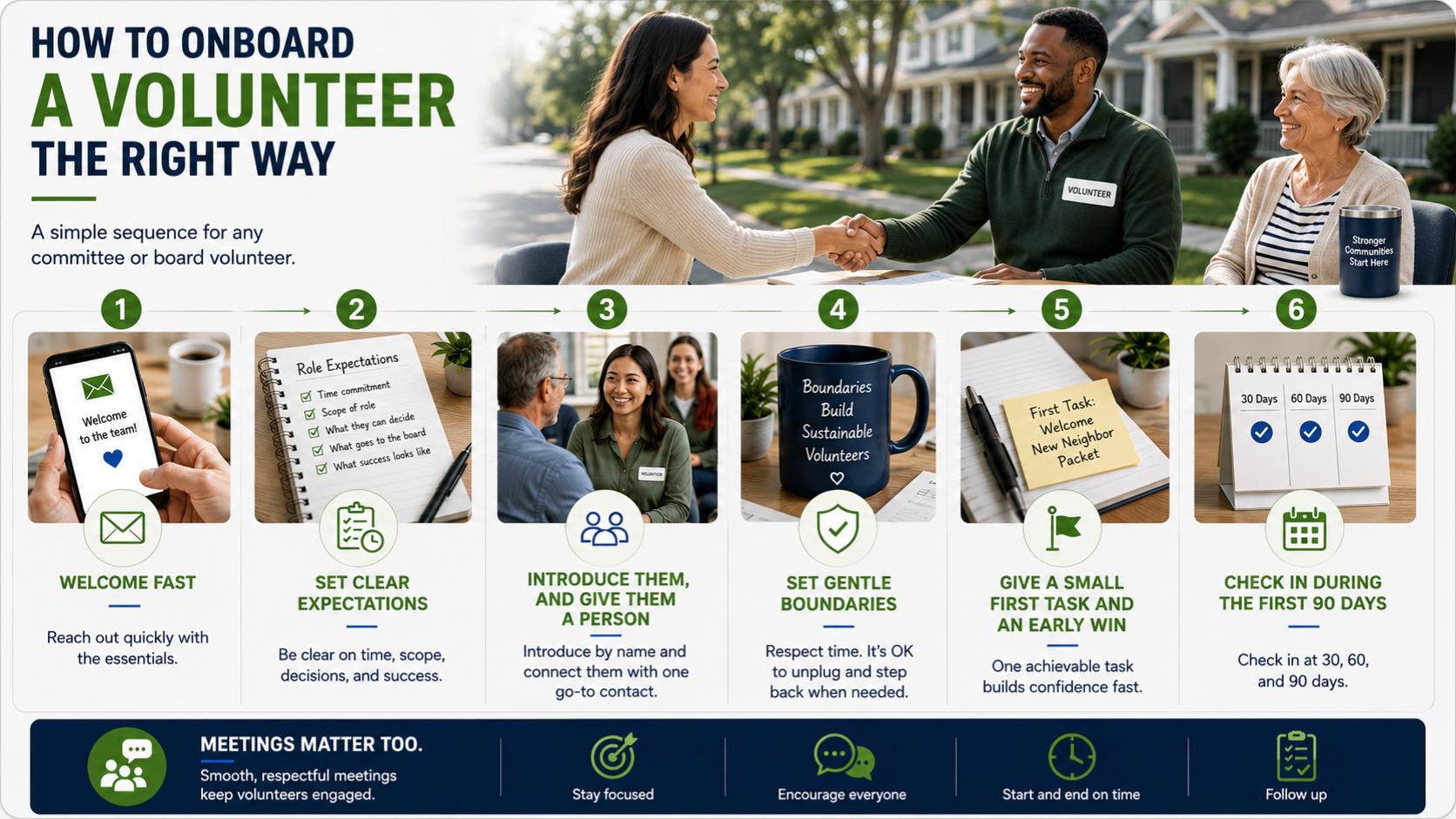
The weeks right after someone says yes are the most fragile and the most decisive. A volunteer who is welcomed well starts contributing with confidence, while one left to figure things out alone often drifts away before their first real task. The strategic response is a light but deliberate onboarding. Reach out within a day or two to thank the new volunteer, share their role description, tell them when and where the first meeting is, and name the one person they can bring any question to. Give them the access the role genuinely requires, the logins, keys, and documents, and nothing beyond it, and share the handful of policies and any brief training the role calls for.
Then keep the first thirty days deliberately light: one meeting, one small task, and plenty of room to ask questions. The goal is not to impress a new volunteer with process but to remove the uncertainty that quietly pushes people out the door. Our full guide to volunteer onboarding lays out the sequence step by step.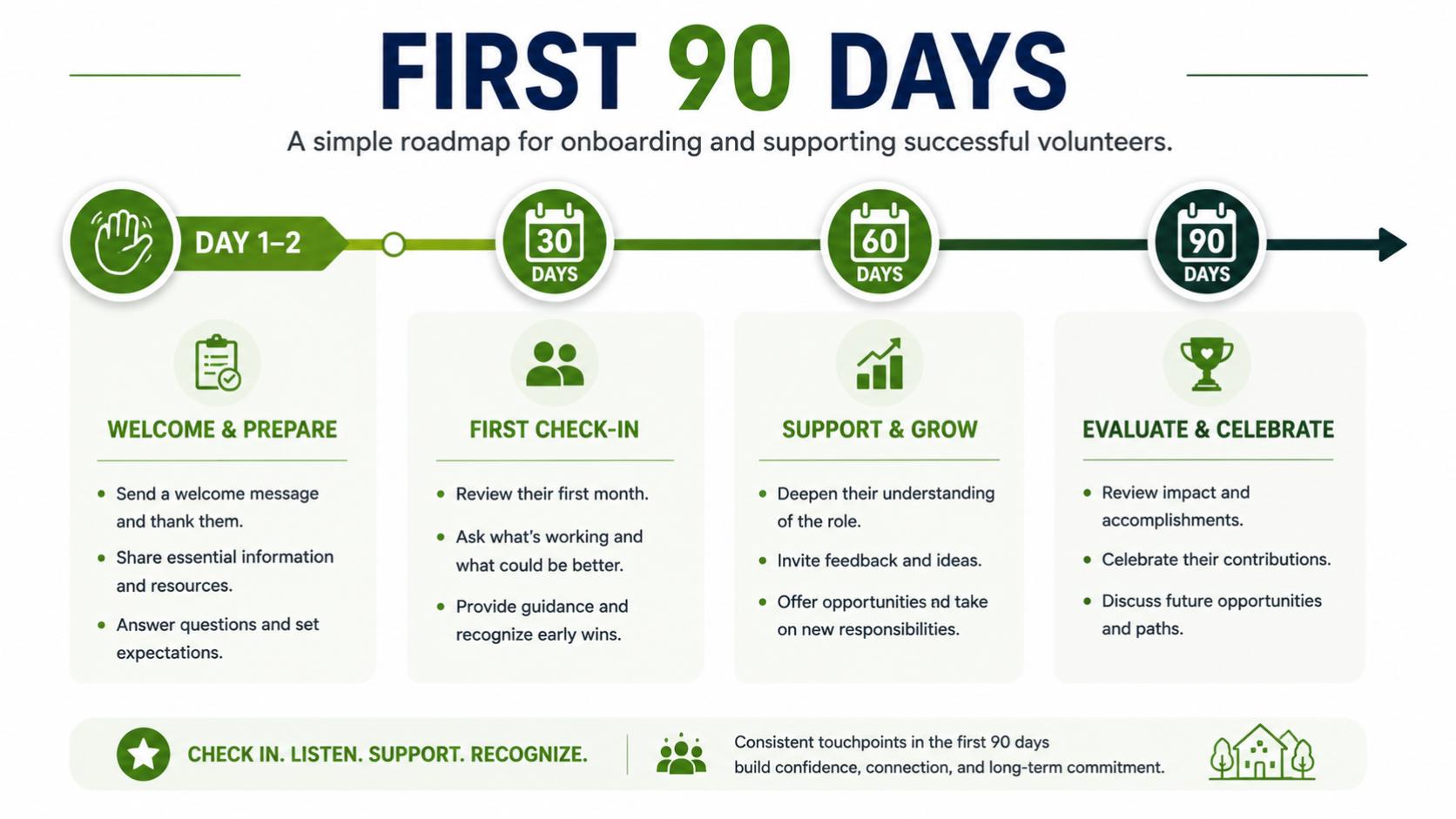
Free Download: Volunteer Onboarding Guide
A welcome checklist, expectations to set, communication norms, and a first-30-days plan for new volunteers.
Get the Guide6. Volunteer Standards
Because volunteers act in the association's name, the standards they hold set the tone that residents experience. The baseline is simple respect: courtesy toward every neighbor and fellow volunteer, even in disagreement. Beyond conduct, volunteers are often trusted with sensitive information, homeowner accounts, disputes, and occasionally legal matters, and that trust depends on keeping such information confidential and sharing it only with those who need it.
Fair housing sits at the center of these standards. Every resident and applicant must be treated equally, regardless of race, color, religion, sex, national origin, familial status, disability, or other protected class, and fair housing law applies squarely to community associations. The U.S. Department of Housing and Urban Development's Fair Housing overview is the authoritative reference. When representing the association, volunteers stay politically neutral and avoid using the role to advance personal positions, and they carry that same care onto social media, never sharing confidential information or blurring the line between speaking personally and speaking for the community. Finally, the association tolerates no harassment and no retaliation against anyone who raises a concern in good faith, which is what makes it safe for volunteers to speak up in the first place.
7. Communication
Good communication is less about eloquence than about consistency and judgment. Keeping association business in approved channels, whether a committee email address or the community portal, ensures nothing is lost and there is always a record to point to. With residents, the standard is clear, timely, courteous, and limited to what a volunteer is authorized to share. Complaints and sensitive matters call for particular discipline: listen, stay respectful, avoid promising outcomes on the board's behalf, and route the issue promptly to the person who can actually address it, escalating anything urgent, legal, or beyond your role without delay. Underpinning all of it is recordkeeping, because simple, accurate notes of decisions and actions are what carry a committee's knowledge from one group of volunteers to the next. Documents tell the story that oral histories inevitably lose.
8. Committee Operations
A committee runs well when its purpose and boundaries are written down before disagreements have a chance to form. That is the job of a one-page charter, which states why the committee exists, who serves on it, how it operates, and, most importantly, whether it recommends to the board or can decide certain things within set limits. With that foundation in place, roles fall into order. The chair sets the agenda, keeps the group focused, and reports to the board, while members attend, take on a fair share, and follow through. Sharing an agenda in advance and keeping short minutes of decisions and action items keeps everyone accountable and preserves the record.
From there, the operating rhythm is straightforward: committees decide by majority vote or consensus, document their recommendations, and give the board a brief update before each meeting covering what they did, what they need, and what comes next. Tracking goals and contributions along the way keeps progress visible and makes it easy to recognize the people carrying the load. Our guide on why every HOA committee needs a charter goes deeper, and a simple tracking spreadsheet keeps the progress and recognition side effortless.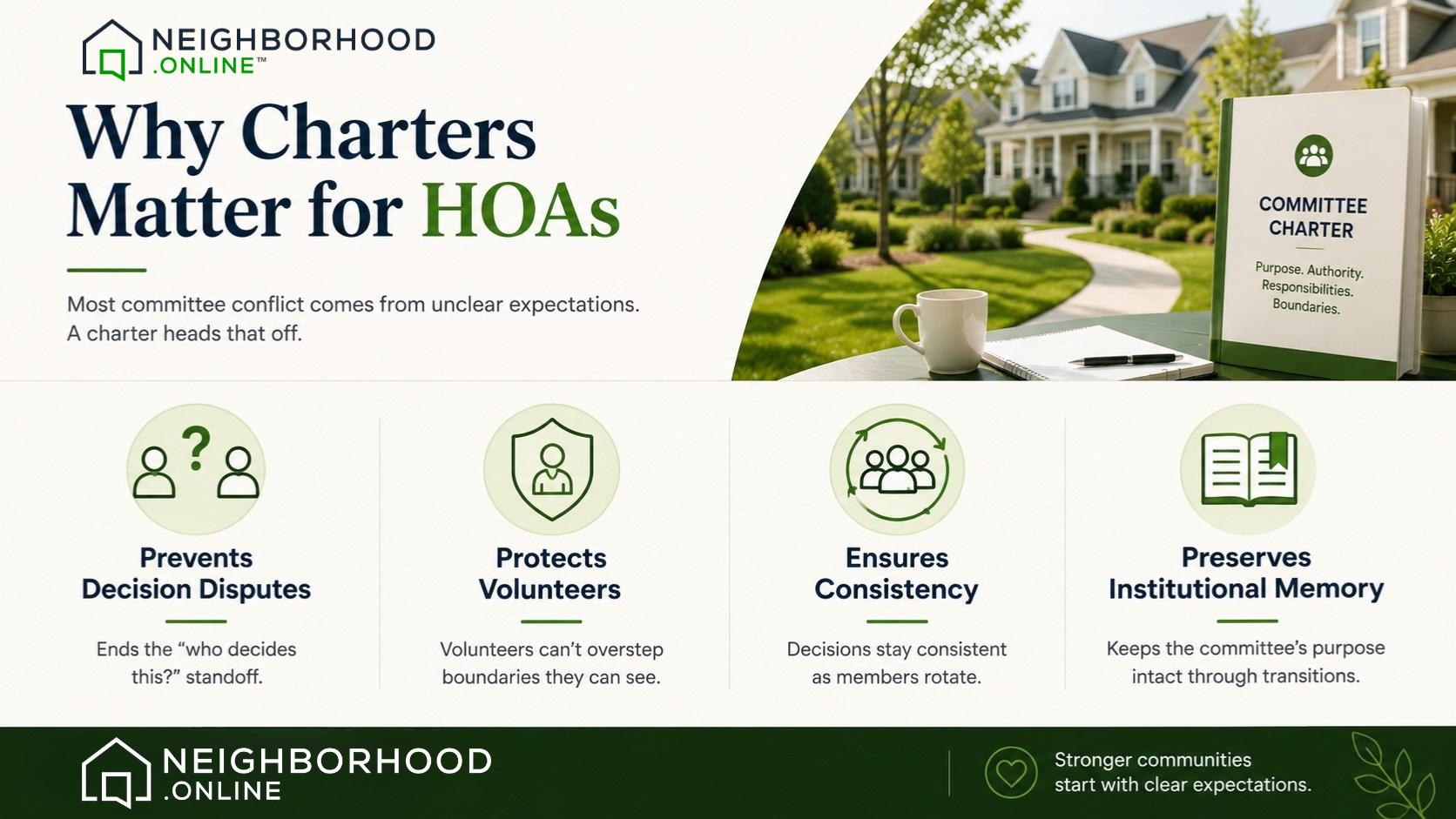
Free Download: Committee Charter Templates
Ready-to-use charters with filled-in examples for the six committees most HOAs rely on.
Get the Templates9. Planning Projects and Events
Projects and events are where committees create the moments residents remember, and a little structure keeps them from becoming a source of stress. New efforts should come to the board as a short proposal covering the goal, cost, and timeline before resources are committed, with any budget requested in advance and treated as a ceiling rather than a suggestion. A simple timeline with a clear owner for each task keeps work from slipping, and vendor arrangements should run through the board or manager rather than being signed by volunteers. Planning with accessibility and inclusion in mind, choosing times, places, and formats that welcome the whole community, is both a legal consideration and a matter of good hosting. And a brief review after each event, capturing what worked and what to change, compounds over time into events that get steadily better.
10. Money, Purchases, and Donations
Nothing erodes trust in an association faster than uncertainty about money, so the rules here are worth stating plainly. Volunteers may spend only up to the limit set in their charter or by the board, with anything larger approved in advance. Approved out-of-pocket costs are reimbursed through the proper process, with receipts, and every purchase is documented, which protects the volunteer as much as the association. Sponsorships and donated goods are coordinated with the board and recorded properly so they are handled transparently. A few activities are simply off-limits: mixing association funds with personal money, accepting payment for a volunteer role, or making unauthorized purchases. Clear financial boundaries are not about distrust. They are what let volunteers handle money without ever having their integrity questioned.
11. Safety and Risk Management
Most volunteer work carries little risk, but the association is well served by volunteers who know what to do when something goes wrong. That starts with knowing the community's emergency contacts and procedures and calling emergency services first in any genuine emergency. Accidents, injuries, or property damage should be reported promptly through an incident report so the association can respond and its insurer is informed. Activities involving children or vulnerable residents call for extra care and any additional screening or supervision the board requires, and community facilities and equipment should be used as intended, with hazards or damage reported right away. Because volunteer activities can carry liability and insurance implications, anything that might pose a real risk is worth checking with the board or manager before it happens rather than after.
12. Handling Conflict
Conflict is not a sign that something has gone wrong. It is a normal part of people caring about where they live, and handling it well is a skill the whole community benefits from. The foundation is de-escalation: staying calm, listening fully, and focusing on the issue rather than the person, since most disagreements soften once people feel heard. Resident disputes call for treating all sides fairly and consistently and resisting the pull to take them personally. Concerns about a volunteer's performance are best raised privately and kindly, with clear expectations and support before any further step, and complaints about board decisions belong with the board through the proper channel rather than aired in public forums. Judgment matters most at the edges: policy and personnel issues go to the manager or board, legal questions to counsel, and any threat to safety to emergency services immediately.
13. Recognition and Retention
Recognition is not a nicety at the end of the process. It is the engine of retention, and treating it as a strategy is what turns first-time helpers into long-term contributors. Thank volunteers promptly and specifically, and celebrate their contributions publicly when they are comfortable with it. Regular check-ins, at thirty, ninety, and one hundred eighty days, surface small frustrations while they are still easy to fix and signal that someone is paying attention. Preventing burnout is largely a matter of sharing the work, respecting people's time and boundaries, and making clear that stepping back for a season is always acceptable.
The associations that thrive also develop their volunteers, encouraging the willing to take on chairs and board seats and supporting them as they grow into those roles. Sharing what volunteers accomplish, so the whole community sees the difference they make, doubles as fair recognition and quiet recruitment for the next person. Keeping an even record of contributions with a simple tracking spreadsheet makes sure appreciation lands where it is earned rather than only on the most visible.
14. Transitions and Offboarding
How a community handles a volunteer's departure says as much as how it handles their arrival. When someone resigns or completes a term, thank them and confirm clearly when the role ends so responsibilities transfer cleanly. Collect any association property they held, keys, badges, and equipment, and remove their access to systems, documents, and accounts. Just as important, have them hand off notes, contacts, and unfinished work, so the knowledge stays with the community rather than walking out the door. A brief exit conversation, asking honestly about their experience, is one of the most useful and least used tools an association has for making the next volunteer's time better.
15. Templates and Resources
A playbook is only as useful as the tools that make it easy to follow, and several of the forms referenced above are available as ready-to-use templates. The volunteer sign-up lives inside our Volunteer Recruitment Kit, while clear Volunteer Role Descriptions, Committee Charter Templates, a Volunteer Onboarding Guide that includes the onboarding checklist and acknowledgment form, and a Volunteer Tracking Spreadsheet for progress and recognition are each available free in the resource center. A handful of remaining forms, a confidentiality agreement, meeting agenda and minutes, a project proposal and budget form, an incident report, a reimbursement request, and a key-contacts and escalation chart, are best provided by your board, manager, or committee chair for your specific community, and the onboarding guide is a good starting point for the contacts chart.
Note: Before adopting this playbook, review it against your association's governing documents, insurance requirements, management agreement, and applicable state and local laws. This guide is general information, not legal advice.