Build Your HOA Website Free
Running an HOA is a big job for a volunteer.
Neighborhood.online gives your community a modern website, document storage, and communication tools in minutes.
No technical skills required.
HOA Committee Charter

Keep Your Whole Community in the Loop
Homeowners trust boards that communicate clearly. A free Neighborhood.online website makes it easy to share meeting minutes, post updates, and give residents one place to find everything they need.
Build Your Free HOA WebsiteUpdated August 26, 2026
Committees are one of the best things a board can create, right up until nobody remembers who decided what. A group starts strong, then meetings drift, two volunteers disagree about whether they are allowed to approve a purchase, and a well-meaning committee accidentally steps on the board's toes.
An HOA committee charter is the one-page fix. It spells out what a committee is for, who is on it, and, most importantly, what it can decide on its own versus what it has to bring to the board. This guide covers what a charter is, why every committee needs one, and how to write one that keeps your groups focused and out of trouble.
What an HOA Committee Charter Is
An HOA committee charter is a short document, usually a single page, that defines a committee's purpose and its boundaries. Think of it as a job description for the whole group rather than for one person. It answers the practical questions before they turn into disputes: why does this committee exist, who serves on it, how often does it meet, how much can it spend, and does it recommend to the board or decide on its own?
Picture a landscaping committee. Its charter might say the group can approve routine mulch and seasonal flowers up to $500, but a new $40,000 irrigation contract goes to the board. That one line removes almost all the guesswork about what the committee is allowed to do.
Why Charters Matter for HOAs
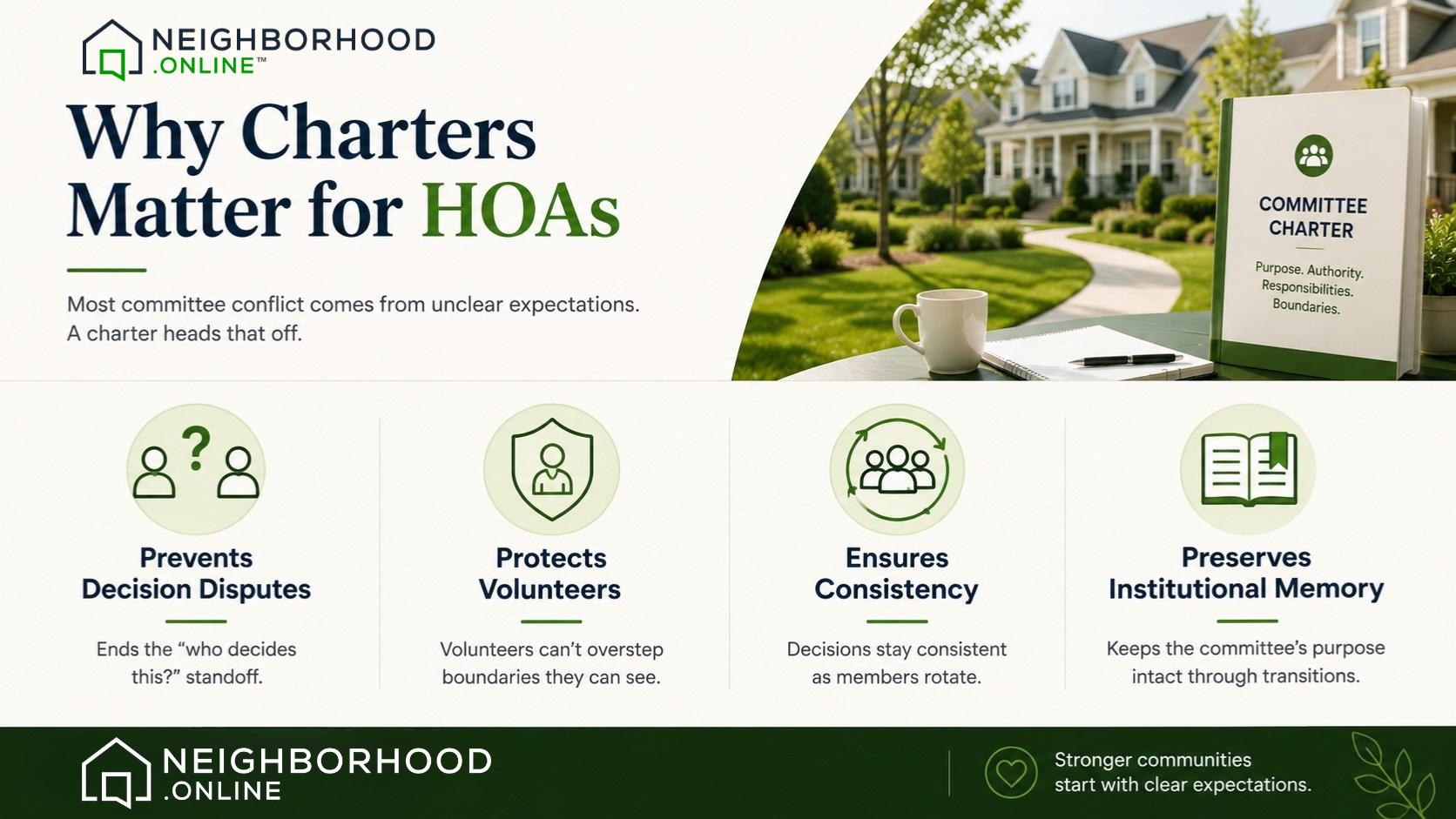
Most committee conflict does not come from bad people. It comes from unclear expectations. A charter heads that off:
- It prevents the "who decides this?" standoff between a committee and the board.
- It protects volunteers, who cannot overstep a boundary they can clearly see.
- It keeps decisions consistent even as members rotate on and off.
- It preserves institutional memory. Committees change hands often, and a written charter keeps the group's purpose intact when the people who started it move on.
Here is how that plays out in real life. A community forms an events committee with a lot of enthusiasm but no charter. One member books a band and signs a $3,000 deposit, assuming the group had the authority. The board never approved it, the budget cannot cover it, and now there is a tense meeting, a frustrated volunteer, and a bill nobody planned for. A single line in a charter, stating that the committee can spend up to a set amount and anything larger goes to the board, would have prevented all of it. Charters are not red tape. They are the guardrails that let volunteers move fast without fear of a misstep.
If you get only one thing right, get this one: state clearly whether the committee recommends or decides. Advisory committees study an issue and recommend to the board, which makes the final call. Committees with authority can make certain decisions within limits the board sets. Writing that single sentence prevents the large majority of committee conflict.
Consistency matters most for committees that touch the rules. When a committee helps apply community standards, it must do so the same way for every homeowner, and always within fair housing law. The U.S. Department of Housing and Urban Development's Fair Housing overview is the authoritative reference for what that requires.
How to Write a Committee Charter
A good charter is short and plain. Keep it to a single page and cover these parts:
- Purpose. One or two sentences on why the committee exists and what it is meant to accomplish.
- Authority. The most important line. State whether the committee recommends to the board or can decide certain things on its own, and within what limits.
- Responsibilities. A short list of the group's main duties, so everyone knows the scope.
- Membership. How many members, how they are appointed, how long they serve, and who chairs the group.
- Meetings. How often the committee meets, what counts as a quorum, and that minutes are kept.
- Budget authority. How much the committee can spend on its own before an expense goes to the board.
- Reporting. How and how often the committee updates the board.
- Review and adoption. A note that the board adopts the charter by vote and reviews it each year.
You do not have to start from a blank page. The templates below include filled-in examples for the six committees most HOAs rely on, so you can adjust a few details and bring them to the board for adoption.
Free Download: Committee Charter Templates
Ready-to-use charters with filled-in examples for landscaping, architectural review, finance, events, safety, and rules committees.
Get the TemplatesHow Technology Can Help
A charter only helps if people can find it. Too often the one copy lives in a former board member's email, and the next group has no idea what they were supposed to do.
Keeping charters somewhere the whole community can see them solves that. Post each adopted charter in a shared document library on your HOA website so every volunteer and resident can read it any time. A platform like Neighborhood.online lets you store charters, meeting minutes, and volunteer forms in one place, so a committee's purpose and boundaries never disappear when its members change. When a new volunteer joins, you simply point them to the charter instead of trying to explain years of history from memory, and everyone works from the same clear rules.
The Bottom Line
A committee charter is a small document that prevents big headaches. Name the purpose, define the authority, and write down who does what, how often they meet, and what they can spend. Keep it to one page, have the board adopt it, and store it where everyone can find it.
Your one next step: pick your busiest committee and give it a charter this month, starting from a template.