Build your Condo an amazing Website!
Unlock Higher Property Values
(No credit card required)
Condo Management Software

Updated September 9, 2026
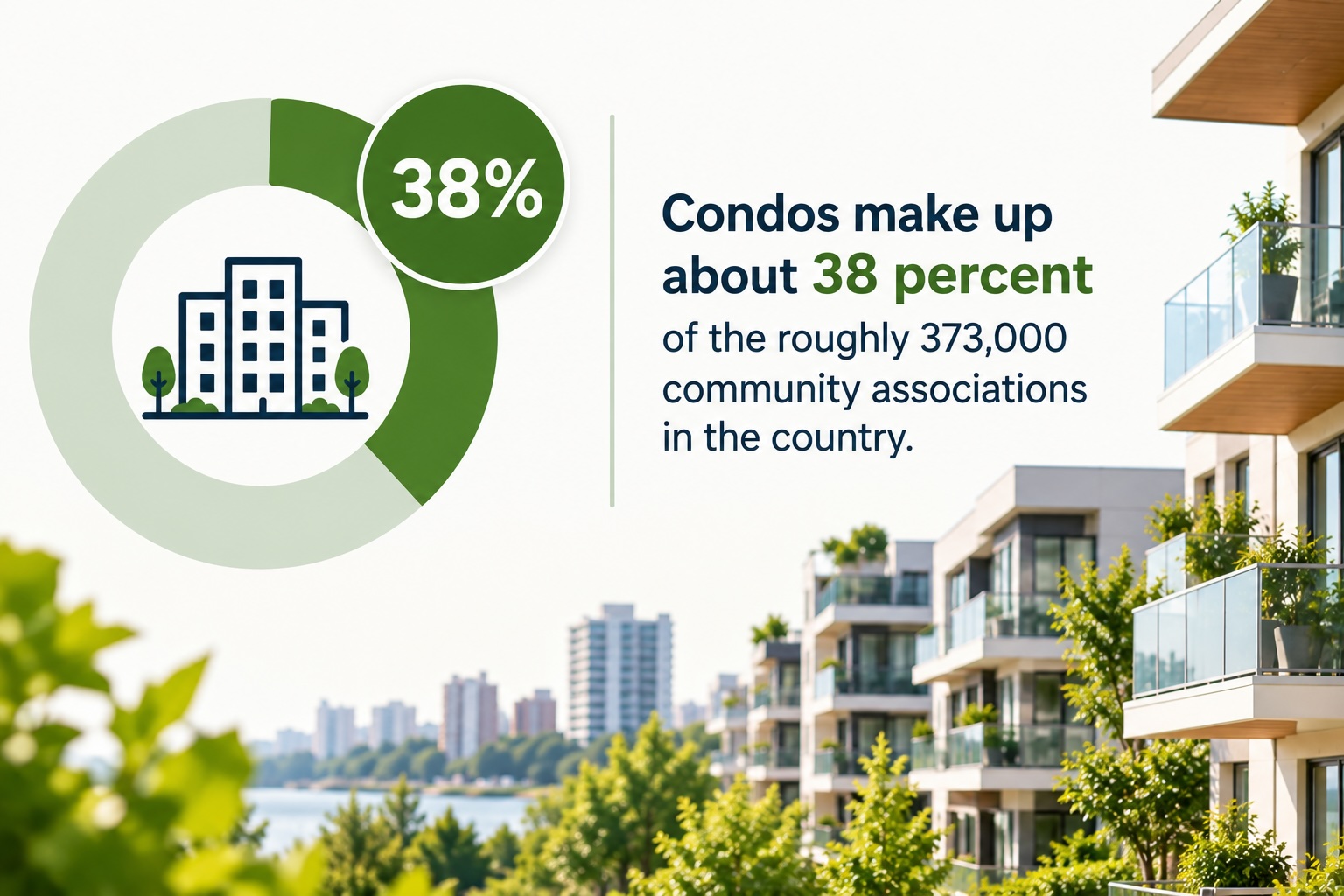
Running a condo association is a different animal than running a single-family HOA, and most software was not built with that difference in mind. A condo board is not just maintaining a neighborhood, it is managing a shared building, offsite owners who rent their units out, insurance and declaration paperwork that has to stay current, and reserves for the roof and the elevator that nobody wants to think about until they fail. This is not a small corner of the housing market either. According to the Community Associations Institute, there are roughly 7.4 million condo units nationwide, condos make up about 38 percent of the roughly 373,000 community associations in the country, and the average condo association runs about 60 units, so most boards are effectively running a small business with a building attached. The right condo management software pulls all of that into one place so a volunteer board is not running the whole operation out of a personal inbox and a shoebox of PDFs. This guide walks through what that software actually is, why it matters for condos specifically, and how to choose a platform without paying for features you will never touch.
If your board is drowning in email threads, chasing down documents, and answering the same owner questions over and over, this is for you.
What Condo Management Software Is
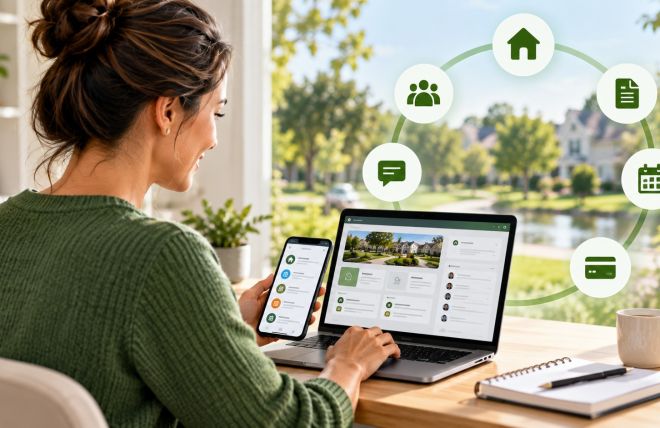
Condo management software is an online platform that brings the day-to-day work of running an association into one system: communication, documents, dues, maintenance requests, meetings, and amenity bookings. Instead of a website here, a payment app there, and a shared drive somewhere else, the board and the owners work from a single hub.
Picture the difference with a simple example. An owner wants to know whether they can install new flooring, and whether their assessment payment went through. Without a platform, that is two emails to two different board members, each of whom has to dig for the answer. With one, the owner logs in, finds the architectural request form, submits it with a photo, checks their own account balance, and never has to bother a volunteer. The board sees the request land in a queue instead of losing it in a thread.
A typical condo platform includes a member directory, a place to store governing documents, tools for meetings and votes, a way to log and track maintenance requests, amenity reservations, budget and assessment tracking, and messaging. Not every board needs all of it on day one, but the point is that these pieces live together and talk to each other. It helps to know how this differs from general property management software. Tools built for landlords focus on rental properties, lease tracking, and tenant screening, needs a condo board rarely has. Condo management software is built specifically for condo and HOA boards, covering homeowner associations (HOAs) and the shared responsibilities of ownership, whether your community is self-managed or works with one of the larger management companies.
Why It Matters for Condo Boards
Condos carry a few pressures that single-family communities do not, and each one is a reason to get off spreadsheets and email.
Condo living is also only becoming more common, not less. CAI estimates that about 67 percent of newly completed homes today are built within a community association, so a growing share of new owners are stepping straight into board and assessment life with no experience to draw on. The first is shared responsibility. In a condo, the line between what the owner maintains and what the association maintains runs right through the building, and it is a constant source of confusion and disputes. When the rules and past decisions are searchable in one place, those arguments get shorter. Knowing exactly how condos differ from HOAs and co-ops is half the battle, and it shapes what your software actually has to handle.
The second is offsite owners. A large share of condo units are rented out, which means many of the people you need to reach do not live in the building and never see the notice taped to the lobby door. Reaching them takes digital communication, not paper, and keeping offsite condo owners in the loop is one of the clearest jobs a good platform does.
The third is paperwork and money. Condos are document heavy, declarations, bylaws, insurance certificates, meeting minutes, and they run real budgets with reserve funds that state laws and lenders care about. When a unit owner is trying to sell or refinance, their buyer's lender will ask the board for documents on a deadline. Scrambling to find them is stressful and can hold up a sale. That kind of delay can stall a real estate transaction that otherwise has nothing to do with the board, and everything to do with paperwork nobody could find. The dollars involved are real too. CAI estimates that homeowners in community associations pay around $120.9 billion a year in assessments nationally, with roughly $30.2 billion of that funneled into reserve funds for future repairs. When owners cannot easily see where that money goes, it is no surprise fee questions turn into suspicion.
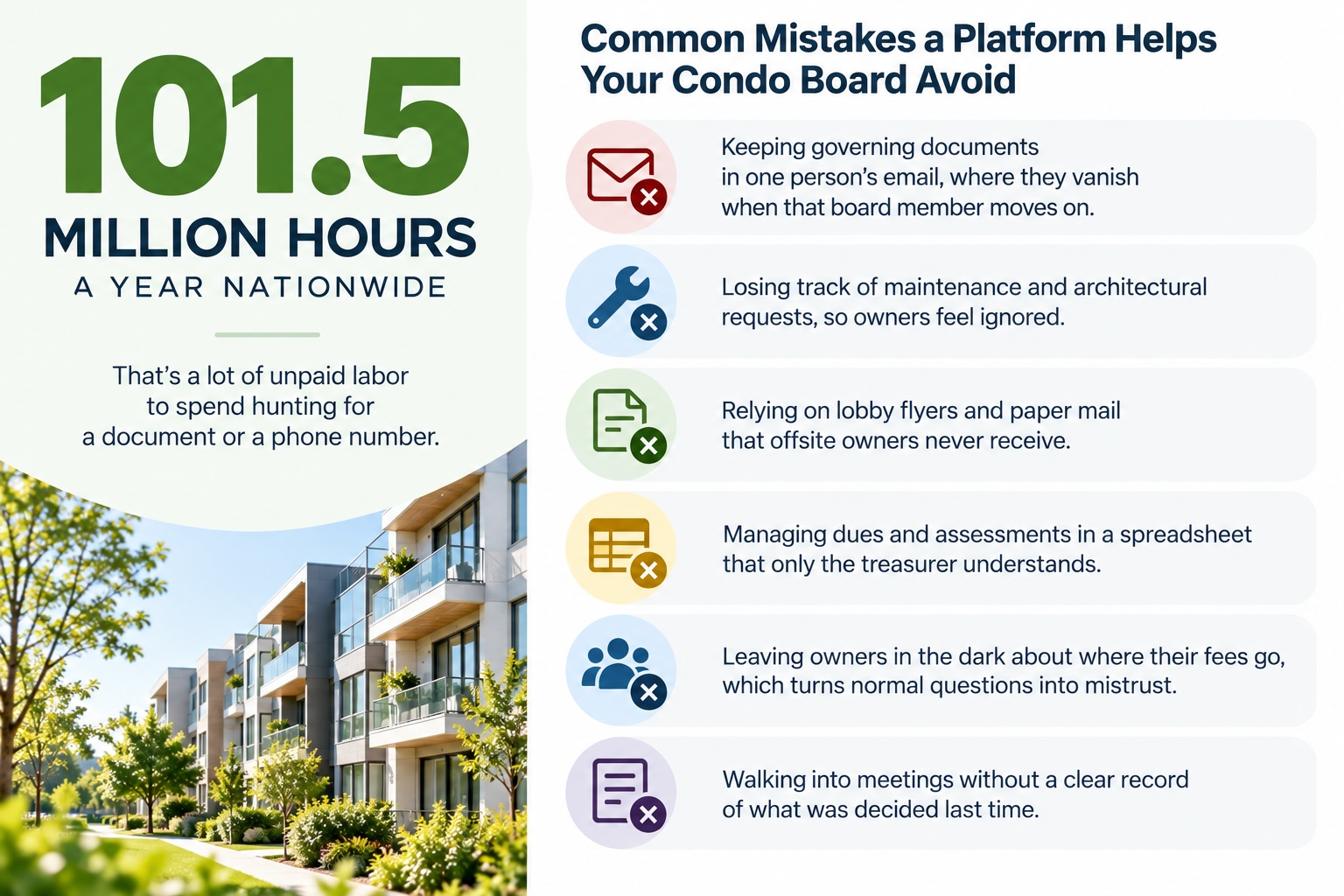
Board members are also almost entirely unpaid. CAI estimates that volunteer board and committee members contribute about 101.5 million hours a year nationwide, which is a lot of unpaid labor to spend hunting for a document or a phone number. Here are the common mistakes a platform helps a condo board avoid:
- Keeping governing documents in one person's email, where they vanish when that board member moves on
- Losing track of maintenance and architectural requests, so owners feel ignored
- Relying on lobby flyers and paper mail that offsite owners never receive
- Managing dues and assessments in a spreadsheet that only the treasurer understands
- Leaving owners in the dark about where their fees go, which turns normal questions into mistrust
- Walking into meetings without a clear record of what was decided last time
How Condo Boards Should Choose Software
The goal is not the platform with the longest feature list. It is the one that fits your building, your budget, and the handful of things your board actually struggles with. Here is a practical way to get there.
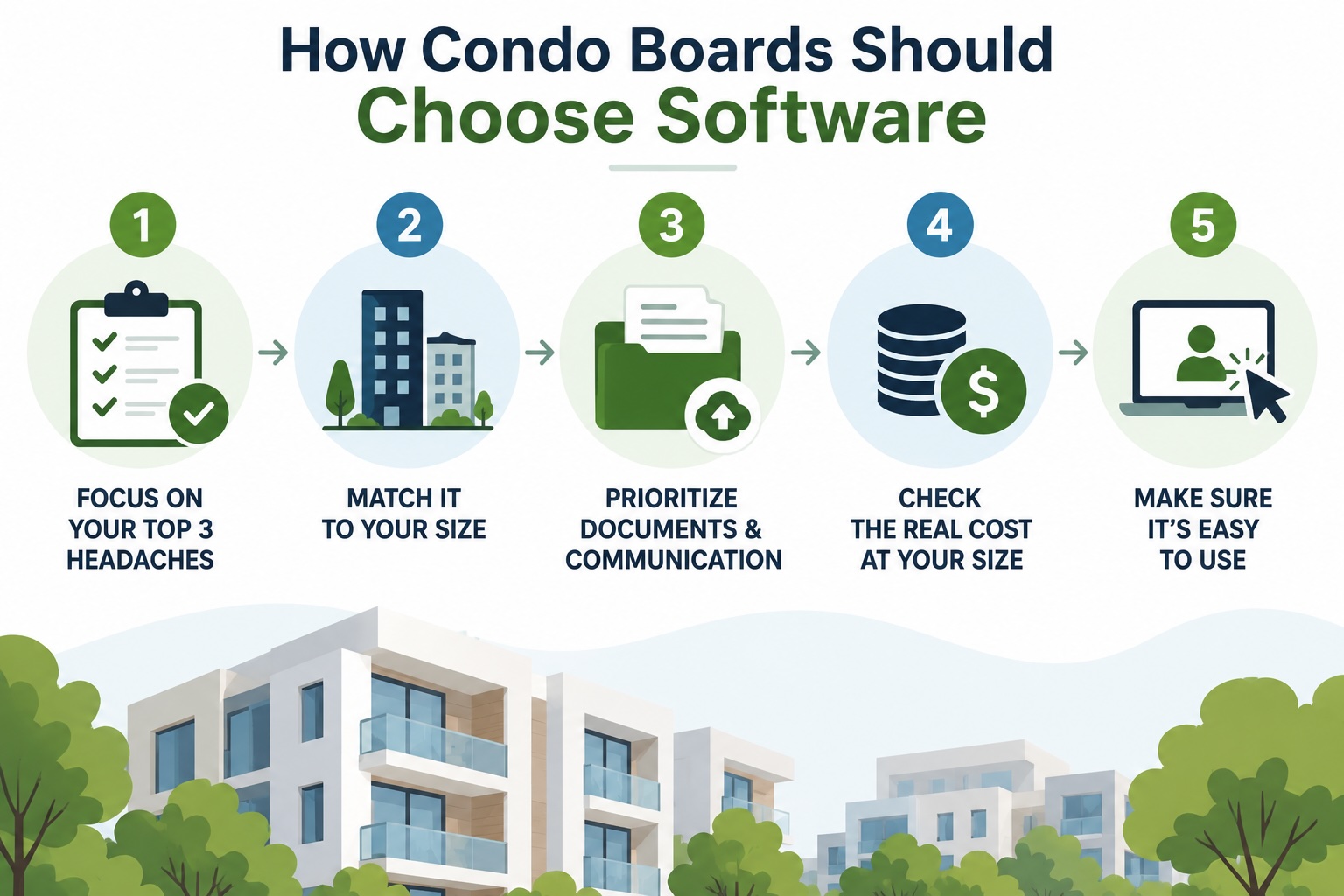
Start with your three biggest headaches. Ask the board what eats the most time or causes the most complaints. For many condos it is communication with offsite owners, tracking maintenance, and collecting dues. Write down your top three, and treat any software as a candidate only if it clearly solves those first. Everything else is a bonus.
Match the tool to your size. A 24-unit self-managed condo and a 300-unit association with a management company need very different things. A small board wants something simple it can run itself, while a large one may need mass messaging, formal workflows, and detailed financial reporting. Do not buy enterprise complexity for a building that needs a clean website and a document library, and do not underbuy for a large association that will outgrow a basic tool in a year. If your association already works with a condominium manager or hoa manager, make sure the platform fits how they already operate rather than forcing them to change everything at once.
Put documents and communication first. If you only fix two things, fix these. Get your declaration, bylaws, insurance certificate, and recent minutes into one searchable place, and get a reliable way to reach every owner, including the offsite ones. Those two changes remove the biggest share of day-to-day friction. Many boards find that moving from paper to organized digital storage is the single upgrade that saves the most time.
Check what it costs at your unit count. Condo software is often priced per unit, so a plan that looks cheap for 20 units can add up for 200. Ask for the real number at your size, and make sure the features you picked it for are included at that tier rather than locked behind an upgrade.
Make sure an ordinary volunteer can run it. Your board is made up of people with day jobs, and the next treasurer might not be technical at all. If setting up a page or posting an announcement takes a manual and an afternoon, adoption will stall. The best platforms feel closer to a consumer app than to accounting software. It also helps to ask whether a real person, such as a dedicated account manager, is available while you get set up, not just a help center article.
How Technology Can Help
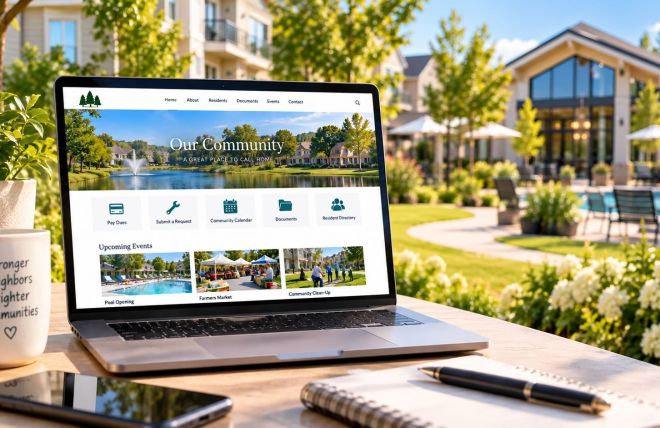
This is where an all-in-one platform earns its keep, because the condo problems above are connected and a connected tool solves them together. A modern platform like Neighborhood.online gives a condo board a website, a place to import and browse governing documents, and communicate with residents, all behind one login that owners actually use.
The practical payoff shows up in the board's week. When the declaration and bylaws live in the platform, owners stop emailing to ask where the rules are. When maintenance requests land in a tracked queue instead of an inbox, nothing falls through the cracks and owners can see their request moving. When announcements and messages go out through the system, offsite owners get the same information as everyone else. And when the budget, assessment schedule, and payment plans live in one place, owners can see what they owe and where their fees go, so the treasurer stops being the only person who understands the money and fee questions stop turning into suspicion. A platform like this can also power a simple owner-facing site, which pairs naturally with knowing what a good condo website should include so the public face of your association looks as organized as the back end.
The Bottom Line
Condo management software is worth it when it solves the problems a condo board actually has: reaching offsite owners, keeping documents findable, tracking maintenance, and managing dues without a mystery spreadsheet. You do not need to digitize everything at once or buy the biggest plan on the market. Start by listing your three biggest headaches, get your documents and communication into one place, and choose a tool a regular volunteer can run. If your association is thinking about handling more of this itself, it is worth seeing how much software built for self-managed associations can take off your plate. Pick the one change that would save your board the most time this month, and start there.