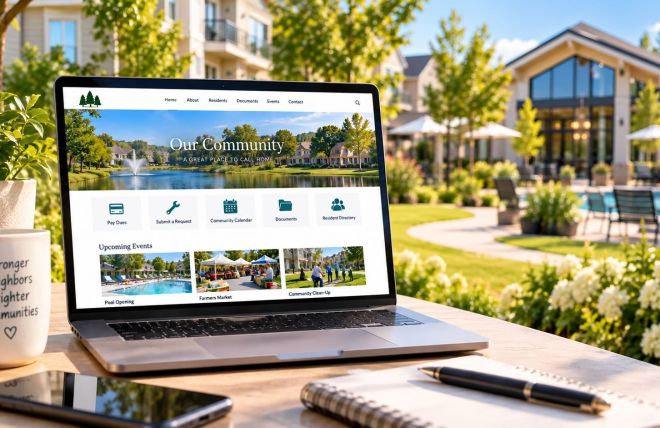
Build Your HOA Website Free
Neighborhood.online gives your community a modern website, document storage, and communication tools in minutes. No technical skills required.
Community Digital Maturity Model: What Stage Are You In?

Keep Your Whole Community in the Loop
Homeowners trust boards that communicate clearly. A free Neighborhood.online website makes it easy to share meeting minutes, post updates, and give residents one place to find everything they need.
Build Your Free HOA WebsiteUpdated September 16, 2026
Most HOA and condo boards never sit down and ask a simple question: what stage is our community actually in? They know something feels harder than it should, board members are fielding the same questions over and over, dues get tracked in a spreadsheet nobody fully trusts, and half the residents seem to miss every announcement. But without a way to name where they stand, boards tend to patch the symptom instead of fixing the stage. The Community Digital Maturity Model is a simple five-stage framework built to fix that. It gives boards a clear, honest answer to "where are we right now," and a specific next step instead of a vague sense that they should probably modernize someday.
This is not a product pitch dressed up as a framework. It is a diagnostic tool you can apply to your own community in about five minutes, using nothing but how residents currently get information and pay their dues.
What the Community Digital Maturity Model Is
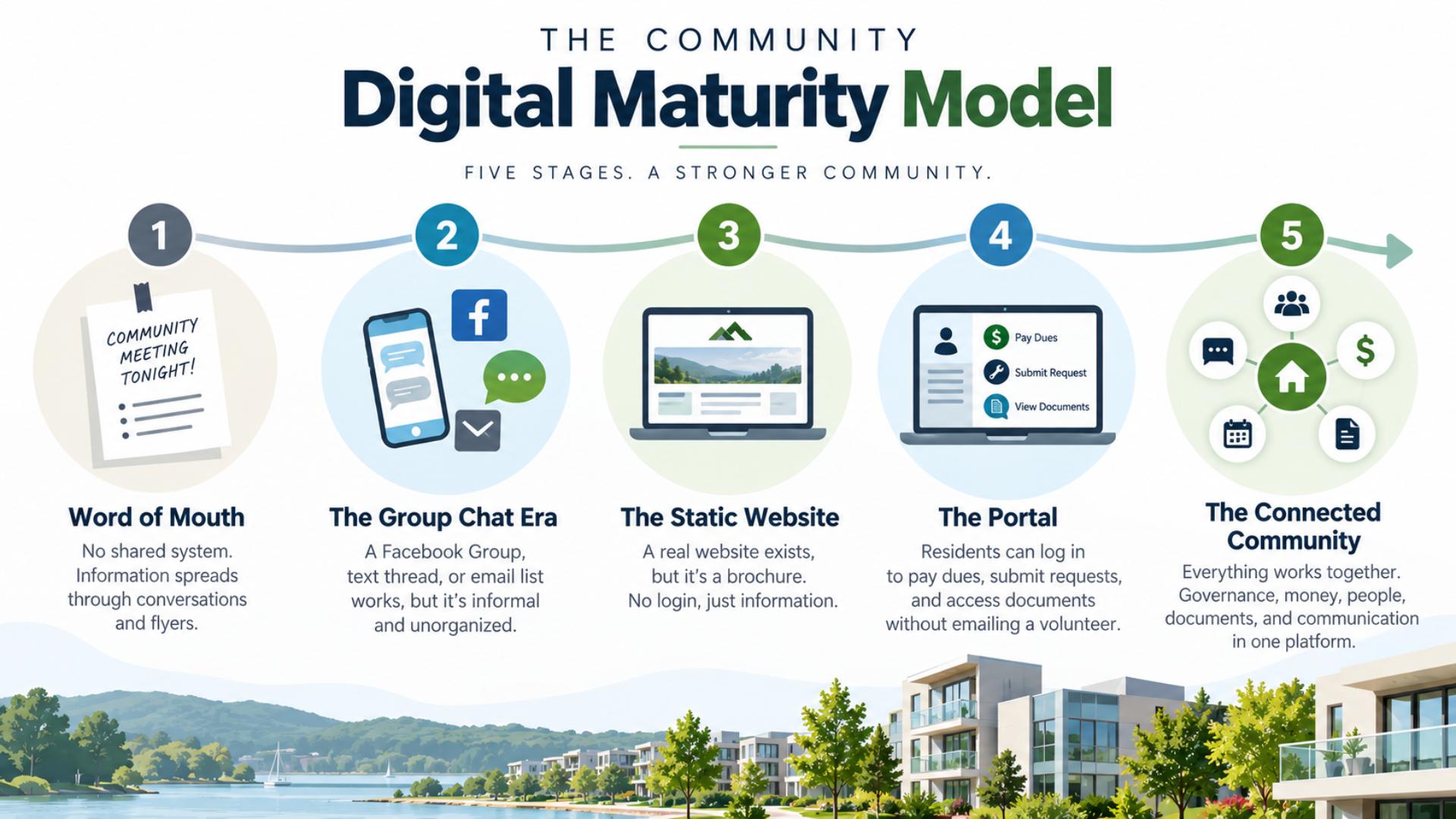
The Community Digital Maturity Model describes five stages a community typically moves through as it goes from entirely informal operations to a fully connected digital platform. Every community sits somewhere on this line, and most boards can place themselves within a minute of reading the descriptions below.
Stage 1: Word of Mouth. There is no shared system. Information travels through hallway conversations, paper flyers taped to a door, or whatever one board member remembers to mention. Nothing is written down anywhere residents can find it later.
Stage 2: The Group Chat Era. The community has landed on an informal digital tool, usually a Facebook Group, a group text, or an email list. It works better than nothing, but it is not official, nothing is organized, and important messages get buried under casual chatter within a day.
Stage 3: The Static Website. A real website exists, with a logo, some pages, maybe a document or two. But it is a brochure, not a tool. There is no resident login, so nobody can do anything on it besides read.
Stage 4: The Portal. Residents can log in. They can pay dues, check their account, submit a maintenance request, or download a governing document without emailing a volunteer. This is the stage most people mean when they search for a "community portal" or a "resident management system."
Stage 5: The Connected Community. Governance, money, people, and communication all live in one system instead of five disconnected tools. Meetings, votes, documents, dues, and messaging talk to each other. This is what the newer term "resident experience" is really describing, a shift from simply having a portal to having a platform that runs the whole community.
Why It Matters for HOA and Condo Boards
No stage is automatically wrong. A twelve-unit self-managed building might run perfectly well at Stage 2 for years. The framework is not a judgment, it is a mirror. The trouble starts when a community has quietly outgrown its current stage and nobody has named it yet, because that is when the cracks show up as complaints, missed payments, and volunteer burnout instead of as a clear, fixable problem.
The scale here is bigger than most boards realize. According to the Community Associations Institute, there are roughly 373,000 community associations operating in the United States today, and about 67 percent of newly completed homes are now built within one. That means a growing share of new board members are stepping into this role with zero experience and no framework for understanding what "good" even looks like. Most boards do not fail because they made a bad decision. They fail because nobody ever showed them there were decisions to make.
Staying too long at an early stage has a real cost. A board stuck at Stage 1 or 2 spends its volunteer hours re-answering the same questions instead of running the community. A board stuck at Stage 3, a website nobody can act on, watches residents default back to word of mouth anyway, because a brochure does not solve anything. The jump from Stage 3 to Stage 4 is usually where a community feels the biggest relief, because that is the point where residents stop needing a person to get something done.
How Boards Should Handle It
Here is a five-minute self-assessment any board can run this week.
Name your current stage honestly. Look at how residents actually get information and pay dues today, not how you wish it worked. If it is word of mouth or paper, you are Stage 1. A Facebook Group or email chain, Stage 2. A website with no login, Stage 3. A working login where residents can act, Stage 4. Everything connected in one system, Stage 5.
Identify your single biggest symptom. Every stuck stage produces a specific complaint. At Stage 1 or 2, it is "nobody told me." At Stage 3, it is "I can't find anything on the website." At Stage 4, it is usually smaller friction, like payments and documents living in different places. Name the complaint you hear most, it tells you exactly which stage you are actually stuck at, regardless of what you assumed.
Move one stage at a time. Do not try to jump from Stage 1 straight to Stage 5. Most of the relief comes from the very next step, not the final destination. A board at Stage 2 gets enormous value just from reaching Stage 4, a real login where residents can act, without needing every advanced feature on day one.
Set a plain-language goal. Instead of "modernize our HOA," write down something concrete like "residents can pay dues and see the budget without emailing anyone by next month." A specific goal is what actually gets a volunteer board to follow through.
Revisit the stage once a year. Communities do not stay still. A board that reaches Stage 4 should check in annually to see whether it is ready for the deeper integration of Stage 5, especially as membership turns over and expectations rise.
How Technology Can Help
Moving between stages is mostly a tooling problem, and it is where the right platform earns its keep. Getting from Stage 2 or 3 to Stage 4 is often a matter of hours, not months, with a modern platform like Neighborhood.online, which lets a board stand up a real communication hub and a working resident portal without hiring a developer or learning a new system from scratch.
The move toward Stage 5 tends to happen gradually, one connected piece at a time. A board might start by getting its operating and reserve funds organized and visible, then add document storage, then bring meetings and votes into the same place residents already check for everything else. Condo boards especially benefit here, since reaching offsite owners digitally is often the single change that does the most to close the gap between Stage 3 and Stage 4. The goal is never to buy every feature at once, it is to stop stitching together five disconnected tools and start operating from one.
Free resource: Still stuck at Stage 3? Use the website planning guide to map out your community site before you build it.
Plan the Perfect HOA Website with Ease!
A simple, step-by-step HOA Website Planning Template to help you build an efficient, engaging, and well-organized community website.
Frequently Asked Questions
What is the Community Digital Maturity Model?
The Community Digital Maturity Model is a 5-stage framework that describes how HOAs and condo associations progress from informal, paper-based operations to a fully connected digital community platform. The five stages are Word of Mouth, The Group Chat Era, The Static Website, The Portal, and The Connected Community.
How do I know what stage my community is in?
Look at how residents currently get information and pay dues. Word of mouth or paper notices means Stage 1. A Facebook Group or email list means Stage 2. A website with no resident login means Stage 3. A working login where residents can pay dues or submit requests means Stage 4. Governance, money, people, and communication all living in one connected system means Stage 5.
Is it bad to still be in an early stage like Stage 1 or 2?
No single stage is wrong for every community, a very small association may be fine at Stage 2 for years. The framework is a diagnostic tool, not a judgment. It becomes a problem only when a community has outgrown its current stage and is paying for it in confusion, complaints, or lost volunteer hours.
What is the difference between a community website and a resident portal?
A community website at Stage 3 is public-facing and informational, like a brochure. A resident portal at Stage 4 requires a login and lets residents take action themselves, such as paying dues, submitting a maintenance request, or checking their account, rather than just reading information.
How long does it take to move from one stage to the next?
Moving from Stage 2 or 3 to Stage 4 can often happen in under an hour with a modern platform, since most of the work is setup rather than construction. Moving to full Stage 5 integration is more gradual and usually happens feature by feature as a board adds document storage, payments, and governance tools over time.
The Bottom Line
Most HOA and condo boards are not failing because they made the wrong choice. They are stuck because nobody ever gave them a way to name where they stand. The Community Digital Maturity Model is that name. Take five minutes this week, place your community honestly on the five stages, name the one complaint you hear most, and pick a single plain-language goal to move one stage forward. You do not need to reach Stage 5 this year. You just need to stop guessing at Stage 2 when the fix for your biggest headache is one stage away.
References
Community Associations Institute Foundation. (2026, March). 2025 statistical review. https://foundation.caionline.org/wp-content/uploads/2026/03/2025StatisticalReviewFoundation.pdf