Build Your HOA Website Free
Running an HOA is a big job for a volunteer.
Neighborhood.online gives your community a modern website, document storage, and communication tools in minutes.
No technical skills required.
HOA Volunteer Onboarding

Updated August 26, 2026
You finally recruited a new volunteer. The hard part is over, right? Not quite. The first few weeks decide whether that person becomes a reliable, long-term helper or quietly disappears after one confusing meeting.
HOA volunteer onboarding, the simple act of welcoming someone well and setting them up to succeed, is what makes the difference, and it costs about an hour of your time. This guide covers what onboarding is, why it matters so much for HOAs, and a practical way to welcome new volunteers so they start confident and stick around.
Set Up Your Free HOA Website in Minutes
Give your community a home base online. Share announcements, post documents, and keep homeowners informed with a free Neighborhood.online website built specifically for HOAs.
Create Your Free WebsiteWhat HOA Volunteer Onboarding Is
Onboarding is everything you do in a volunteer's first few weeks to help them feel welcome, understand their role, and start contributing with confidence. It is not a formal program or a stack of paperwork. For most communities it is four simple things: a warm welcome, a clear explanation of the role, an introduction to the right people, and one small first task.
Picture a neighbor who just joined the events committee. Good onboarding means they get a friendly note within a day or two, they know when the first meeting is and who to ask questions, and they leave that meeting with one small job that fits their interests. That is it. No binder, no bureaucracy, just a clear and welcoming start.
Why Onboarding Matters for HOAs
Recruiting a volunteer takes real effort, and losing them a month later means doing it all over again. Onboarding is what protects that investment:
- First impressions set the tone. A volunteer who feels welcomed leans in. One who feels dropped in the deep end quietly backs away.
- Unclear expectations cause burnout. When people do not know the scope or the time involved, they either overcommit and crash or hold back and disengage.
- A good start builds confidence. Volunteers who understand their role contribute sooner and worry less about stepping on toes.
- Onboarded volunteers stay longer. And volunteers who stay are the ones who eventually chair committees and join the board.
Skip onboarding and you get a revolving door, the same seats emptying and refilling every few months. A little structure up front is what breaks that cycle.
Consider two volunteers who join the same week. The first gets a welcome email, a clear role, and a small task, and a month later is happily running point on a project. The second hears nothing for two weeks, shows up to a meeting already in progress with no idea what the group is working on, and never comes back. Same community, same enthusiasm at the start. The only difference was the first hour of onboarding.
How to Onboard a Volunteer the Right Way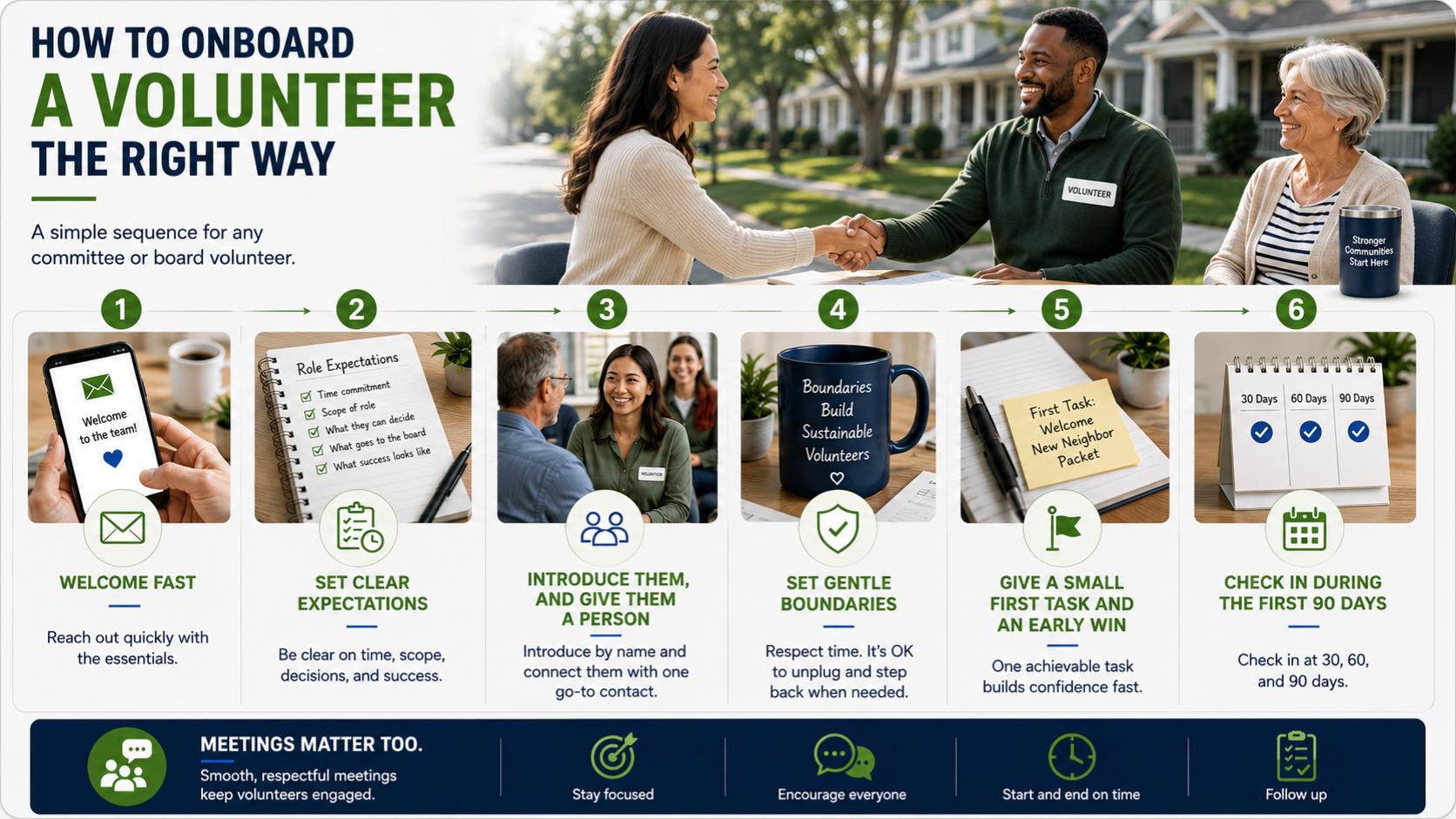
Here is a simple sequence that works for a committee member or a new board volunteer alike.
- Welcome fast, while the enthusiasm is fresh. Within a day or two of a yes, reach out to say thank you and cover three things: when the first meeting is, who their main point of contact is, and what, if anything, to look at beforehand.
- Set clear expectations early. Be honest about the time ("about an hour a month"), the scope of the role, what the person can decide versus what goes to the board, and what a good result looks like. Clear role descriptions do most of this work for you.
- Introduce them, and give them a person. Introduce the new volunteer to the group by name, and make sure they have one friendly contact they can bring any question to.
- Set gentle boundaries. Say out loud that the group meets about an hour a month, that nobody is expected to answer messages at midnight, and that it is fine to step back when life gets busy. Boundaries are not a turnoff. They are what makes volunteering feel safe to commit to.
- Give a small first task and an early win. Hand the volunteer one concrete, achievable job in the first few weeks. Finishing something early builds confidence far faster than sitting through meetings.
- Check in during the first 90 days. A quick "how is it going?" at 30, 60, and 90 days catches small frustrations before they become reasons to quit.
Meetings matter here too. A committee that runs long, circular meetings will lose new volunteers fast, so the habits in our guide to running smooth, respectful meetings apply to committees just as much as to the board.
Free Download: Volunteer Onboarding Guide
A ready-to-use onboarding checklist, welcome templates, expectations to set, and a first-30-days plan for new volunteers.
Get the GuideOnboarding works best right after a strong recruiting push, so if you are still filling seats, pair this with how to recruit HOA volunteers.
How Technology Can Help
Onboarding gets easier when everything a new volunteer needs lives in one place instead of scattered across inboxes and text threads.
A central home base, usually your HOA website, lets a new volunteer find their role description, the committee's charter, meeting notes, and the calendar without hunting anyone down. A platform like Neighborhood.online brings these together, so you can welcome a volunteer, point them to everything in one link, and message their committee directly. The less a new volunteer has to chase down, the faster they feel like part of the team. It also means the next person who joins inherits an organized starting point instead of a mystery, which makes every future onboarding a little easier.
The Bottom Line
Onboarding is the cheapest retention tool you have. Welcome people quickly, be honest about the time and the role, set gentle boundaries, hand them an early win, and check in during the first few months. Do that and you turn a nervous new recruit into a confident volunteer who sticks around.
Your one next step: the next time someone says yes, send a warm welcome note within two days. For the full picture on building a community that runs on many hands, our HOA volunteer playbook pulls it all together.