Build Your HOA Website Free
Running an HOA is a big job for a volunteer.
Neighborhood.online gives your community a modern website, document storage, and communication tools in minutes.
No technical skills required.
Preventive Maintenance for HOAs

Build Your HOA Website Free
Neighborhood.online gives your board one place to manage work orders, store maintenance records, communicate with residents, and keep everything your community needs in one spot. No developer. No credit card. Live in under an hour.
Build Your Site FreeThere is a mental model that separates boards who run their communities well from boards who spend most of their time in crisis mode. It is not about budget size or staff capacity. It is about whether the board sees maintenance as something you do before things break or something you do after.
Preventive maintenance is not a new idea. Aviation, manufacturing, commercial real estate, and every other industry that manages physical assets at scale has understood its value for decades. What is relatively new is the recognition that community associations, where volunteer boards often operate without formal training or written plans, need it just as urgently.
The Foundation for Community Association Research put it plainly in their 2023 Best Practices Report: without maintenance, a community will begin a process of degradation until each building and common area ultimately deteriorates and eventually becomes uninhabitable. The countervailing force to that entropy is a maintenance plan, consistently applied.
This post makes the full case for the preventive maintenance mindset using real numbers, real case studies, and the practical framework boards need to act on it.
What Preventive Maintenance Actually Means
Maintenance is referenced in three ways, and understanding the difference between them is the foundation of everything else.
Preventive maintenance is the work you do on a planned, recurring schedule to preserve assets before they deteriorate or fail. It is proactive. You do it because a schedule says it is time, not because something is visibly broken. Lubricating gate hardware, cleaning gutters before rainy season, applying waterproof sealants to decks and balconies, touching up exterior paint before moisture penetrates, inspecting pool equipment before the season begins. None of these tasks is expensive. All of them prevent something that is.
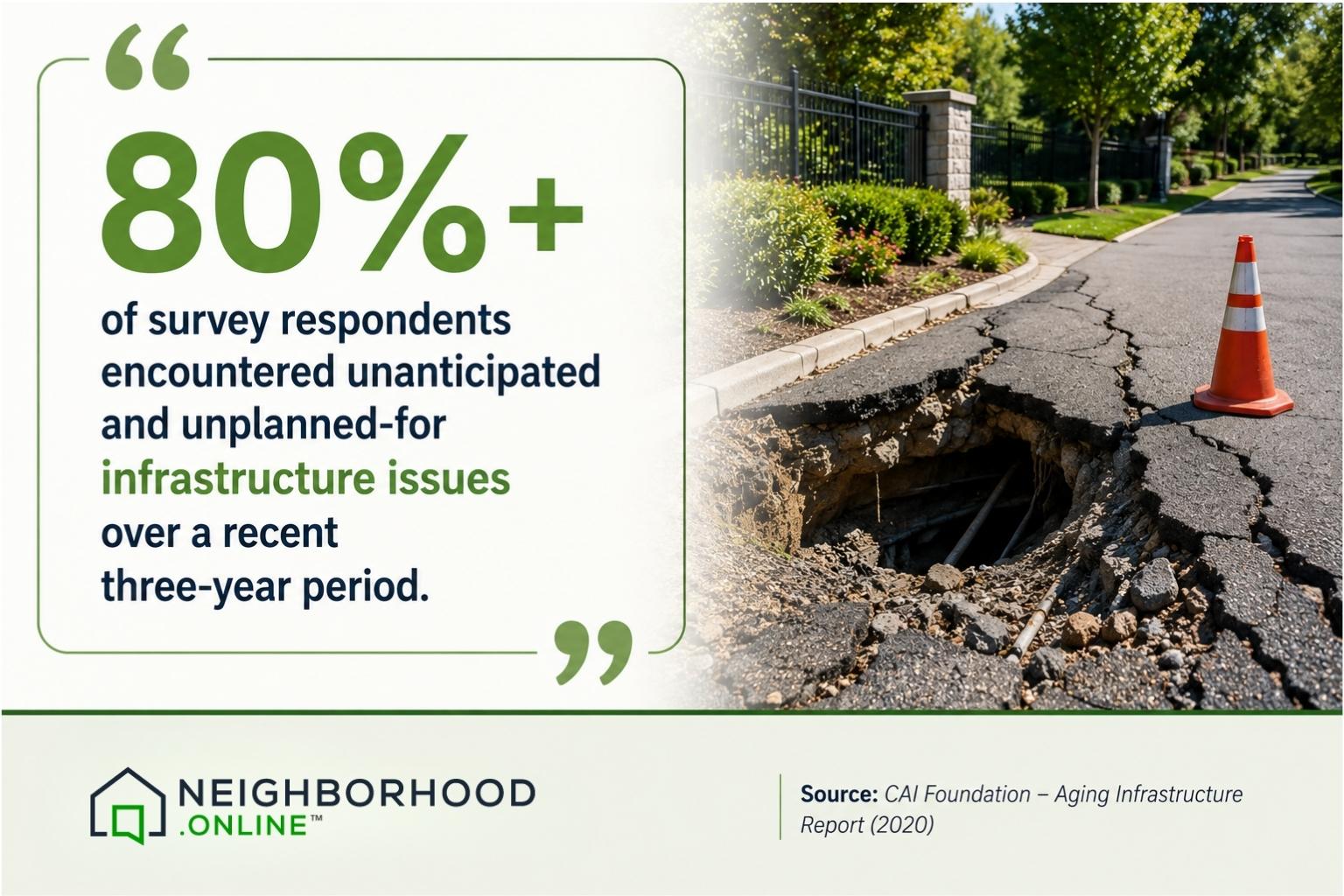
Corrective maintenance is reactive work done after something has already failed or deteriorated. Replacing buckled sidewalk sections, repairing a broken pool gate latch, patching a roof after water intrusion. Corrective work is more expensive than preventive work because you are now dealing with damage, not just wear. The CAI Foundation report describes it as repairing components that have prematurely deteriorated due to a lack of preventive maintenance and are no longer operating to their intended purpose.
Deferred maintenance is the most dangerous category. It is the act of postponing both preventive and corrective work, usually because the board is reluctant to spend money or simply does not have a plan. Deferred maintenance leads to premature failure of building components and can create serious safety and health issues. Deferred repairs quickly turn into safety hazards or expensive building component replacements.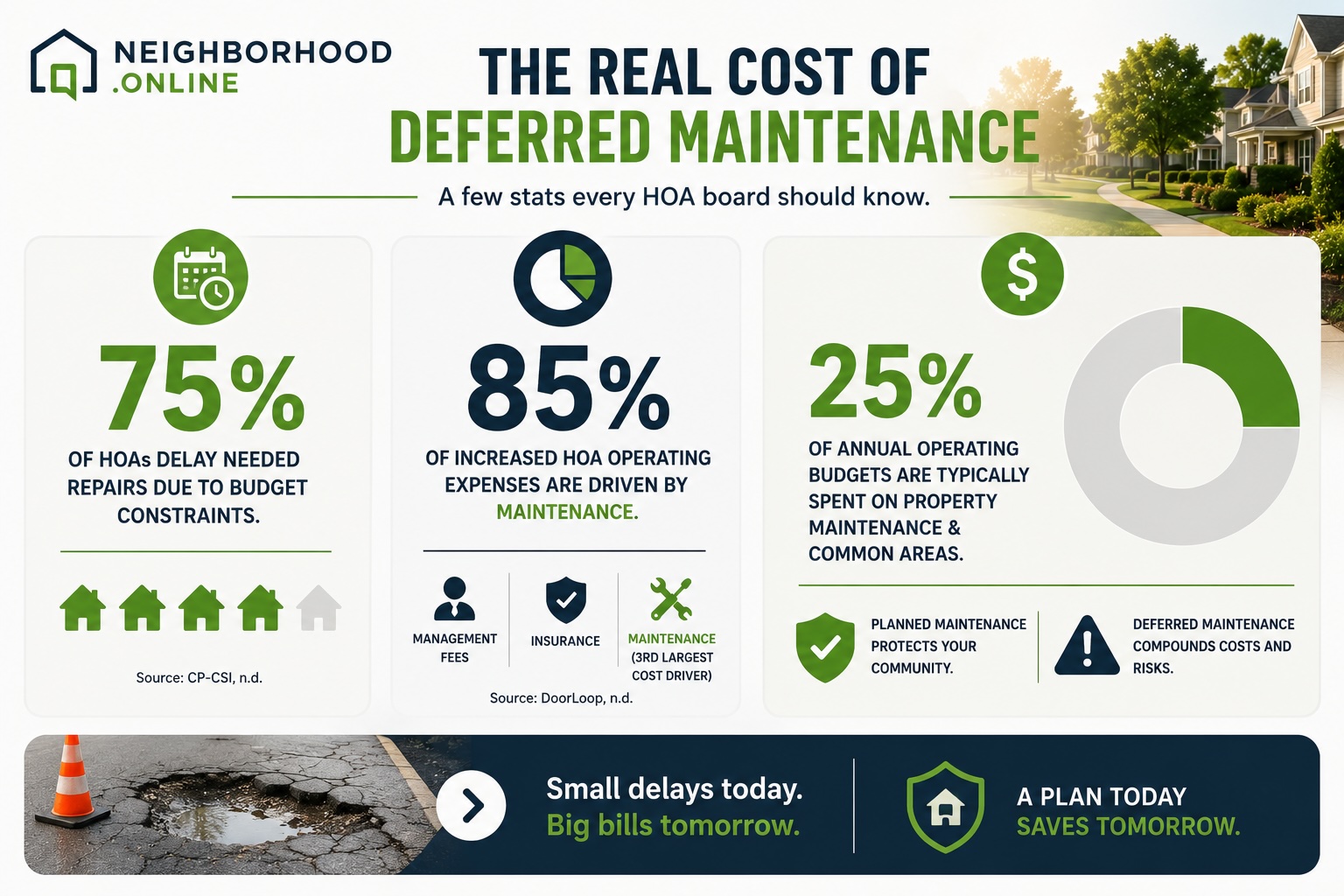
The ratio between these three categories in any well-run community should be heavily weighted toward prevention. Research published in the Structure and Infrastructure Engineering Journal found that preventive maintenance represents only 10% to 30% of total maintenance costs, while corrective maintenance accounts for the remaining 70% to 90%. Every dollar not spent on prevention tends to generate three to nine dollars in corrective costs.
Among HOA amenities, the most commonly maintained services are landscaping at 52% of associations, sidewalk maintenance at 43%, children's play areas at 39%, swimming pools at 38%, and outdoor recreation spaces at 37%. Each of these categories has its own preventive maintenance requirements, and each deteriorates predictably when those requirements are skipped.
The Financial Case: Numbers That Are Hard to Ignore
Community associations in the United States contributed $26.6 billion to reserve funds in 2021 and 2022 specifically to fund the repair, replacement, and enhancement of common property. That figure represents the scale of the maintenance obligation HOA boards are managing. For the roughly 30% to 40% of associations that are self-managed, that obligation falls entirely on volunteer board members.
A Jones Lang LaSalle study on the economic value of preventive maintenance found that organizations performing preventive maintenance can achieve a return on investment of up to 545% compared to reactive-only approaches. The CAI Foundation report references this finding specifically in the context of community associations, noting that the savings are difficult to fully enumerate because they are largely unseen. You cannot put a cost on something that did not break.
The cost of preventive maintenance as a percentage of replacement cost typically runs between 2% and 5% of the component's value per year. Consider what that means in practice. Take a component with a replacement cost of $200,000 and a useful life of 20 years. Without preventive maintenance, adding 5% to the cost for proper upkeep means an annual cost of $10,500 rather than $10,000, with the same useful life maintained. If preventive maintenance is skipped and the useful life is reduced by 10% to 18 years, the annual cost rises to $11,111, an increase of 6% compared to the properly maintained scenario.
That difference compounds across every component in a reserve study. And if a problem goes undiscovered until it requires emergency corrective work, the cost of corrective maintenance can run 30 or more times the cumulative preventive maintenance that was skipped. Using the same parameters, if a problem is discovered in year 10 requiring corrective maintenance, the preventive work that was not performed would have cost $500 per year for ten years, totaling $5,000. Correcting the condition at that point costs approximately $150,000, resulting in either a special assessment or borrowing.
Reserve Advisors illustrates the same principle with a simpler example: extending a component's useful life by 30% lowers the annual cost of ownership from $2,000 to $1,538 on a $20,000 asset. Small improvements in asset longevity, achieved through consistent preventive maintenance, produce meaningful savings when applied across an entire community's asset inventory.
A larger example makes the point even more clearly. Consider a 30-year roof valued at $9 million. The annualized reserve contribution at full replacement cost is $300,000 per year. If proper preventive maintenance extends that roof's life by just five years, the annualized cost drops by roughly $43,000 per year. If no maintenance is performed and the roof fails at 25 years instead of 30, the annualized cost jumps to $360,000, which is $60,000 more per year, a huge financial burden that could have been avoided.
Real Case Studies: What Deferred Maintenance Actually Costs
The financial argument becomes concrete when you look at what has actually happened in communities that skipped maintenance planning.
A master association in coastal California, situated near the beach with ocean breezes carrying moist salt air through the community, never received a maintenance manual from the developer at turnover. Seven years after the first homeowners moved in, the association commissioned an inspection of its nine miles of metal fencing surrounding the golf course. The moist salt air combined with recycled irrigation water from the golf course had settled on the fencing over those seven years. The fencing had literally disintegrated in whole eight-foot metal sections. Landscaping that had grown through the fence further accelerated the deterioration. The association ultimately spent hundreds of thousands of dollars on replacement. A simple one-page plan recommending an annual inspection would have caught the problem early and prevented it.
A second case from San Diego involved two homeowners associations built by the same developer, side by side, with identical homes. Home prices in the area averaged $400,000 at the time. One community implemented the maintenance manual provided by the builder and an accompanying building maintenance program. The other did not. After ten years, homes in the well-maintained community were selling for up to $150,000 more than homes in the other. The association that failed to maintain eventually started the expensive process of corrective and remedial work, expended all its reserve funds in the process, and needed an additional special assessment to catch up. It now has a maintenance manual, a program, and a reserve study. But it got there the expensive way.
Perhaps the most striking illustration of what consistent preventive maintenance can achieve is Disneyland's approach to its wrought iron fencing along Main Street. The fence is more than 50 years old and very expensive. Because touch-up paint is added almost every night, Disney will most likely never need to replace it. The year-over-year impact on reserve funds is essentially zero. If a community took the same approach to its ornamental iron fencing, inspecting and touching it up regularly, the reserve analyst would have a reset expectation that the fence would not need replacement for another 30 or more years. Many building components can last indefinitely if properly maintained.
The Property Value and Community Stability Case
The financial benefits of preventive maintenance extend well beyond the maintenance budget itself. The CAI Foundation report identifies three pillars of a well-maintained community: financial savings, environmental benefit, and community stability. These cascade from one to the other.
Well-maintained communities consistently command higher property values and support stronger appraisals than comparable communities with visible deferred maintenance. Every time a home sale escrow takes place, an appraiser visits the community and reviews the overall condition of the common areas, the reserve study numbers, and the amount of deferred maintenance on common area assets. Those observations directly affect appraisal values. The San Diego case study above puts a $150,000 number on that difference.
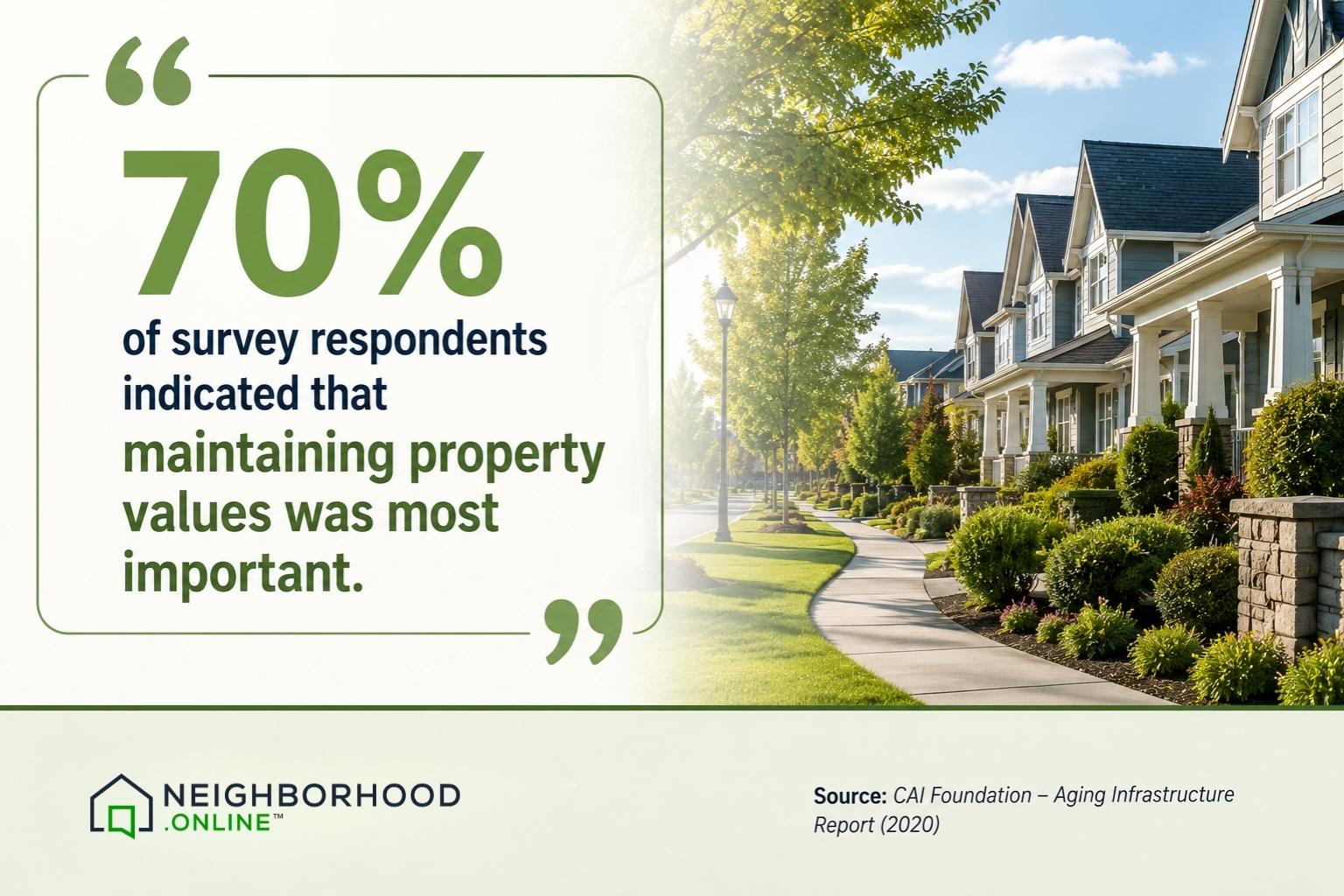
Beyond appraisals, maintenance affects insurance. A well-maintained community substantially reduces insurance premiums because it presents lower accident and liability risk. Insurance companies will counsel boards that a building maintenance program is an important tool for reducing risks and lowering premiums. The inverse is also true: communities with documented deferred maintenance face higher premiums and, in some cases, difficulty renewing coverage at all.
Community stability is the third pillar. Financial savings from preventive maintenance translate into fewer special assessments, less board member recall activity, more people willing to serve on the board, and less management turnover. A well-maintained community is also one where residents are happy with their daily experience. When a parent takes their toddler to the playground and the equipment is clean, painted, and free of sharp edges, they are satisfied. When an elderly couple takes an evening walk and the paths are even and the landscaping is well kept, they are satisfied. That daily quality of life is a direct product of consistent maintenance.
The Legal Case
HOA board members have a fiduciary duty to maintain, protect, and enhance the community. This duty of care is among the highest standards implied by law, and it applies whether a board member personally prioritizes maintenance spending or not.
When boards consistently defer maintenance and common areas deteriorate, homeowners can and do take legal action. Cases where board members have been sued specifically for failing to perform maintenance procedures that had a direct, material, negative impact on property values and safety are documented in HOA case law. The business judgment rule protects boards that acted reasonably and followed a documented maintenance plan. It does not protect boards that chose not to maintain.
There is an additional legal dimension that most boards do not anticipate. A maintenance plan that exists but is not followed creates liability rather than protection. If a maintenance manual specifies that waste lines should be cleaned every two years, and the board adopts that manual but cleans them only four times over 20 years, the manual becomes evidence against the board in a dispute, not evidence in its favor. The CAI report documents exactly this scenario: a board member deposed six years into their term testified they had never heard of or reviewed the maintenance manual, despite it being referenced in the CC&Rs. The lesson is that adopting a maintenance plan and actually following it are two different obligations.
Several states have recognized the importance of maintenance planning clearly enough to mandate it by statute. California, Minnesota, and Oregon all require formal maintenance plans for condominiums. Legislators in those states concluded that without minimum guidance, boards are naturally hesitant to spend on maintenance, leading to predictable deterioration and expensive component replacement.
What a Preventive Maintenance Program Looks Like in Practice
A preventive maintenance program has three components that work together: a maintenance plan, a maintenance program to implement it, and documentation to record what was actually done.
The maintenance plan identifies every common area component the HOA is responsible for, what preventive maintenance each requires, and how frequently. At its simplest, this is a spreadsheet. A more comprehensive version is a full preventive maintenance manual containing photos, inspection schedules, manufacturer maintenance requirements, and warranty information for each component. Either version is better than nothing, and a simple plan done consistently is always better than a comprehensive plan that never gets used.
The maintenance program is how the plan gets implemented. It assigns a skilled maintenance technician or contractor to perform corrective and preventive maintenance on a regularly scheduled basis, and it designates a maintenance manager or responsible board member to coordinate the work, advise the board when inspections and repairs are needed, and serve as the liaison between the board and whoever is doing the physical work.
Documentation records what was actually done: which procedures were performed, on what date, by whom, and with what results. This is the component most boards skip and the one that matters most for legal protection and institutional continuity. The CAI Foundation is explicit on this point: a maintenance plan that is not followed creates liability. One that is followed and documented creates protection. For practical guidance on building a records system that stores this history and survives board turnover, the guide on transitioning from file cabinets to digital document storage covers how to set it up correctly.
Seasonal Thinking as the Practical Expression of the Mindset
Most maintenance tasks have a right time to be performed. Doing them at that time prevents the specific damage each seasonal transition causes. Fall is for cleaning gutters before freeze, winterizing pools and irrigation systems, inspecting and replacing exterior sealants before cold and moisture penetrate, and planning the following year's budget and project list. Spring is for inspecting what winter damaged and preparing summer amenities before peak use. Summer is for monitoring high-use systems and completing warm-weather repairs. Winter is for monitoring, planning, and preparing.
Boards that follow this seasonal rhythm rarely face true maintenance emergencies. What looks like an emergency from the outside, a failed pool heater on Memorial Day or a retaining wall that collapses after the first hard freeze, is almost always a deferred maintenance item that reached its failure point at an inconvenient moment. For a complete month-by-month breakdown of what should happen in each season, the guide on the essential HOA maintenance calendar covers the full year in detail.
Why Boards Avoid Preventive Maintenance and Why Those Reasons Do Not Hold
Most boards that operate reactively do not do so because they are unaware of preventive maintenance. They do so because of objections that feel reasonable in the moment.
The most common is cost. Preventive maintenance costs money, and the board wants to keep assessments low. The CAI Foundation report addresses this directly, describing it as the penny-wise and pound-foolish trap. Boards that defer maintenance do not save money. They shift costs to the future at a much higher rate. The research is unambiguous: preventive maintenance costs less than corrective maintenance, and corrective maintenance costs dramatically less than emergency replacement.
The second objection is that things look fine. Deterioration in building components is gradual and often invisible until it reaches failure. The CAI report notes that it takes a trained eye by a maintenance general contractor, architect, or structural engineer to know what components require attention. The fencing in the San Diego coastal case looked serviceable until it disintegrated. The fact that something looks fine is an argument for an inspection, not against one.
The third objection is that the board does not have time. A board that has built a maintenance plan, a schedule, and a roster of reliable vendors does not spend more time on maintenance than a reactive board. It spends less, because it is not managing emergency calls, contractor disputes, angry homeowners, and special assessment votes. The front-loaded investment in the system pays back in reduced operational chaos.
How to Start This Month
Building a preventive maintenance program does not require a full board retreat. It requires three decisions made in sequence.
First, commit to an inventory. Walk the property with a board member or licensed inspector and list every common area component the HOA is responsible for. Compare that list against your reserve study. Note the condition of each item. This is the asset inventory that makes all subsequent planning possible.
Second, assign an inspection frequency to each item. Use the CAI Foundation's guidance as a reference: automatic gates biweekly, pool equipment and fitness areas monthly, fences and HVAC systems twice a year, roofing and structural elements annually. This becomes your maintenance schedule. The free HOA Seasonal Maintenance Calendar organizes common tasks by month with a built-in status tracker and is a ready-made starting point.
Third, assign an owner to each item and a place to record completion. The schedule only works if someone is accountable and results are documented. Tools like Neighborhood.online make it easy to manage work orders, store inspection results, and keep the whole board aligned on what is open and what is complete, without relying on individual board members' email inboxes to hold the history.
For the broader context of how preventive maintenance connects to vendor management, capital projects, and resident communication, the guide on HOA operations and maintenance mastery covers how all the pieces fit together across a full operating year.
Free Download: HOA Seasonal Maintenance Calendar
A full year of maintenance tasks organized by month, color-coded by category, with a built-in status tracker your board can update as tasks are completed.
Download the Free CalendarThe Bottom Line
The preventive maintenance mindset is not about spending more money. It is about spending the same money earlier, when it costs a fraction of what it will cost later. Boards that adopt it consistently find their communities are better maintained, their budgets are more predictable, their reserve contributions are lower, their homeowners are less angry, and their board positions are easier to fill because the job is less chaotic.
The research, the case studies, and the legal framework all point in the same direction. Preventive maintenance saves HOA boards time and money. The only thing it requires is the decision to stop waiting for things to break.
References
Community Associations Institute. (2022). New report highlights key statistics and trends for U.S. community association housing market. https://www.caionline.org/new-report-highlights-key-statistics-and-trends-for-u-s-community-association-housing-market/
Foundation for Community Association Research. (2023). Community association maintenance: Best practices. Community Associations Institute. https://foundation.caionline.org
Jones Lang LaSalle. (n.d.). Determining the economic value of preventive maintenance. http://cdn.ifma.org/sfcdn/docs/default-source/default-document-library/determining-the-economic-value-of-preventative-maintenance.pdf
National Association of Realtors. (n.d.). Study: Homeowners associations are booming. https://www.nar.realtor/magazine/real-estate-news/study-homeowners-associations-are-booming
Raza, A., & Ulansky, V. (2022). Preventive and corrective maintenance cost comparison and cost-benefit analysis. Structure and Infrastructure Engineering, 12(5). https://www.tandfonline.com/doi/abs/10.1080/15732479.2015.1032983
Reserve Advisors. (n.d.). Preventative maintenance in community associations. https://www.reserveadvisors.com/resources/blog/preventative-maintenance-in-community-associations/
This Old House. (2024). HOA statistics. https://www.thisoldhouse.com/moving/hoa-statistics
UPKeep Technologies. (n.d.). How to budget for equipment maintenance. https://www.upkeep.com/learning/budget-for-equipment-maintenance