Build Your HOA Website Free
Your community website, live in under an hour. Neighborhood.online gives you everything your HOA needs in one place. No developer. No credit card. No hassle.
HOA Maintenance Planning

Summer is the season most HOA boards look forward to. More daylight, more activity, more residents enjoying the common areas. It is also the season when everything that was quietly deteriorating all winter finally becomes impossible to ignore. The pool gate that stuck a little in March now will not close at all. The parking lot crack that looked minor in April has turned into a trip hazard. The landscaping vendor who seemed reliable last fall has not returned two calls.
HOA maintenance does not fail all at once. It fails gradually, through skipped inspections, delayed decisions, and plans that never quite made it onto paper. By the time a board is dealing with a $40,000 emergency repair, the path that led there was usually years of small deferrals. This guide is about building the habits and systems that keep your community ahead of that curve, not behind it.
Whether you are a new board member trying to understand what you have inherited or a seasoned president who wants to run a tighter operation this year, here is a practical look at what good HOA maintenance management actually looks like.
What HOA Maintenance Actually Means (and Why It Is More Than Mowing the Lawn)
Most board members know that the HOA is responsible for maintaining common areas. What fewer realize is that maintenance comes in three very different forms, and treating them all the same is one of the most expensive mistakes a board can make.
Preventive maintenance is the work you do before something breaks. Lubricating gate hardware, cleaning gutters before the rainy season, touching up exterior paint before moisture gets into the wood, inspecting pool equipment before opening day. This work is planned, scheduled, and relatively inexpensive.
Corrective maintenance is fixing something that has already broken or deteriorated. Replacing buckled sidewalk sections, repairing a broken pool fence latch, patching a roof after water intrusion. Corrective work costs more than preventive work because you are now dealing with damage, not just wear. Industry data suggests reactive maintenance can cost three to nine times more than the preventive work that would have prevented it.
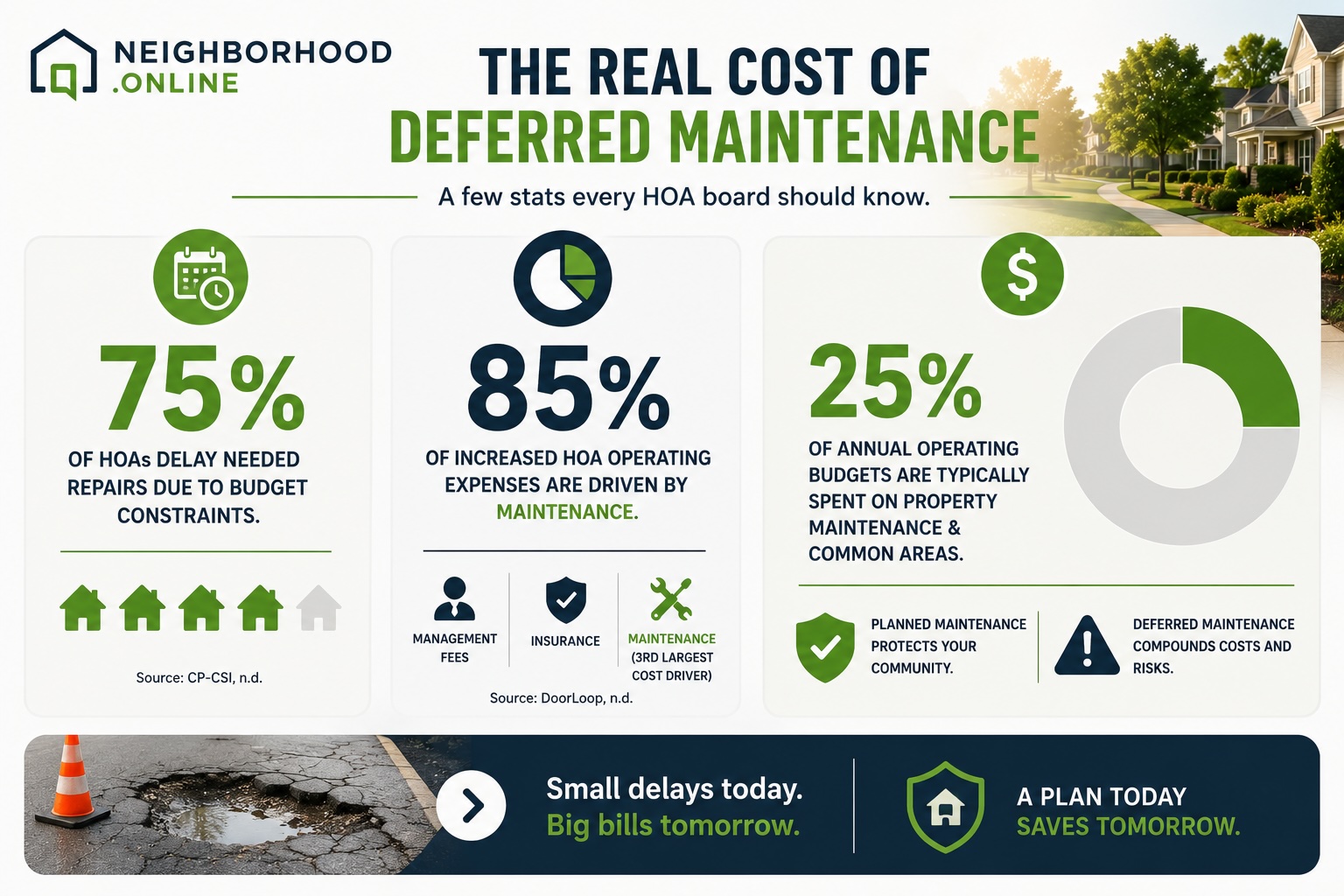
Deferred maintenance is the most dangerous category. It is the act of postponing needed work, usually because the board wants to keep assessments low or simply does not have a plan in place. According to industry reporting, budget constraints delay repairs in as many as 75% of HOAs (CP-CSI, n.d.). Deferred maintenance turns into corrective maintenance. Corrective maintenance turns into capital replacement. A fence that needed a $500 paint job five years ago now needs a $12,000 replacement. A roof that needed annual inspections and small repairs now needs a full replacement a decade ahead of schedule.
The Foundation for Community Association Research has documented cases where preventive maintenance that cost a few hundred dollars per year, when skipped, resulted in six-figure emergency replacements. The math is not subtle. Boards that defer maintenance do not save money. They borrow it from the future, at a much higher interest rate.
Why HOA Maintenance Planning Matters More Than Most Boards Realize
There is a legal dimension to this that boards sometimes overlook. As a board member, you have a fiduciary duty to maintain, protect, and enhance the community. That is not a suggestion. It is among the highest standards of duty implied by law, and it applies whether your HOA has 40 units or 400.
When a board consistently defers maintenance and common areas deteriorate, homeowners can and do take legal action. Insurance premiums go up. Property values go down. Board recall elections happen. The cascade from deferred maintenance to community instability is well documented, and deferred maintenance is consistently identified as one of the primary drivers of higher insurance, legal, and repair costs across community associations.
The financial case is equally clear. Maintenance accounts for 85% of increased HOA operating expenses nationally, making it the third largest cost driver behind management fees and insurance (DoorLoop, n.d.). HOAs historically spend roughly 25% of annual operating budgets on property maintenance and common areas. That spending, when planned well, protects the community. When deferred, it compounds.
Consider a common example from reserve study analysts: a 30-year roof valued at $9 million costs the community $300,000 per year in reserve contributions at full replacement cost. If proper preventive maintenance extends that roof's life by just five years, the annualized cost drops by roughly $43,000 per year (Foundation for Community Association Research, 2023). That is real money that stays in the operating budget rather than going into emergency reserves or, worse, a special assessment.
Well-maintained communities also sell homes for more money. Every time a buyer's appraiser visits the property, they note the condition of the common areas. A community with fresh paint, functioning amenities, and no visible deferred maintenance supports higher appraisals. One with deteriorating fences, an aging pool, and patchy landscaping does not. For more on how capital planning connects to property values, the guide on planning capital improvements for your HOA is a helpful starting point.
How HOA Boards Should Build a Maintenance Plan
A maintenance plan does not have to be a 60-page document. At its simplest, it is a list of what your HOA is responsible for maintaining, how often each component should be inspected, and what preventive maintenance tasks those inspections should trigger.
Free Download: HOA Seasonal Maintenance Calendar
A full year of maintenance tasks organized by month, color-coded by category, with a built-in status tracker your board can update as tasks are completed.
Download the Free CalendarHere is a straightforward process for building one from scratch:
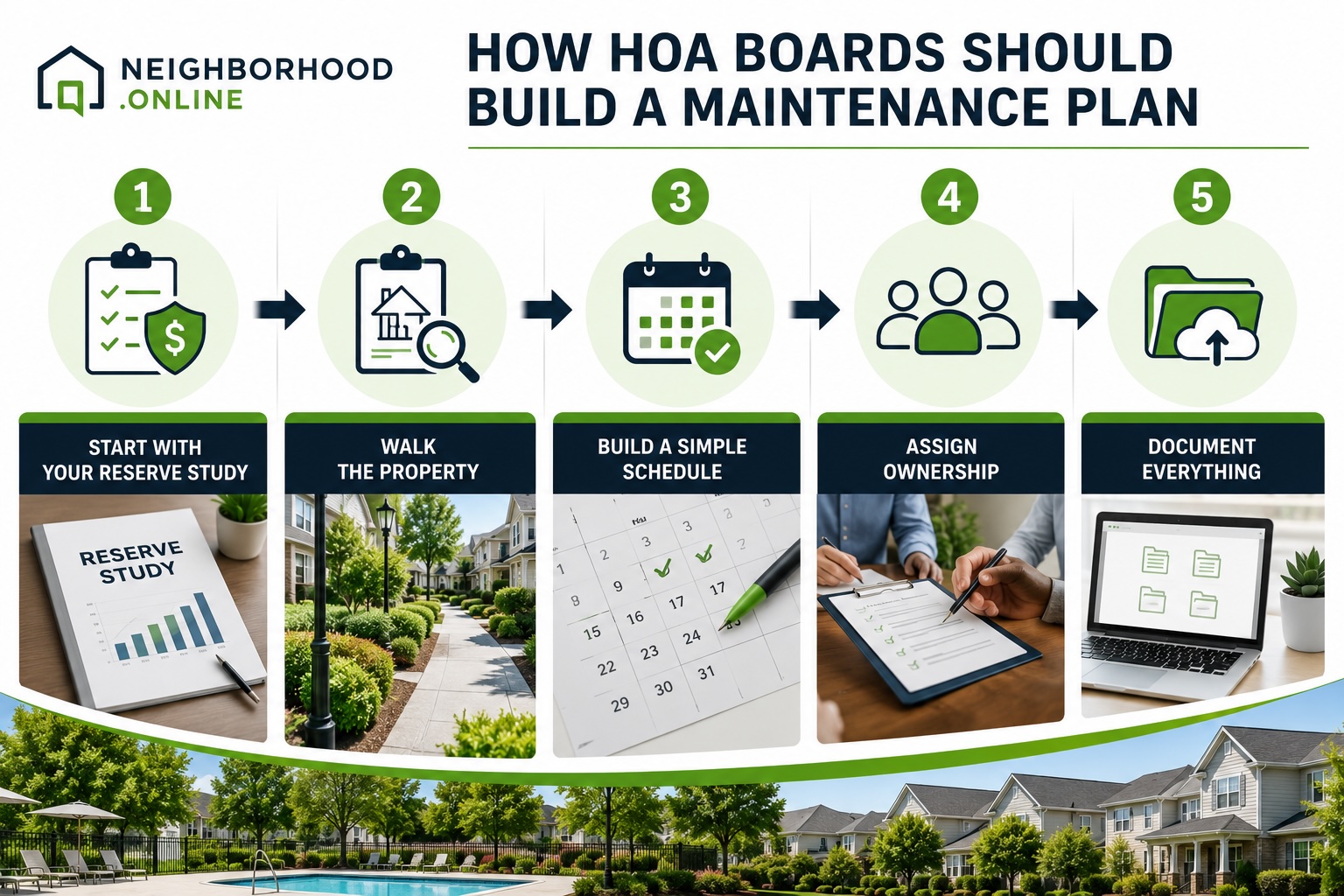
- Start with your reserve study. Your reserve study identifies the major components the association owns and their expected replacement schedules. This is the foundation of your asset inventory. If you do not have a current reserve study, getting one commissioned is the first priority. Most associations aim to keep three to six months of operating expenses on hand as a working buffer alongside reserve contributions (BJM Group, n.d.).
- Walk the property. Do a systematic walkthrough of all common areas with someone who knows what to look for, ideally a licensed maintenance contractor or property inspector. Take photos. Note the condition of fencing, lighting, pavement, roofing, drainage, amenities, and landscaping. Compare what you find against the reserve study.
- Build a simple schedule. For each component, assign an inspection frequency. Gates and automatic entry systems should be checked every two weeks. Pool equipment monthly. Fences and HVAC systems twice a year. Roofing and structural elements annually. The free HOA Seasonal Maintenance Calendar organizes all of this by month with a built-in status tracker your board can update throughout the year.
- Assign ownership. Every item on the schedule needs a name attached to it. Who is responsible for completing the inspection? Who reviews the results? Who approves any corrective work that comes out of it? Without clear ownership, schedules exist on paper and nowhere else.
- Document everything. When a board member turns over after two years, all the institutional knowledge they carry about vendor relationships, past repairs, and ongoing issues walks out the door with them. Written documentation, stored somewhere accessible to the whole board, is how communities survive leadership transitions intact. For practical guidance on moving away from scattered files and email threads, the guide on transitioning from file cabinets to digital document storage in HOAs covers the basics well.
Vendor Management, Capital Projects, and Resident Communication
Three things will make or break your summer maintenance season beyond the plan itself: who you hire to do the work, how you manage larger projects, and how you communicate with residents throughout.
Vendor management starts before you sign anything. A licensed contractor is not just a preference, it is a protection. In many states, if an unlicensed contractor injures an employee on your property, the association may be treated as the employer and bear liability. Before approving any vendor, verify that their license is current and covers the scope of work, confirm their general liability and workers compensation insurance is active with your HOA named as an additional insured, check references specifically from other community associations, and get the scope of work in writing before any work begins. The guide on vendor management in HOAs with AI and data insights covers how boards can build systematic vendor evaluation processes rather than relying on memory and word of mouth.
Capital projects, meaning larger planned improvements to common areas, require additional care. Before a major project begins, boards should notify residents well in advance with clear information about what is happening, when, what disruptions to expect, and who to contact with questions. A vague notice sent two days before construction starts generates far more complaints than a detailed notice sent a week ahead.
Resident communication during maintenance season is one of the most underestimated parts of HOA operations. Residents who feel informed are patient. Residents who feel blindsided become difficult. When the pool closes for its annual inspection, send a notice before it happens and another one when it reopens. When a landscaping crew will be using loud equipment Tuesday morning, let residents know Monday. The free Resident Communication Templates for Repairs and Maintenance covers the four most common scenarios: scheduled maintenance reminders, construction noise notices, amenity closures, and project completion updates.
Safety during maintenance and repair work is also the board's responsibility. Common areas need to be secured during active work, hazards marked clearly, and contractors required to follow safety protocols. The guide on enhancing HOA security with modern technology solutions includes useful information on access control and monitoring during construction periods.
How Technology Can Help With HOA Maintenance
Running HOA maintenance well generates a lot of information. Work orders need to be logged and tracked. Vendor contracts and insurance certificates need to be stored somewhere accessible. Inspection results need to be documented. Resident notices need to go out on time and to the right people.
Tools like Neighborhood.online make it easy to log work orders, store vendor contracts and maintenance documentation, and send maintenance notices to residents all from one place. Rather than tracking open repairs across a spreadsheet, a text thread, and three board members' email inboxes, everything lives in one accessible system.
The other thing technology does well is reduce board turnover friction. When a new treasurer joins the board in January, they should be able to open the platform and immediately understand the state of every open work order, every vendor relationship, and every planned maintenance task. That kind of institutional continuity does not happen by accident. For a deeper look at how HOA landscape maintenance fits into a broader property management strategy, that guide is worth a read as well.
Start This Summer With a Plan
HOA maintenance planning is not complicated. It is consistent. Boards that stay ahead of their common areas do not do it because they have more time or more money than other boards. They do it because they made a plan, assigned ownership, documented what they found, and communicated clearly with the people they serve.
Start this summer by downloading the free HOA Seasonal Maintenance Calendar and walking your property with it. Note what you see. Build your inspection schedule. Get your vendors lined up before you need them on an emergency basis. And when a project comes up, send the notice early, use the Resident Communication Templates to keep homeowners in the loop, and send the completion notice when it is done.
Your residents will notice. Your property values will reflect it. And the next board that inherits your community will thank you for what you built.
References
ASPM San Diego. (n.d.). Solving the HOA deferred maintenance challenge. https://www.aspm-sandiego.com/solving-the-hoa-deferred-maintenance-challenge/
BJM Group. (n.d.). Recommended HOA operating fund balance. https://bjmgroup.com/https-bjmgroup-com-recommended-hoa-operating-fund-balance/
CP-CSI. (n.d.). Effective solutions for common HOA property maintenance challenges. https://www.cp-csi.com/post/effective-solutions-for-common-hoa-property-maintenance-challenges
DoorLoop. (n.d.). HOA statistics. https://www.doorloop.com/blog/hoa-statistics
Foundation for Community Association Research. (2023). Community association maintenance: Best practices. Community Associations Institute. https://foundation.caionline.org
Reserve Advisors. (n.d.). Preventative maintenance in community associations. https://www.reserveadvisors.com/resources/blog/preventative-maintenance-in-community-associations/
Santa Clara Association Management. (n.d.). Deferred maintenance: The hidden cost that can impact your HOA's future. https://www.santaclaraassociationmanagement.com/blog/deferred-maintenance-the-hidden-cost-that-can-impact-your-hoas-future

If you want simple, modern, and free to start, you are in the right place.
We run your community.
Set up a complete community platform in under an hour. No developer required. No credit card needed. No accounting degree required.