Build Your HOA Website Free
Running an HOA is a big job for a volunteer.
Neighborhood.online gives your community a modern website, document storage, and communication tools in minutes.
No technical skills required.
Pool Season Made Easy

Updated July 16, 2026
Pool risk management for HOAs is one of the most stressful parts of the summer calendar, and it does not have to be. Every year, boards scramble to confirm vendors, post rules, handle complaints, and respond to residents who cannot understand why the pool is not open yet. Most of that stress is avoidable with a little planning before opening day.
This guide covers what boards need to think about before the season starts, how to set rules that actually get followed, how to communicate clearly with residents, and what to do when things do not go as planned.
Note: Pool safety requirements vary significantly by state, county, and municipality. Always work with a licensed pool professional and your HOA attorney to confirm your community meets all applicable codes and regulations. This article is a planning and communication guide, not a legal compliance resource.
Download the Free Amenity Inspection Checklists
What Pool Season Actually Looks Like for Most HOA Boards
If you have managed an HOA pool before, you know the opening day pressure is real. According to a snap survey conducted by the Foundation for Community Association Research in 2022, only 82% of HOA pools opened as usual in a recent season. The rest faced delayed openings, limited hours, or in rare cases, full closures. The most commonly cited reasons were inability to secure lifeguards, staffing concerns, and maintenance expenses.
Community swimming pools are among the most common amenities in HOA communities. A 2024 study found that approximately 38% of HOAs nationwide offer a community swimming pool, making it one of the most expected and most scrutinized shared spaces in any neighborhood.
The boards that made it through smoothly were not the ones with the fanciest facilities. They were the ones who planned early, confirmed their vendors ahead of time, and communicated with residents before problems surfaced rather than after.
That is the whole game. Plan early, communicate clearly, and get the right professionals involved for the questions that go beyond board expertise.
Why Pool Risk Management Matters More Than Most Boards Realize
The pool is the most visible amenity in most communities. According to research published in Common Ground by the Community Associations Institute in July 2026, 88% of HOA communities offer social events to residents, and the pool is almost always the backdrop for the most popular ones. What happens at the pool reflects directly on the board.
But pools also carry real liability exposure. The decisions boards make about rules, signage, access, and vendor selection have consequences that go well beyond a bad summer.
A few things most boards do not know going in:
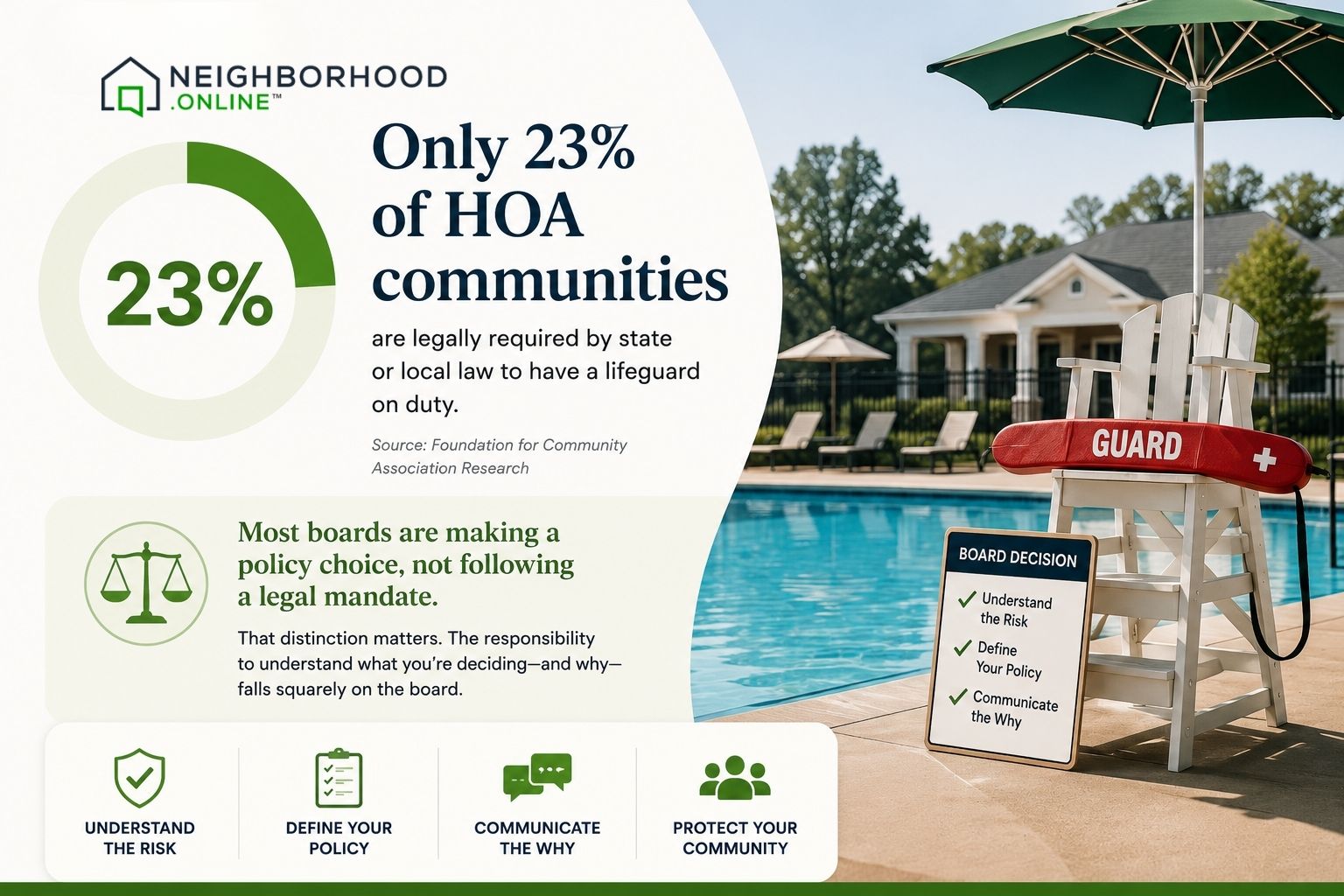
Only 23% of HOA communities are legally required by state or local law to have a lifeguard on duty, according to the Foundation for Community Association Research. That means most boards are making a policy choice, not following a legal mandate. That distinction matters because it puts the responsibility squarely on the board to understand what they are deciding and why.
Even among communities that usually have a lifeguard, only 33% expected to have one during the 2022 season due to nationwide staffing shortages. Boards cannot assume a vendor will deliver what they promised. Confirm staffing before you announce opening day to residents.
And costs are rising. In the same survey, 71% of communities expected increased expenses due to supply chain issues, and 28% anticipated chlorine shortages specifically. Pool season is getting more expensive whether boards plan for it or not.
None of this is meant to alarm anyone. It is meant to help boards walk into the season with realistic expectations and a plan.
How HOA Boards Should Handle Pool Season
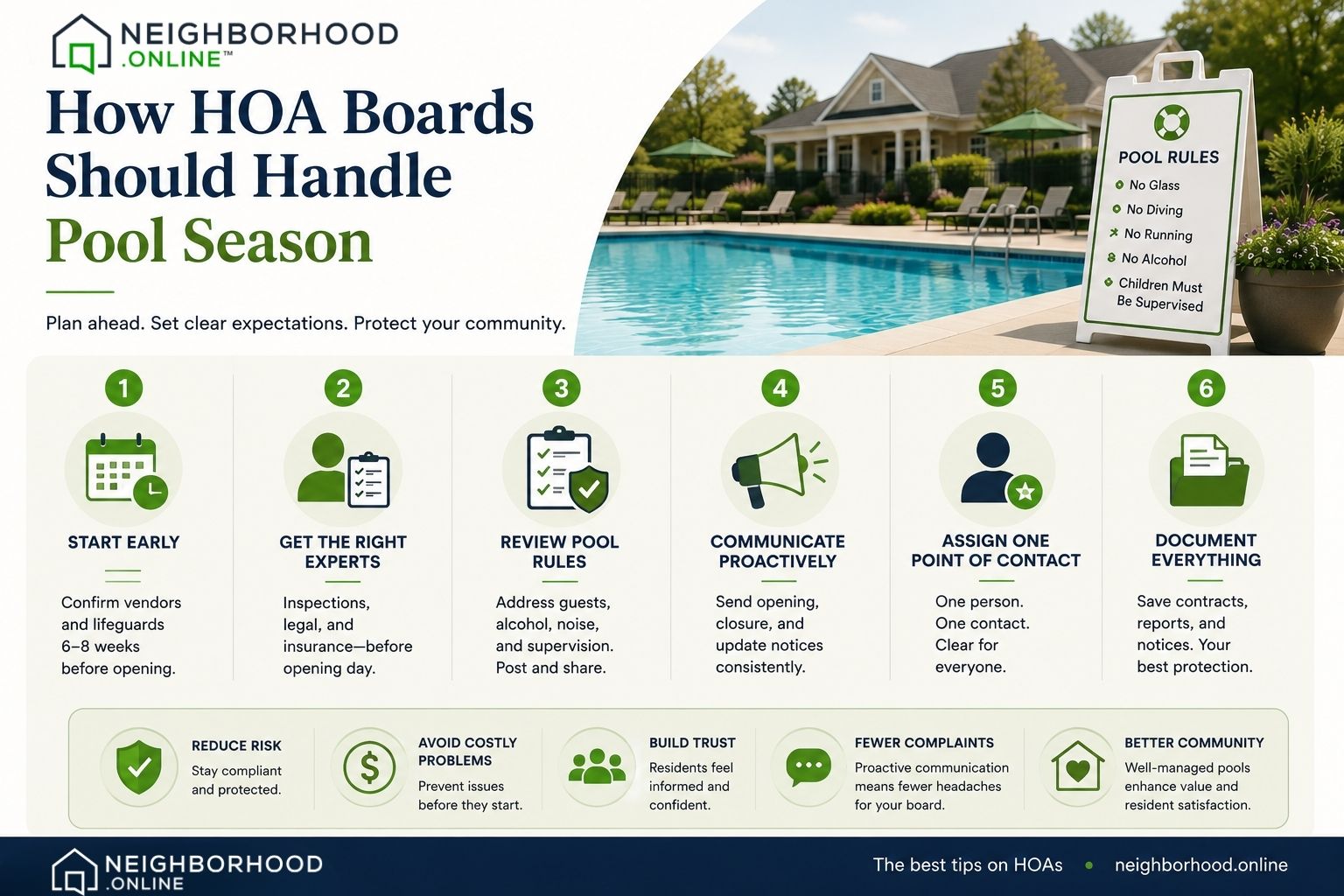
Start earlier than you think you need to. Confirm your pool service vendor and any lifeguard contracts at least six to eight weeks before your planned opening date. If you wait until late spring to call around, you will be competing with every other community in your area doing the same thing.
Get the right professionals involved for the right questions. Your board's job is not to be pool safety experts. It is to ask good questions and make sure the right people are answering them. Before opening day, make sure a licensed pool professional has inspected the facility and given you a written report. Ask your HOA attorney whether your state or municipality requires a lifeguard, what signage you are legally required to post, and whether your current rules are consistent with your governing documents. Ask your insurance carrier to confirm your coverage is adequate for the season.
Review and update your pool rules before opening day, not after the first complaint. Clear rules set expectations before problems happen. The most common sources of pool conflict are guest policies, alcohol, noise, and unsupervised children. Make sure your rules address all of these directly, and make sure they are posted visibly at the pool entrance and shared digitally with residents before the pool opens.
Have a communication plan ready before you need it. Residents do not get upset about pool closures or rule changes. They get upset when they are not told about them. Have a notice ready to send for your opening announcement, any temporary closures, and your end of season closing. Sending these consistently builds trust over the course of the summer and dramatically reduces the number of individual complaints your board has to field.
Assign one board member as the pool season point of contact. When every board member is responsible, no board member is responsible. Pick one person, put their contact information on the opening notice, and make sure residents know who to call with questions or concerns.
Document everything. Keep records of your vendor contracts, inspection reports, and every notice you send to residents. If a dispute comes up later, having a paper trail of when residents were notified and what your professional vendors confirmed is your best protection.
How Technology Can Help
One of the easiest ways to reduce pool season friction is to make information easy to find. When residents can look up pool hours, rules, and announcements on their own without emailing the board, everyone wins.
Neighborhood.online makes it straightforward to post pool rules, share seasonal announcements, and store vendor documents in one place where homeowners can access them any time. Boards can send opening and closing notices directly through the platform, keep a record of every communication sent, and post rule updates without waiting for the next newsletter cycle.
The pool is also where a lot of community tension starts. Parking, noise, and shared spaces are consistently the top sources of HOA conflict according to the Foundation for Community Association Research, and the pool sits at the intersection of all three. Having a central communication hub reduces the number of situations that escalate because a resident simply did not know a rule existed.
For boards managing amenity reservations or access control, the platform also supports scheduling and access features that take some of the administrative load off volunteers who are already stretched thin.
The Bottom Line
Pool season does not have to be stressful. The boards that handle it best are not the ones with the most resources. They are the ones who plan ahead, get the right professionals involved for questions outside their expertise, set clear expectations with residents before problems happen, and communicate consistently throughout the season.
Start early, confirm your vendors, review your rules, and have your notices ready to send. That is the whole plan. For a broader look at managing all of your shared spaces this summer, see our complete HOA amenities guide.
Download the Free Amenity Inspection Checklists
The Amenity Inspection Checklists include monthly inspection guides for pools, playgrounds, fitness centers, and clubhouses, with Pass, Fail, and N/A columns and a notes field for every item. A sign-off and follow-up log helps boards track open action items and assign owners before the next inspection.
References
Community Associations Institute. (2026, July/August). Your turn: Member pulse. Common Ground. https://www.caionline.org/publications/common-ground/
Foundation for Community Association Research. (2022). Impact of staffing shortages and inflation on community association pool openings [Snap survey]. Community Associations Institute. https://foundation.caionline.org/
Foundation for Community Association Research. (2026). Preferred places to call home: Resident perspectives on community association living. Community Associations Institute. https://foundation.caionline.org/
Fin Channel. (2024). Study: Homeowners associations are booming. https://finchannel.com/study-homeowners-associations-are-booming/119339/business-2/r-estate/2024/03/