Build Your HOA Website Free
Running an HOA is a big job for a volunteer.
Neighborhood.online gives your community a modern website, document storage, and communication tools in minutes.
No technical skills required.
HOA Risk and Insurance Essentials

Updated June 22, 2026
- Why This Matters More in Summer
- HOA Insurance versus Homeowner Insurance
- Core Coverages Every Board Should Review Annually
- Coverage Gaps Boards Commonly Miss
- Conducting a Summer Safety and Risk Inspection
- Vendor Contracts and Insurance Requirements
- What Belongs in Executive Session When Discussing Risk
- Emergency Communication Plans
- How Technology Strengthens Safety and Reduces Liability
- Your Pre-Storm Season Action Plan
Keep Your Whole Community in the Loop
Homeowners trust boards that communicate clearly. A free Neighborhood.online website makes it easy to share meeting minutes, post updates, and give residents one place to find everything they need.
Build Your Free HOA WebsiteRunning an HOA board is a lot of things. It is budget meetings and maintenance requests and trying to get a quorum for a vote on the new fence policy. Most of the time, insurance sits quietly in the background. You pay the premium, you file it away, and you hope you never need it. Then storm season arrives, or a contractor gets injured on the property, or a resident trips on a cracked sidewalk, and suddenly what your HOA does or does not have in place matters enormously.
A thorough HOA insurance review before peak risk season is one of the most valuable things a board can do. Not because it is exciting work, but because the cost of getting it wrong is high and the steps to get it right are straightforward. This guide covers every area your board should review, from the policies themselves to the physical condition of your property to the plan you have in place if something goes wrong.
Why This Matters More in Summer
Summer is peak risk season for most HOA communities. Amenities like pools, playgrounds, and fitness centers are in heavy use. Contractors are on-site doing deferred maintenance and capital projects. Storm season brings wind, flooding, and structural damage. More residents are home, more guests are visiting, and more activity means more opportunity for something to go wrong.
Insurance companies know this. Many HOA policies come up for renewal in the spring precisely because carriers price risk by season. Boards that complete their insurance review in the spring, before summer activity ramps up, are in the best position to catch gaps and make changes before they become relevant.
If your renewal date has already passed, it is still worth doing the review now. Identifying gaps mid-policy year gives your board time to add endorsements, adjust coverage, or put interim risk management measures in place before the next renewal cycle.
HOA Insurance versus Homeowner Insurance
One of the most persistent sources of confusion in HOA communities is the boundary between what the HOA's master policy covers and what individual homeowners are responsible for covering themselves. Getting this wrong causes conflict, delays claims, and can leave both the HOA and individual residents financially exposed after a loss.
The HOA's master policy covers common areas and shared structures. This includes the exterior of buildings in a condominium community, common area amenities like pools and clubhouses, shared infrastructure like parking areas and walkways, and the HOA's liability for incidents that happen in those spaces.
What the HOA's policy does not cover is the inside of individual units. Homeowners are responsible for their own personal property, interior fixtures, and improvements. They are also responsible for their own liability coverage for incidents that happen inside their unit. In a condominium community, homeowners should carry an HO-6 policy that covers the gap between the HOA's master policy and their own unit.
Boards should communicate this distinction clearly to residents, especially new homeowners who may assume the HOA handles everything. A simple one-page summary of what the HOA covers and what homeowners should insure themselves is a worthwhile document to keep in your community's resource library.
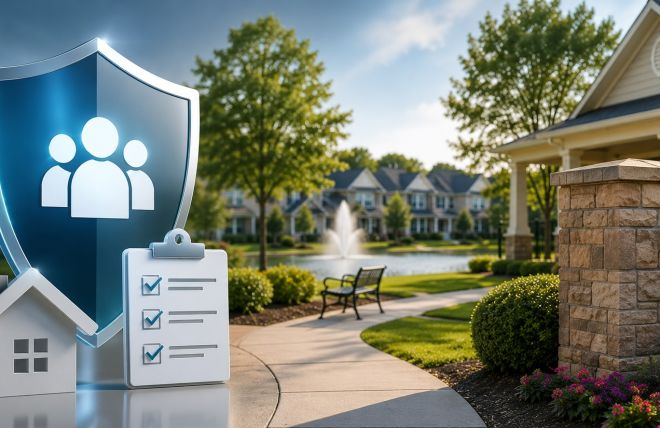
Free Download: HOA Insurance Review Checklist
Use this free checklist to review every policy type, coverage limit, exclusion, and deductible before your renewal date. 49 items across 6 sections, available in Word.
Core Coverages Every Board Should Review Annually
There is no single policy that covers everything an HOA needs. A complete insurance program typically involves several separate policies, each covering a different category of risk. Boards should confirm that all of the following are in place and that the coverage limits are still adequate.
General Liability Insurance protects the HOA when someone is injured in a common area or when HOA activities cause damage to someone else's property. It covers bodily injury, property damage, and legal defense costs. This is the foundation of any HOA insurance program and the most commonly needed coverage in practice. Most HOAs should carry at least $1 million per occurrence, and communities with pools, playgrounds, or fitness centers should consider $2 million or higher. See our full guide to HOA general liability insurance for more detail.
Directors and Officers (D&O) Insurance protects individual board members from personal liability arising from decisions they make in their board role. Without D&O coverage, board members can be personally sued for decisions related to rule enforcement, budget allocations, vendor selection, and other board actions. This is one of the most overlooked policies in HOA insurance and one of the most important for the people who volunteer their time to serve on the board. See our post on HOA D&O insurance for a full explanation.
Property Insurance covers physical damage to HOA-owned structures and common area improvements. Coverage should be based on replacement cost, not market value, and should be updated annually as construction costs change. A policy written five years ago at replacement cost values from that time may significantly under-insure your community today. See our post on HOA property insurance.
Fidelity Insurance protects the HOA against financial losses resulting from theft or fraud by board members, employees, or volunteers. Most mortgage lenders require fidelity coverage equal to at least three months of assessments plus reserve funds. It is a relatively inexpensive policy that addresses a real and recurring risk in HOA communities. See our post on HOA fidelity insurance.
Workers' Compensation Insurance is required in most states for HOAs that have employees and protects the association if a worker is injured on the job. Even HOAs without traditional employees should ask their insurance agent about a Workers Comp If-Any policy, which provides protection in case a contractor is reclassified as an employee after an injury. See our full guide to HOA workers' compensation insurance.
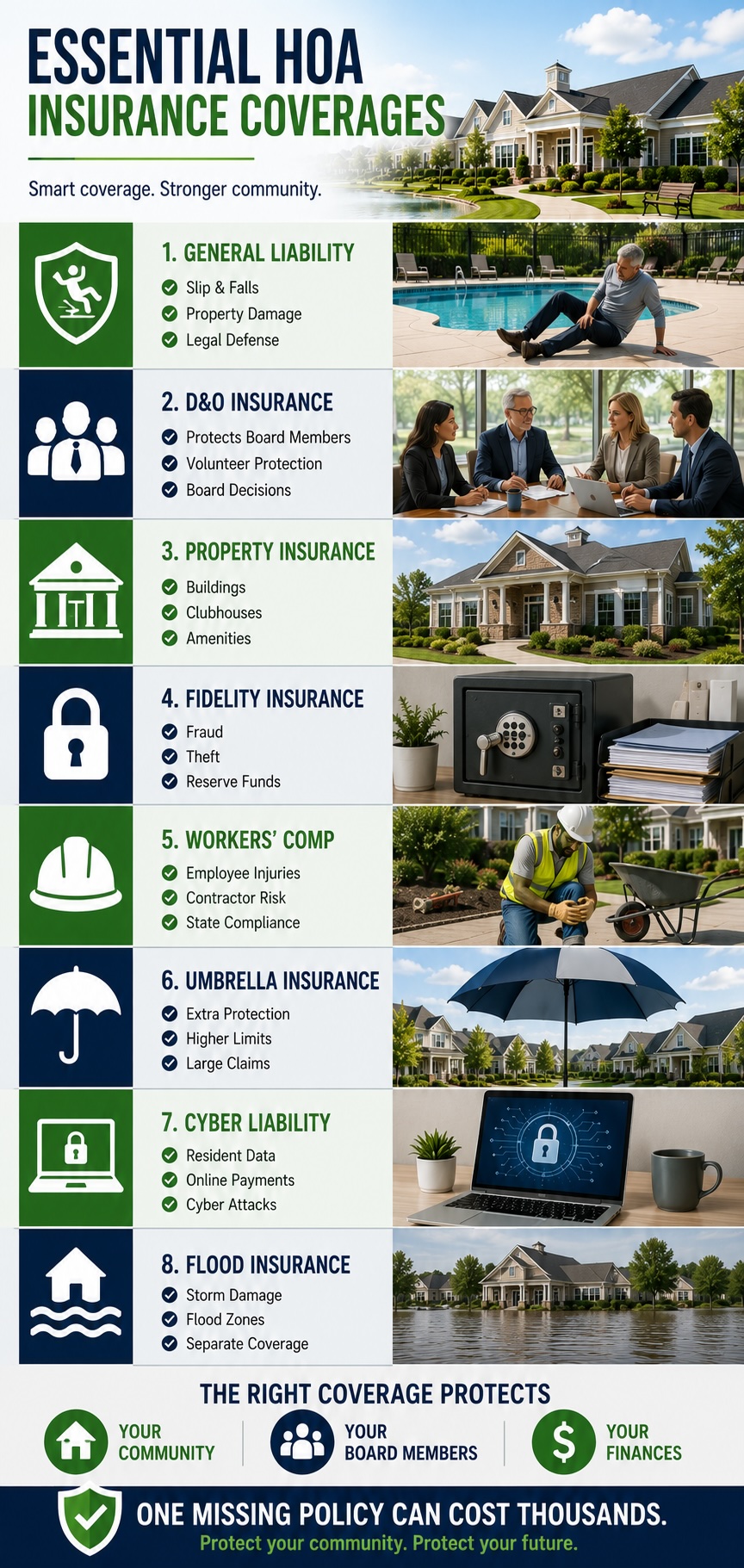
Umbrella Insurance provides an additional layer of liability coverage above the limits of your general liability, D&O, and other underlying policies. For communities with significant amenities or large numbers of residents, an umbrella policy is a cost-effective way to increase protection without dramatically increasing premiums on each underlying policy.
Cyber Liability Insurance is increasingly relevant for any HOA that collects dues online, stores resident data electronically, or uses digital communication platforms. A data breach or ransomware attack on an HOA's systems can be surprisingly costly, and most general liability policies explicitly exclude cyber incidents.
Flood Insurance is excluded from most standard property policies and must be purchased separately. HOAs in flood zones should carry separate flood coverage for common area structures and improvements. Even communities not in designated flood zones may want to consider it given the increasing frequency of weather events that produce flooding in areas not historically at risk.
Coverage Gaps Boards Commonly Miss
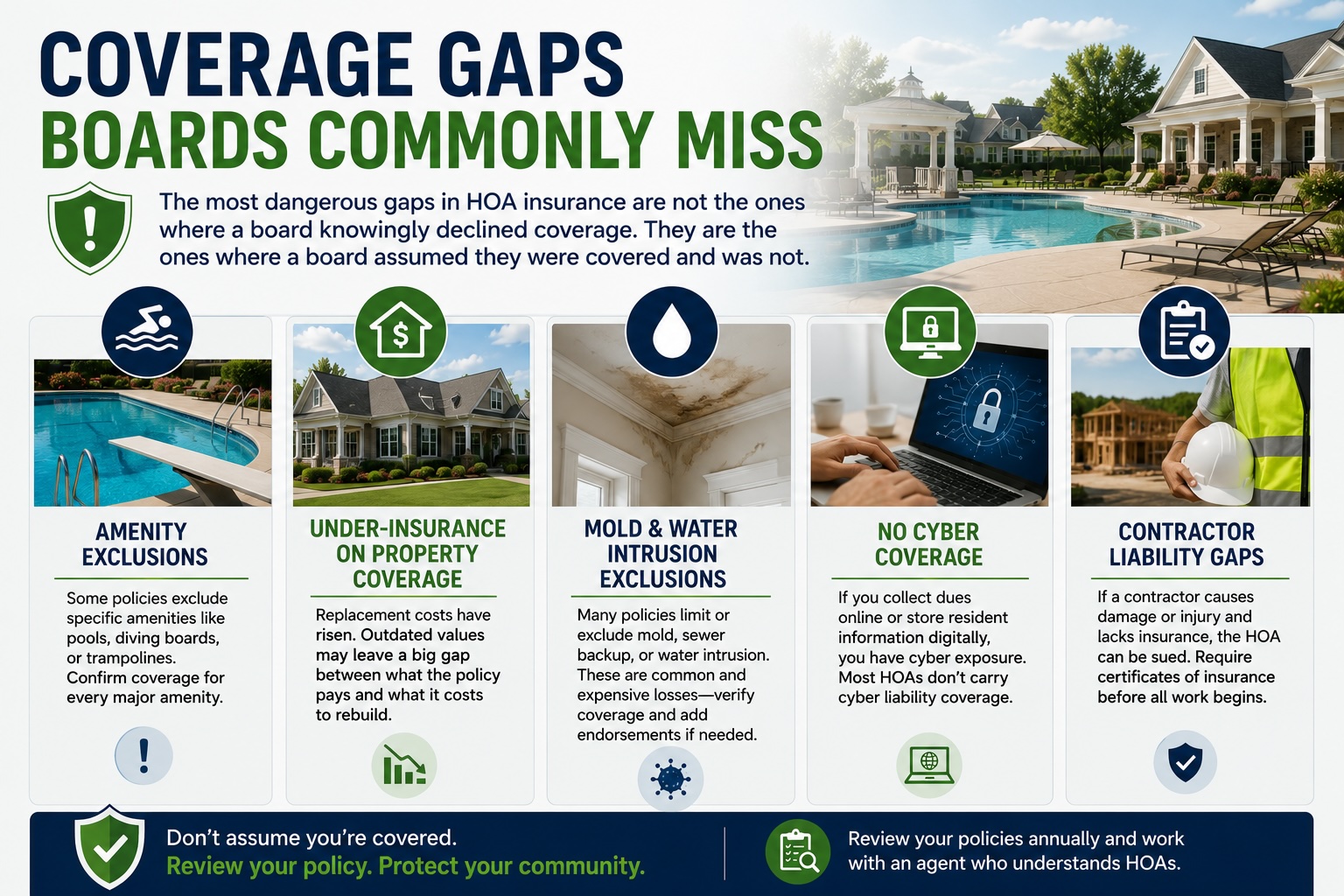
The most dangerous gaps in HOA insurance are not the ones where a board knowingly declined coverage. They are the ones where a board assumed they were covered and was not. Here are the most common gaps boards discover at the worst possible time.
Amenity exclusions. Some general liability policies contain exclusions for specific amenities, including pools, diving boards, or trampolines. A policy that excludes pool incidents in a community with a pool is a serious problem. Read your exclusions section carefully and confirm coverage for every major amenity your community operates.
Under-insurance on property coverage. Replacement costs have risen significantly in recent years. A property policy written at values from three or four years ago may leave a meaningful gap between what the policy pays and what it actually costs to rebuild after a significant loss.
Mold and water intrusion exclusions. Many property policies limit or exclude claims related to mold, sewer backup, or water intrusion. These are among the most common and expensive losses HOA communities face, particularly after storms. Confirm whether your policy covers these scenarios and consider adding endorsements if it does not.
No cyber coverage. If your HOA collects dues online or stores resident information digitally, you have cyber exposure. Most HOAs do not carry cyber liability coverage and are unaware that their general liability policy explicitly excludes it.
Contractor liability gaps. When a contractor working on your property causes damage or injures someone and does not carry adequate insurance, the HOA can be named in the resulting lawsuit. Requiring certificates of insurance from every contractor before work begins is the most direct way to close this gap.
Conducting a Summer Safety and Risk Inspection
Insurance covers losses after they happen. Risk inspections are how boards reduce the likelihood of losses occurring in the first place. A structured walk-through of common areas before summer season is one of the most effective risk management steps a board can take.
A thorough inspection should cover:
- Walkways and sidewalks: Look for raised edges, cracks, uneven surfaces, and trip hazards. Raised concrete edges over half an inch are a common cause of slip and fall claims.
- Exterior lighting: Walk the property after dark or ask residents to report dark areas. Inadequate lighting is a consistent factor in both accidents and security incidents.
- Pool and amenity areas: Confirm gate latches and self-closing mechanisms are functional. Check pool decks for cracks and uneven surfaces. Verify that safety equipment is present and in good condition.
- Playground equipment: Check for broken parts, sharp edges, and adequate safety surfacing. Equipment that is out of compliance with current safety standards creates liability even if it has been in place for years.
- Drainage and stormwater: Clear storm drains and catch basins before storm season. Confirm that ground slopes away from building foundations and that downspouts discharge away from structures.
Download the free HOA Insurance Review Checklist to work through every policy type, coverage limit, exclusion, and vendor requirement in a single structured annual review.
Vendor Contracts and Insurance Requirements
Every vendor and contractor who works in your community's common areas creates liability exposure for the HOA. If a contractor causes property damage, injures a resident, or creates a hazard while working on your property, the HOA can be drawn into any resulting lawsuit regardless of who was at fault.
The most important protective step is simple: require every vendor to provide a certificate of insurance before work begins. That certificate should confirm:
- The contractor carries general liability coverage of at least $1 million per occurrence
- The HOA is named as an additional insured on the contractor's policy
- The contractor carries workers' compensation coverage if they have employees
- The certificate covers the dates of the work being performed
Do not accept verbal assurances. Require the certificate before work starts, every time, without exception. The board should also have a process for tracking certificate expiration dates so coverage does not lapse mid-project.
What Belongs in Executive Session When Discussing Risk
Not all insurance and risk discussions belong in an open board meeting. Certain topics should be handled in executive session to protect the HOA's legal position and avoid creating a public record that could be used against the association in litigation.
Topics that generally belong in executive session include:
- Active or threatened litigation against the HOA
- Specific insurance claims that have been filed or are being investigated
- Known hazards or safety issues that the board is aware of but has not yet remediated
- Legal advice from the HOA's attorney regarding liability exposure
- Personnel matters involving employees or contractors
The general rule is that if a discussion could create a written record that damages the HOA's position in a lawsuit, it belongs in executive session where the minutes are not publicly distributed. Your HOA attorney can advise on the specific executive session rules in your state.
Emergency Communication Plans
Insurance and risk management cover what happens after an incident. Emergency communication planning covers how your board responds during one. A community that communicates clearly and quickly during a hurricane warning, gas leak, or severe storm protects both its residents and its liability position.
A basic emergency communication plan should define:
- Who is authorized to send official community alerts
- What channels are used for different levels of urgency
- What message templates look like for each scenario
- A vendor and emergency contact directory with after-hours numbers
- Pre-event, during-event, and post-event checklists
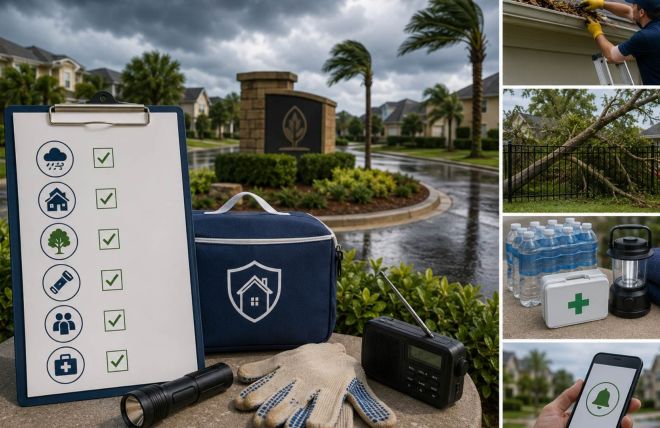
The plan should be completed before it is needed, stored somewhere every board member can access it, and reviewed annually. Download the free Disaster Communication Plan Template to build your community's plan now, before storm season is underway.
How Technology Strengthens Safety and Reduces Liability
Technology is increasingly practical for HOA risk management, and the cost of most tools has come down significantly. Boards that use technology thoughtfully can reduce risk exposure, document incidents more reliably, and communicate with residents more effectively during emergencies.
Digital document storage is one of the most straightforward improvements a board can make. Insurance certificates, vendor contracts, inspection records, and incident reports stored in a central digital library are accessible to all board members instantly, from any device. When an insurance agent calls asking for a certificate from 18 months ago, or a new board member needs to review a vendor contract, the information is there. Tools like Neighborhood.online make it easy to store and share documents with the full board without relying on one person's email inbox or a filing cabinet that only one person can access.
Incident documentation tools create a timestamped record of safety issues, maintenance requests, and reported hazards. A documented record of when a hazard was reported and what action was taken is one of the most effective defenses against liability claims. If a resident trips on a cracked sidewalk and the board can show that the crack was reported, assessed, and scheduled for repair within a reasonable timeframe, the HOA's legal position is significantly stronger than if no record exists at all.
Mass communication tools ensure that emergency alerts reach every resident quickly and through multiple channels. An HOA website with integrated email alerts, SMS messaging, and public posting capability means that a board can send a hurricane advisory or all-clear notice to the entire community within minutes, from any location.
Security infrastructure such as camera systems, motion-activated lighting, and electronic access controls on common areas reduces both the likelihood of incidents and the cost of investigating them when they do occur. Well-lit, well-monitored common areas deter vandalism, unauthorized access, and the kind of accidents that happen in poorly maintained or poorly secured spaces.
Your Pre-Storm Season Action Plan
If you have read this far, you have a clear picture of what a thorough insurance and risk review covers. Here is a practical checklist your board can work through in the next 30 days.
- Pull out every current insurance policy and confirm the renewal dates
- Review coverage limits on general liability, property, and D&O policies and confirm they are still adequate
- Read the exclusions section of your property and general liability policies and look for the gaps described in this article
- Confirm your flood insurance situation, especially if your community is in or near a flood zone
- Ask your insurance agent specifically about cyber liability coverage
- Schedule a physical walk-through of all common areas using the Community Risk Inspection Checklist
- Verify that every active vendor has a current certificate of insurance on file
- Complete or update your Disaster Communication Plan Template
- Confirm that all board members know where insurance documents and the emergency plan are stored
- Schedule your next insurance review for 60 to 90 days before your next renewal date
Free Download: HOA Insurance Review Checklist
A structured annual checklist covering every policy type, coverage limit, exclusion, vendor requirement, and renewal step. 49 items across 6 sections, free in PDF and Word.
If you want simple, modern, and free to start, you are in the right place.
We run your community.
Set up a complete community platform in under an hour. No developer required. No credit card needed. No accounting degree required.