Build Your HOA Website Free
Neighborhood.online gives your community a modern website, document storage, and communication tools in minutes. No technical skills required.
How to Prepare Your Community for Storm Season

Updated June 25, 2026
Set Up Your Free HOA Website in Minutes
Give your community a home base online. Share announcements, post documents, and keep homeowners informed with a free Neighborhood.online website built specifically for HOAs.
Create Your Free WebsiteStorm season does not announce itself with enough warning to get everything done at once. By the time a hurricane watch is issued or a severe storm system is tracking toward your community, the window for preparation has mostly closed. The boards that handle storm season well are the ones that prepared in the weeks and months before anything happened.
This guide covers everything an HOA board should do before storm season begins, from reviewing insurance to inspecting the property to making sure residents know what to expect and how to reach the board when conditions deteriorate. It also covers the steps that matter most in the hours and days after a storm passes.
Why Boards Should Prepare Before the Season Starts
The Atlantic hurricane season runs from June 1 through November 30, with peak activity typically occurring between August and October. But preparation that starts in August is already late. Contractors are booked, insurance endorsements take time to process, and community communication systems are not something you want to test for the first time during an active storm warning.
Boards that prepare in May and June have time to address property issues identified during inspections, confirm insurance coverage before it is needed, establish communication protocols before residents are anxious, and build relationships with vendors who will be in high demand during and after a major storm.
Preparation also protects the HOA's legal and financial position. A board that documents pre-storm conditions, follows a defined communication plan, and takes reasonable steps to protect common areas is in a far stronger position if a dispute arises later over what the HOA should have done.
Start with Your Insurance
Before doing anything else, your board should confirm that your insurance program is complete and that coverage limits are adequate. A storm that damages your community when you are underinsured or carrying a policy with a significant gap is a compounding disaster.
The specific questions to answer before storm season:
- Does your property policy cover wind damage, or is wind excluded and requires a separate endorsement?
- Does your property policy cover flood damage, or do you need a separate flood policy for common areas?
- What is your deductible? Many policies in coastal areas carry percentage-based wind or hurricane deductibles rather than a flat dollar amount. A 2% deductible on a $5 million property policy is $100,000 out of pocket before the policy pays.
- Are your coverage limits based on current replacement cost? Construction costs have risen significantly in recent years and limits from three or four years ago may leave a meaningful gap.
- Do you have the HOA's insurance agent's direct number and after-hours claims line in your emergency contacts?
Download the free HOA Insurance Review Checklist to work through every policy type, coverage limit, and deductible before storm season begins.
HOA Insurance Review Checklist
Also review what your policy requires the HOA to do before a storm to preserve coverage. Some policies have requirements around securing property, shuttering windows on HOA-owned buildings, or taking other protective measures before a named storm. Failing to follow these requirements can complicate a claim.
Pre-Storm Property Inspection
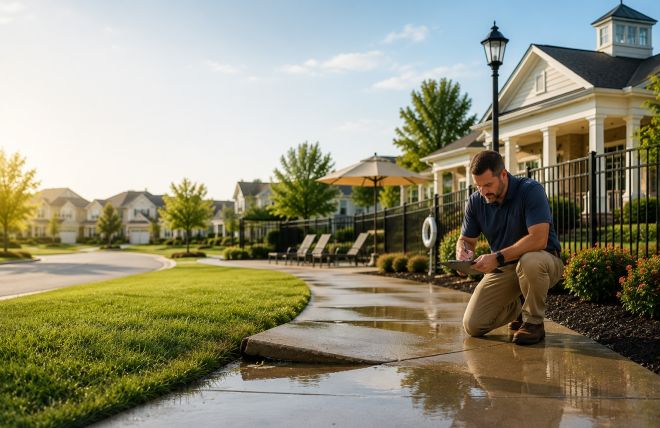
A physical walk-through of all common areas before storm season serves two purposes. It identifies conditions that could become hazards or generate claims during a storm, and it creates a documented baseline of property condition that is valuable if you need to file an insurance claim after a storm.
Walk every common area with a checklist and document what you find with dated photos. The areas that deserve the most attention before storm season are:
Roofs. Look for missing or lifted shingles, damaged flashing, clogged gutters, and any areas where water could pool. A minor roof issue that was manageable in dry conditions can become a major water intrusion problem during a heavy rain event.
Trees. Have a licensed arborist assess any large trees near buildings, walkways, or parking areas. Dead branches, compromised root systems, and trees with significant lean are significant hazards in high winds. The time to address a dangerous tree is before a storm, not after it has fallen on a car or through a roof.
Drainage. Clear storm drains, catch basins, and gutters. Confirm that ground slopes away from building foundations. A blocked drain or negative grading that causes minor nuisance flooding in a normal rain event can cause serious damage in a tropical system.
Fencing and gates. Loose fence panels and gates that do not latch properly become projectiles in high winds. Inspect all perimeter fencing and entry gates and make repairs before storm season.
Outdoor furniture and equipment. Identify everything in common areas that would need to be secured or stored before a storm, and make sure the board has a plan for doing so quickly when a warning is issued.
Keep Your Whole Community in the Loop
Homeowners trust boards that communicate clearly. A free Neighborhood.online website makes it easy to share meeting minutes, post updates, and give residents one place to find everything they need.
Build Your Free HOA WebsiteSecuring Common Areas Before a Storm
When a storm warning is issued, your board needs to move quickly to secure common areas. Having a defined plan in advance means the board is executing rather than improvising under pressure.
Standard pre-storm common area tasks include:
- Close and lock the pool, fitness center, clubhouse, and all other amenity areas
- Bring in or secure all outdoor furniture, umbrellas, cushions, and portable equipment
- Clear pool decks of all loose items
- Secure or remove any temporary signage, potted plants, or decorative items in common areas
- Confirm that all entry and exit gates are functioning and can be secured if needed
- If your community has outdoor grills or fire pits, confirm they are secured and gas is shut off
- Photograph all common areas after securing them. Dated photos taken just before a storm are valuable evidence for an insurance claim.
Assign specific tasks to specific board members or staff so nothing falls through the gaps when time is short. A one-page pre-storm task list with named assignments is worth preparing now and reviewing annually.
Setting Up Your Communication Plan
Clear communication before, during, and after a storm is one of the most important things an HOA board can do for its community. Residents who know what is happening and what to expect are calmer, more cooperative, and less likely to take matters into their own hands in ways that create additional problems.
Your communication plan should answer these questions before a storm arrives:
- Who sends official community alerts? Name a primary person and a backup.
- What channels does the HOA use? Website, email, SMS, and physical posted notices each reach different residents.
- What triggers a community alert? Define the level of event that warrants a message so the board is not debating it during an active situation.
- What do the messages say? Pre-written templates save time and ensure consistent, calm communication.
Download the free Disaster Communication Plan Template to build your community's plan now. It includes role assignments, alert level definitions, four ready-to-use message templates, and pre-event, during-event, and post-event checklists.
What to Tell Residents Before a Storm
Residents need guidance before a storm, not just during one. A pre-season communication from the board sets expectations and reduces the volume of individual questions and concerns your board has to manage when conditions deteriorate.
A pre-season resident communication should cover:
- When common areas will be closed in advance of a storm and how residents will be notified
- What residents are responsible for securing on their own balconies, patios, and entryways
- Where to find official HOA communications during and after a storm (website, email, posted notices)
- Who to contact for emergencies and what constitutes an HOA emergency versus a personal one
- A reminder that the HOA's insurance covers common areas and that residents should carry their own coverage for their units and personal property
- A reminder about loss assessments and why residents should carry loss assessment coverage in their individual policies
Keep the tone calm and practical. The goal is to make residents feel that the board is prepared and has thought through the process, not to alarm anyone or generate unnecessary anxiety.
Vendor and Emergency Contacts
After a major storm, roofing contractors, tree services, and general contractors are in high demand and short supply. HOAs with established vendor relationships and current contact information are better positioned to get service quickly. HOAs scrambling to find a contractor after a storm are competing with every other community and homeowner in the area.
Before storm season, confirm that your vendor contact directory is current and includes:
- Roofing contractor with an after-hours emergency line
- Tree service with storm response capability
- General contractor for structural repairs
- Plumber for water damage and pipe repairs
- Electric utility company outage reporting line
- HOA insurance agent with a direct claims line
- Local fire department non-emergency line
- County emergency management office
Consider reaching out to your key vendors before storm season to confirm their availability and response process. Some contractors offer priority response agreements to clients who establish the relationship before the season starts.
Also confirm that every vendor on your list has a current certificate of insurance on file. A contractor who shows up to do storm repair work without adequate coverage creates liability exposure for the HOA at exactly the wrong time. See our post on HOA workers' compensation insurance for more on what to require from contractors.
What to Do After the Storm
The hours and days after a storm passes require a structured response. Boards that have a defined post-storm process move faster, communicate better, and protect the HOA's insurance position more effectively than those improvising under pressure.
Safety first. Do not send board members or staff into common areas until conditions are safe. After a major storm that may mean waiting for official clearance from local authorities. Downed power lines, unstable trees, and structural damage all create hazards that are not obvious from a distance.
Document everything before touching anything. Walk every common area as soon as it is safe and photograph all damage with timestamps before any cleanup or repair work begins. Your insurance adjuster will need this documentation. Starting cleanup before documentation can complicate a claim.
Contact your insurance agent within 24 hours. Report the damage and open a claim as quickly as possible. Early notification helps the adjuster prioritize your community's inspection and speeds the overall claims process.
Do not authorize permanent repairs before your insurer approves. Emergency temporary repairs (covering a damaged roof with tarps, boarding broken windows) are generally acceptable and necessary. But contracting for permanent repairs before your insurer has assessed the damage can create disputes about coverage and cost. Get written approval or at minimum verbal confirmation from your adjuster before committing to significant repair work.
Send a post-event update to residents. Within 24 hours of the storm passing, send a community update covering the status of common areas, any known damage, utility status, and when residents can expect further information. Transparent communication after a storm reduces anxiety, prevents rumors, and demonstrates that the board is in control of the situation.
Your Pre-Storm Season Checklist
Use this checklist in the weeks before storm season begins. Most items can be completed in a single board work session if you divide the tasks among board members.
- Review property insurance for wind, hurricane, and flood coverage and confirm deductible amounts
- Confirm property insurance replacement cost values are current
- Verify HOA insurance agent and claims contact information
- Complete a physical walk-through of all common areas with dated photo documentation
- Schedule tree assessment by a licensed arborist for any trees near buildings or walkways
- Clear all storm drains, gutters, and catch basins
- Inspect all fencing, gates, and entry systems
- Identify all outdoor furniture and equipment that will need to be secured before a storm
- Confirm vendor contact directory is current with after-hours numbers
- Verify current certificates of insurance are on file for all active vendors
- Complete or update the Disaster Communication Plan Template
- Assign pre-storm common area securing tasks to specific board members
- Send a pre-season communication to all residents covering expectations and HOA procedures
- Confirm all board members know where the insurance documents and emergency plan are stored
Free Download: HOA Insurance Review Checklist
Before storm season is the best time to review every policy type, coverage limit, and deductible. The HOA Insurance Review Checklist walks your board through the full annual review in one structured session. Free in PDF and Word.
Sources
-
Federal Emergency Management Agency. (2024, March). Wildfire hazard information sheet. Ready.gov. https://www.ready.gov/sites/default/files/2024-03/ready.gov_wildfire_hazard-info-sheet.pdf
-
Federal Emergency Management Agency. (n.d.). Wildfire. FEMA. https://community.fema.gov/ProtectiveActions/s/article/Wildfire
-
Arrowsmith, L. (2023, August 7). Natural disaster statistics 2023. Forbes. https://www.forbes.com/advisor/homeowners-insurance/natural-disaster-statistics/
-
The Zebra. (2023). Natural disaster statistics for 2023. https://www.thezebra.com/resources/research/natural-disaster-statistics/
-
Specialty Fuel Services. (n.d.). Natural disaster statistics. https://specialtyfuelservices.com/natural-disaster-statistics/
-
Statista. (n.d.). Natural disasters. https://www.statista.com/topics/2155/natural-disasters/
-
National Weather Service. (n.d.). Hazardous weather statistics. https://www.weather.gov/hazstat/
-
Statista. (n.d.). Natural disasters. https://www.statista.com/topics/1714/natural-disasters/
-
Ritchie, H., & Roser, M. (2014). Natural disasters. Our World in Data. https://ourworldindata.org/natural-disasters
-
National Centers for Environmental Information. (n.d.). Billion-dollar weather and climate disasters: Summary stats. NOAA. https://www.ncei.noaa.gov/access/billions/summary-stats

If you want simple, modern, and free to start, you are in the right place.
We run your community.
Set up a complete community platform in under an hour. No developer required. No credit card needed. No accounting degree required.