Build Your HOA Website Free
Running an HOA is a big job for a volunteer.
Neighborhood.online gives your community a modern website, document storage, and communication tools in minutes.
No technical skills required.
How to Move Your HOA Off Facebook Groups (And What to Use Instead)

Updated July 1, 2026
Keep Your Whole Community in the Loop
Homeowners trust boards that communicate clearly. A free Neighborhood.online website makes it easy to share meeting minutes, post updates, and give residents one place to find everything they need.
Build Your Free HOA WebsiteFacebook groups made sense when your HOA needed a free, fast way to reach homeowners. No setup cost, everyone already had an account, and posting a pool closure notice took thirty seconds. For a lot of communities, the HOA Facebook group became the default communication channel almost by accident. Then it became the only one. And that is where the problems start.
If your board is dealing with drama in the comments, homeowners who missed important announcements because the algorithm buried them, or residents asking where to find the budget documents you definitely posted three months ago, this guide is for you. Here is why the HOA Facebook group stops working at a certain point, what a proper replacement looks like, and how to make the move without a community rebellion.
Why HOA Facebook Groups Cause Real Problems
The issues with running HOA communications through Facebook are not just aesthetic. Several of them create genuine risk for your board.
You do not control who sees what. Facebook's algorithm decides which posts appear in members' feeds and in what order. A notice about a parking enforcement change or a board meeting reminder can reach 40 percent of your group on one day and 12 percent on another, depending on engagement. Your most important announcements are not guaranteed to reach the people who need them.
Not everyone is on Facebook. This was already true in 2020 and it is more true now. Older homeowners who never joined, younger homeowners who left, and anyone with privacy concerns about the platform are simply not reachable through your group. If your Facebook group is your primary channel, those homeowners are effectively excluded from community communication.
There is no document home. Bylaws, meeting minutes, the annual budget, vendor contracts, reserve study reports. None of these have a natural home in a Facebook group. Pinned posts get buried. Files uploaded to the group are hard to find six months later. When a homeowner asks where the CC&Rs are, someone has to go dig for them every time.
Personal and official lines blur. A Facebook group that mixes legitimate board announcements with neighbor disputes, lost pet posts, and political arguments does not project a well-run community. It also makes it genuinely difficult for homeowners to find the information that matters. Boards that use Facebook as their primary governance tool often find that the informal nature of the platform works against them when they need to communicate something serious.
Sharing homeowner information on Facebook creates privacy exposure. Member directories, contact lists, and any personally identifiable information about residents shared in a Facebook group are subject to Facebook's data practices, not your HOA's. Depending on your state, this may also create compliance concerns.
Your history lives on Facebook's servers, not yours. If the group administrator leaves, if Facebook changes its policies, or if the group is reported and removed, you lose everything. Meeting notices, announcements, votes. Gone.
What a Real HOA Platform Does That Facebook Cannot
The goal is not to find something that looks like Facebook for HOAs. The goal is to have a system that actually handles what an HOA needs to do. That is a meaningfully different thing. A dedicated HOA website and management platform provides:
- A document library. Bylaws, CC&Rs, meeting minutes, financial reports, and insurance certificates stored in one place where any homeowner can find them without asking. Documents do not expire or get buried in a feed.
- Controlled announcements. When the board sends a notice, every member receives it. Not the members Facebook decided to show it to that day.
- A private, verified member directory. Homeowners can find neighbor contact information within the community without it being visible to anyone outside it or indexed by search engines.
- Event calendar with RSVP. Annual meetings, community events, maintenance windows. Members can respond and the board can plan around actual headcounts.
- Online dues payment. One of the most common frustrations for both boards and homeowners is the payment process. A platform built for HOAs handles this without requiring a third-party workaround.
- Voting and surveys. When the board needs homeowner input or a formal vote, a dedicated platform handles the process cleanly and creates a record of the result.
- Governance records. Meeting minutes, board decisions, and official notices stored in a way that is accessible to homeowners and defensible if questions arise later.
None of these are features Facebook was designed to provide. They are features a community management platform was specifically built around. There is also a practical benefit to your HOA communication strategy when everything lives in one place: board members do not have to check three different channels to know what has been communicated and to whom.
How to Move Your HOA Off Facebook Without Losing Everyone
The migration itself is straightforward. The part that requires care is managing homeowner expectations through the transition.
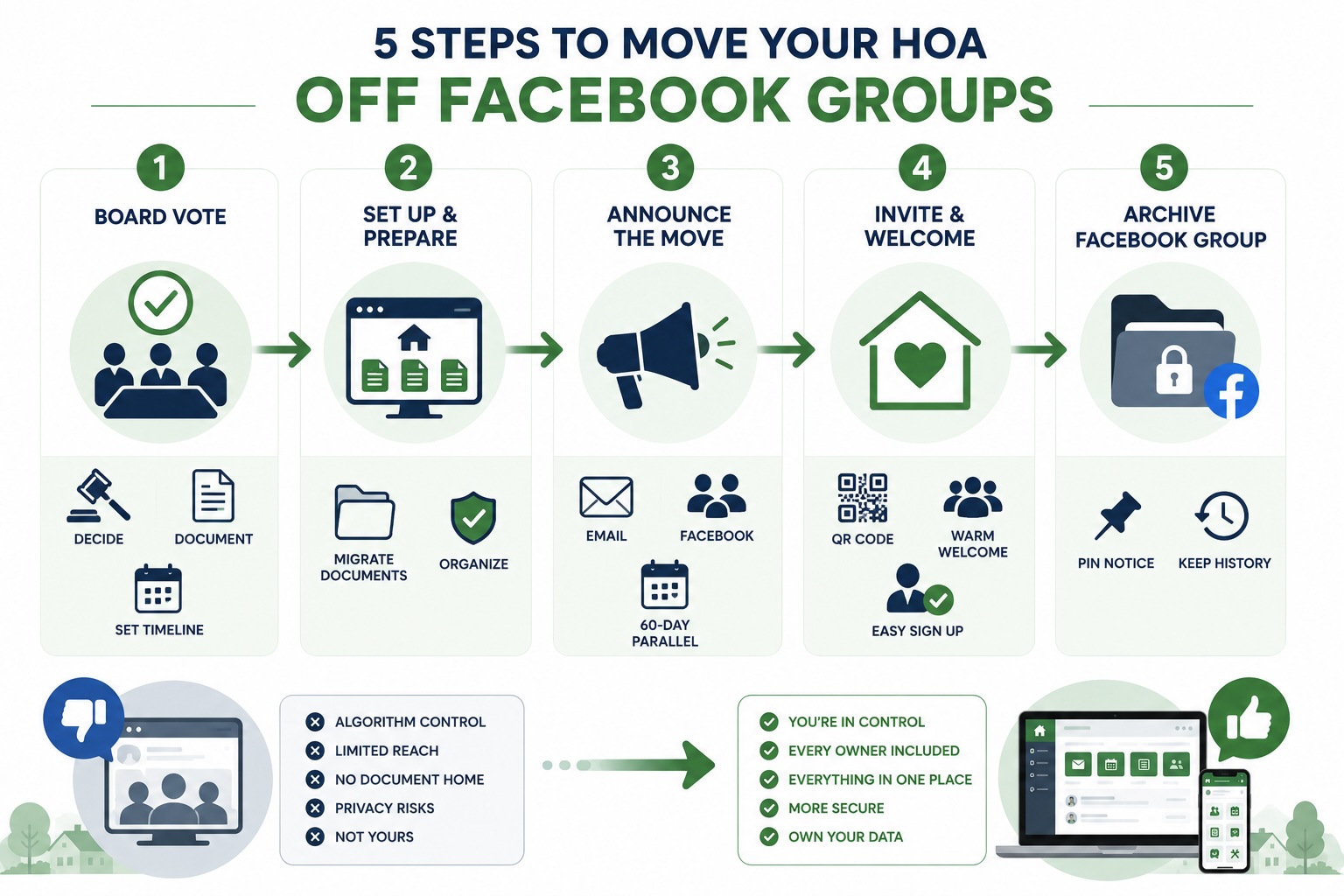
Start with the board vote. Make the decision formally, document it in meeting minutes, and set a timeline. Trying to migrate without a clear decision and a deadline leads to running two platforms indefinitely, which is worse than staying on Facebook.
Set up the new platform before you announce the move. Migrate your documents first. Upload bylaws, the most recent meeting minutes, the current budget, and any other frequently requested files. Nothing undermines confidence in a new platform faster than a launch where the promised resources are not there yet. This is also a good time to build out your digitizing your document library properly rather than just moving the same disorganized files to a new location.
Send the announcement through Facebook and email simultaneously. Use the Facebook group one last time to tell people where to go next. Include a direct link to the new platform, a clear explanation of why the board made the switch, and a deadline for the transition. A 60-day parallel period where you post in both places gives homeowners time to find the new platform before the old one goes quiet.
Make the first invitation feel welcoming, not administrative. A QR code in a physical mailer or on posted notices around common areas, alongside a warm welcome message, reaches homeowners who are not checking email or the Facebook group. The goal is to make signing up take less than two minutes.
Archive, do not delete, the Facebook group. Set the group to closed and pin a final post pointing to the new platform. Deleting it removes any record of past announcements and can frustrate homeowners who had bookmarked specific posts. Archiving preserves the history while making clear that the group is no longer active.
How to Handle Homeowners Who Resist the Switch
Some homeowners will push back, and usually for one of three reasons: they do not want another login to manage, they are used to Facebook, or they simply do not trust that the board chose a good platform.
The response to the first concern is simplicity. If signing up takes more than two minutes or requires more than a name and email address, your onboarding needs to be simplified before the announcement goes out. The easier the registration, the less this objection comes up.
The response to the second concern is patience. Give people the full parallel period to adjust. Keep posting important content in both places during that window. When the Facebook group goes quiet and the new platform has the documents, the calendar, and the board activity, most holdouts follow.
The response to the third concern is transparency. Explain what the platform does, why the board chose it, and what it costs the community. Homeowners who understand the reasoning behind a decision are more likely to accept it, even if they would have made a different choice.
A simple HOA newsletter announcement with a short FAQ covering the most common objections before they become complaints handles the majority of resistance before it starts. A resident portal that actually works well does the rest.
How Technology Built for HOAs Makes This Easier
The reason many boards end up on Facebook in the first place is that building a proper community platform used to feel like a significant project. A website needed a developer. A member database needed someone to manage it. Dues collection needed a payment processor. It was a lot for a volunteer board to take on.
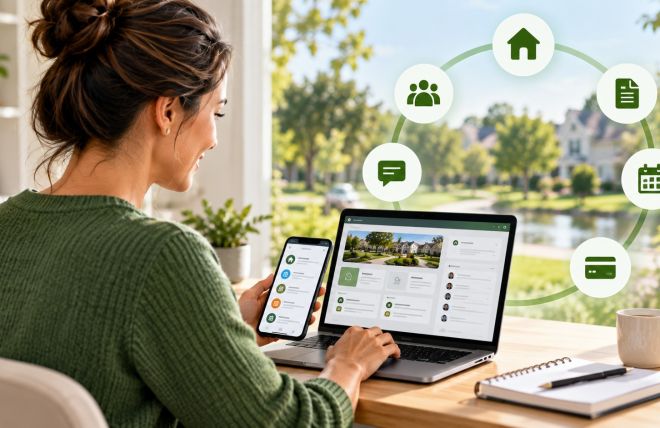
Platforms like Neighborhood.online are built specifically to eliminate that friction. The setup process is designed for board members who are not web developers, the features map directly to what HOAs actually need to manage, and the onboarding experience for homeowners is built around making the first login as easy as possible. The document library, member directory, announcement tools, event calendar, and dues collection are all in one place rather than spread across four different services.
For Webmaster Wiley types who want more control, the platform still allows customization. For Board Leader Blake types who just need it to work without becoming a second job, it does that too.
The Right Time to Make the Move
Summer is a practical time to migrate, particularly before the fall budget season and annual meeting cycle begins. You want the new platform fully established and familiar to homeowners before you are using it to communicate something consequential, like a dues increase or a special meeting notice.
If your community has a Facebook group that is more drama than utility, or where important information routinely gets lost, or where a meaningful portion of your homeowners simply are not present, the cost of staying is already higher than the cost of moving. The migration takes a few weeks of focused effort and a parallel period of maybe 60 days. The return is a communication infrastructure your board controls, your homeowners trust, and that actually works for running an HOA rather than a social network.

If you want simple, modern, and free to start, you are in the right place.
We run your community.
Set up a complete community platform in under an hour. No developer required. No credit card needed. No accounting degree required.