Build Your HOA Website Free
Running an HOA is a big job for a volunteer.
Neighborhood.online gives your community a modern website, document storage, and communication tools in minutes.
No technical skills required.
Vendor Insurance Requirements: What HOAs Must Ask Before Approving Work

Updated June 22, 2026
- Why Vendor Insurance Matters to Your HOA
- What Your HOA Should Require from Every Vendor
- Understanding the Certificate of Insurance
- Why Additional Insured Status Matters
- Coverage Minimums to Require
- Workers Compensation Requirements
- Tracking and Renewing Certificates
- Common Mistakes Boards Make
- Action Steps for Your Board
Set Up Your Free HOA Website in Minutes
Give your community a home base online. Share announcements, post documents, and keep homeowners informed with a free Neighborhood.online website built specifically for HOAs.
Create Your Free WebsiteEvery contractor who works in your community's common areas brings liability exposure with them. A landscaper who damages a sprinkler system. A roofing crew member who falls from a ladder. A painter whose equipment scratches a resident's car. A tree service that drops a limb through a fence. These things happen, and when they do, your board needs to know exactly what coverage is in place and whether the HOA is protected.
The good news is that managing vendor insurance exposure is straightforward. It requires a clear policy, consistent enforcement, and a simple system for tracking certificates. Boards that get this right eliminate one of the most common and avoidable sources of HOA liability. Boards that do not often discover the gap at the worst possible time.
Why Vendor Insurance Matters to Your HOA
When a contractor causes damage or injury while working on your property, your HOA can be drawn into the resulting claim even if the contractor was entirely at fault. This happens for a few reasons.
First, injured parties and their attorneys often name every potentially responsible party in a lawsuit. If a contractor's employee is injured on your property and that contractor carries no workers compensation insurance, your HOA may be treated as the employer of last resort in some states, making the HOA responsible for injury costs that should have been the contractor's problem.
Second, your HOA's general liability policy is not designed to cover damage or injury caused by third-party contractors. If a contractor causes a loss and cannot pay, your HOA's insurer may have to respond and then seek to recover those costs from the contractor, which is a lengthy and uncertain process. The cleaner outcome is a contractor with adequate coverage who handles the claim directly.
Third, a contractor working without adequate insurance is often a signal of other problems. Unlicensed contractors, contractors cutting corners on safety, and contractors operating without proper credentials frequently also operate without insurance. Requiring proof of coverage before work begins is a basic screening step that filters out the highest-risk vendors.
See our post on HOA general liability insurance for more on how the HOA's own policy interacts with contractor coverage.
What Your HOA Should Require from Every Vendor
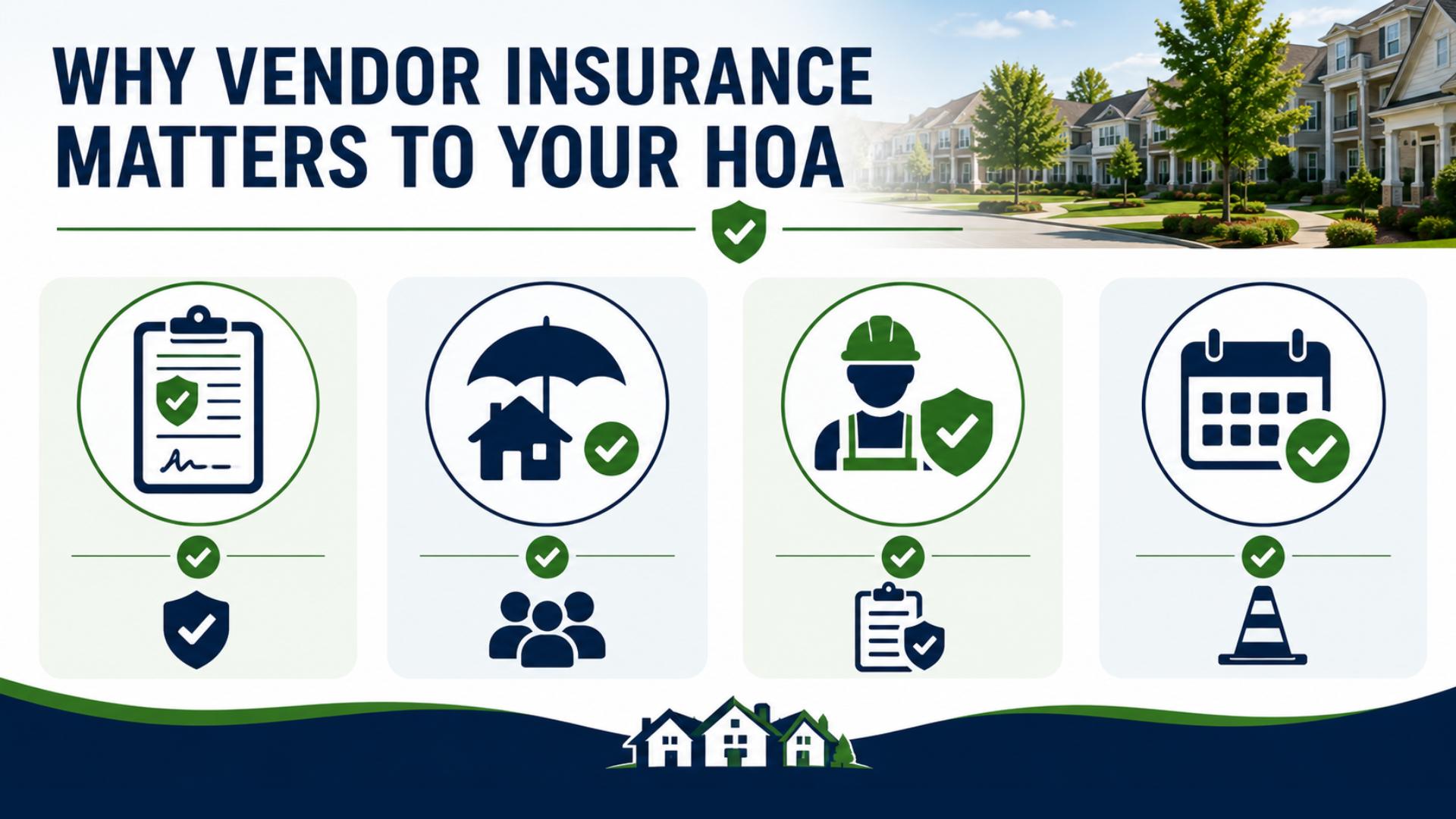
Before any contractor begins work in a common area, your board should require four things:
- A current certificate of insurance showing active general liability coverage
- The HOA named as an additional insured on the contractor's general liability policy
- Proof of workers compensation coverage if the contractor has employees
- Confirmation that coverage is active for the dates of the work being performed
These requirements should apply to every vendor without exception, regardless of the size of the job, how long the HOA has worked with the contractor, or how trusted the vendor is. The contractor your HOA has used for five years without incident is just as capable of causing a loss as a new vendor, and the board's liability exposure is the same either way.
Put these requirements in writing in your vendor approval process and in every service contract your HOA signs. A contract provision that states the contractor warrants they are properly insured and agrees to indemnify the HOA for any claims arising from their failure to carry required coverage gives the HOA an additional layer of contractual protection.
Understanding the Certificate of Insurance
A certificate of insurance, sometimes called a COI, is a one-page document issued by an insurance company that summarizes the key terms of a contractor's coverage. It lists the types of coverage the contractor carries, the policy limits for each, the policy effective and expiration dates, and the name of the certificate holder.
When reviewing a certificate of insurance, boards should confirm the following:
The named insured matches the contracting entity. The name on the certificate should match the legal name of the business you are contracting with. A certificate issued to a different entity name, even a similar one, may not apply to the work being done.
Coverage dates are current. The effective and expiration dates on the certificate should cover the entire period of work. A certificate that expires during a multi-month project provides no coverage for work done after the expiration date.
Coverage limits meet your minimums. Confirm that the general liability limits on the certificate meet the minimums your HOA requires. We cover specific minimums below.
The HOA is listed as an additional insured. The additional insured designation should appear on the certificate itself or on an attached endorsement. A certificate that simply lists the HOA as the certificate holder does not make the HOA an additional insured. These are different things with very different implications.
The certificate is issued directly by the insurer or a licensed broker. Certificates can be altered or fabricated. For significant contracts, consider calling the insurance company listed on the certificate to verify that the policy is active and the terms are accurate.
Why Additional Insured Status Matters
The difference between being a certificate holder and being an additional insured is significant and worth understanding clearly.
A certificate holder receives a copy of the insurance certificate for their records. That is all. Being a certificate holder does not give the HOA any rights under the contractor's insurance policy. If a claim arises, the HOA cannot make a claim directly on the contractor's policy as a certificate holder.
An additional insured is an entity that has been added to the contractor's insurance policy and has actual rights under that policy. If a claim arises from the contractor's work and the HOA is named as an additional insured, the HOA can be defended under the contractor's policy and covered for losses arising from the contractor's operations. This is a meaningful protection that certificate holder status does not provide.
Always require additional insured status, not just certificate holder status, for any contractor doing significant work in your community.
Coverage Minimums to Require
The right coverage minimums depend on the size and nature of the work being performed, but the following benchmarks are reasonable starting points for most HOA communities.
General liability insurance:
- Minimum $1 million per occurrence for routine maintenance contractors such as landscaping, cleaning, and pool service
- Minimum $1 million per occurrence, and preferably $2 million, for contractors doing structural, roofing, electrical, or plumbing work
- Minimum $2 million per occurrence for contractors working near or above buildings, power lines, or high-traffic areas
Workers compensation: Required for any contractor with employees. The minimum coverage should comply with your state's requirements. There is no minimum to negotiate here. Either the contractor carries it or they do not.
Professional liability (errors and omissions): Required for contractors providing professional services such as engineering assessments, legal advice, financial management, or design work. General liability does not cover professional errors, only general liability does not cover claims arising from professional negligence.
Umbrella coverage: For large-scale capital projects involving significant construction activity, boards may want to require an umbrella policy above the contractor's underlying limits. Consult with your HOA's insurance agent about appropriate minimums for major projects.
Your HOA attorney or insurance agent can advise on appropriate minimums for your specific community and the types of work you commonly contract. When in doubt, require more coverage rather than less. The cost of higher limits to the contractor is typically small, and the protection to the HOA is meaningful.
Workers Compensation Requirements
Workers compensation deserves specific attention because the consequences of a contractor not carrying it fall disproportionately on the HOA in many states.
When a contractor's employee is injured on your property and the contractor carries no workers compensation insurance, the injured worker may have legal claims against the HOA directly. Depending on the state, the HOA may be treated as a statutory employer, making it responsible for injury costs that should have been the contractor's obligation. The HOA's general liability policy may not cover this scenario.
The risk is not limited to contractors with employees on a payroll. A sole proprietor who works alone and is injured on your property may also have claims against the HOA if they do not carry their own workers compensation or occupational accident coverage.
Require proof of workers compensation coverage from every contractor who has employees. For sole proprietors, ask your HOA's insurance agent whether your policy provides any protection in that scenario or whether the HOA should require occupational accident insurance as an alternative.
For a full explanation of workers compensation requirements for HOAs, see our post on HOA workers' compensation insurance.
Tracking and Renewing Certificates
Requiring a certificate of insurance once is not enough. Certificates expire, and a contractor whose coverage was active when they started a project may be operating without coverage partway through it. Your board needs a system for tracking certificate expiration dates and requesting renewals before gaps occur.
A basic tracking system does not need to be complicated. A simple spreadsheet or document that lists each active vendor, their certificate expiration date, and the date a renewal request was sent is sufficient for most HOA communities. The key is that someone is responsible for maintaining it and reviewing it regularly.
For ongoing vendor relationships, require a new certificate at the start of each calendar year regardless of when the current certificate expires. This ensures that your files are current and gives you a natural annual touchpoint to confirm coverage minimums and additional insured status are still in place.
Store all certificates in your HOA document library in a location accessible to all board members. When a claim arises, the last thing you want is a certificate that only one board member has in their email inbox. Neighborhood.online's document storage makes it easy to keep vendor insurance records centrally organized and accessible to the full board at any time.
Common Mistakes Boards Make
These are the vendor insurance mistakes boards make most often, usually without realizing the exposure they are creating.
Accepting a certificate without verifying additional insured status. A certificate that does not list the HOA as an additional insured provides much less protection than boards typically assume. Always verify this specifically.
Allowing work to begin before receiving a certificate. Vendors who resist providing a certificate before starting work are a red flag. Reputable contractors with adequate coverage have no reason to delay providing one. Never allow work to begin without the certificate in hand.
Not updating certificates when coverage limits change. A contractor may renew their policy with different limits than the previous year. A certificate from 18 months ago does not reflect current coverage. Require fresh certificates annually for ongoing vendor relationships.
Accepting verbal assurances. A contractor telling you they are insured is not the same as providing proof. Require the document every time.
Not requiring certificates from small or infrequent vendors. The handyman who comes twice a year is just as capable of causing a significant loss as the landscaping company that is on-site weekly. Apply the requirement uniformly.
Not reviewing contracts for insurance language. A service contract that does not include insurance requirements and indemnification provisions leaves the HOA without important contractual protections even when the contractor carries adequate coverage. Have your HOA attorney review contract templates to ensure insurance language is included.
Action Steps for Your Board
- Create a written vendor insurance policy that defines what every contractor must provide before starting work
- Add insurance requirements and indemnification language to all HOA service contracts
- Build a vendor insurance tracking system that monitors certificate expiration dates
- Collect certificates from every active vendor and confirm additional insured status on each one
- Store all certificates in a central document library accessible to all board members
- Require annual certificate renewals for all ongoing vendor relationships
- Never allow work to begin without a current certificate on file
- Confirm workers compensation coverage for every contractor with employees
- Review coverage minimums with your HOA insurance agent annually
- Have your HOA attorney review service contract templates for adequate insurance language
Free Download: HOA Insurance Review Checklist
The vendor and contractor insurance section of this checklist walks your board through certificate requirements, additional insured status, and workers compensation verification. 49 items across 6 sections, free in PDF and Word.

If you want simple, modern, and free to start, you are in the right place.
We run your community.
Set up a complete community platform in under an hour. No developer required. No credit card needed. No accounting degree required.