Build Your HOA Website Free
Running an HOA is a big job for a volunteer.
Neighborhood.online gives your community a modern website, document storage, and communication tools in minutes.
No technical skills required.
Understanding HOA Insurance: What Is Covered and What Is Not

Updated June 22, 2026
- What Is HOA Insurance
- What the HOA Master Policy Covers
- What the HOA Master Policy Does Not Cover
- Who Covers Fixtures and Interior Improvements
- Bare Walls versus All-In Coverage
- Can an HOA Require Homeowners to Carry Insurance
- What Is a Loss Assessment
- What Homeowners Should Carry
- What This Means for Your Board
Keep Your Whole Community in the Loop
Homeowners trust boards that communicate clearly. A free Neighborhood.online website makes it easy to share meeting minutes, post updates, and give residents one place to find everything they need.
Build Your Free HOA WebsiteMost homeowners move into an HOA community with a general sense that the association handles insurance for shared areas and that their own policy covers the rest. That understanding is roughly correct but the details matter more than most people realize. When a pipe bursts in a shared wall, or a storm damages a roof, or someone slips in the parking lot, the question of which policy responds and who pays the deductible becomes very specific very quickly.
This guide explains what HOA insurance covers, what it does not, and what both boards and homeowners need to understand to avoid the gaps that cause the most conflict after a loss. It also answers one of the most common questions boards receive from residents: can the HOA require homeowners to carry their own insurance?
What Is HOA Insurance
HOA insurance, also called a master policy, is the insurance program the homeowners association carries to protect the community's shared assets and cover its liability exposure. It is funded through HOA dues and managed by the board, typically with the help of an insurance agent who specializes in community associations.
Unlike a single homeowner's policy, the HOA's master policy covers multiple buildings, structures, and common areas shared by all residents. The scope of what it covers depends on the type of community, the specific policy the HOA has purchased, and state law where applicable.
For a complete overview of all the policy types an HOA should carry, see our guide to HOA insurance types and real-life examples.
Not sure what your HOA's master policy actually covers?
The HOA Insurance Review Checklist walks your board through every policy type, coverage limit, and exclusion in one annual review. Free in PDF and Word.
What the HOA Master Policy Covers
The HOA master policy typically covers three categories of loss.
Common areas and shared structures. This is the core of what the HOA's property insurance covers. Common areas include walkways, parking lots, landscaping, entry gates, and any outdoor amenities the HOA maintains. Shared structures in a condominium community include the exterior of buildings, roofs, hallways, lobbies, stairwells, and any structural elements shared between units.
HOA-owned property and equipment. Any property the HOA owns outright is covered under the master policy. This includes clubhouse furniture and equipment, pool equipment, fitness center equipment, groundskeeping tools, and any other assets the association owns and maintains.
Liability in common areas. The HOA's general liability insurance covers the association's legal and financial responsibility when someone is injured in a common area or when HOA activities cause damage to someone else's property. This includes slip and fall accidents on walkways, injuries at the pool or playground, and property damage caused by HOA contractors. See our post on HOA general liability insurance for a detailed breakdown of what this coverage includes.
What the HOA Master Policy Does Not Cover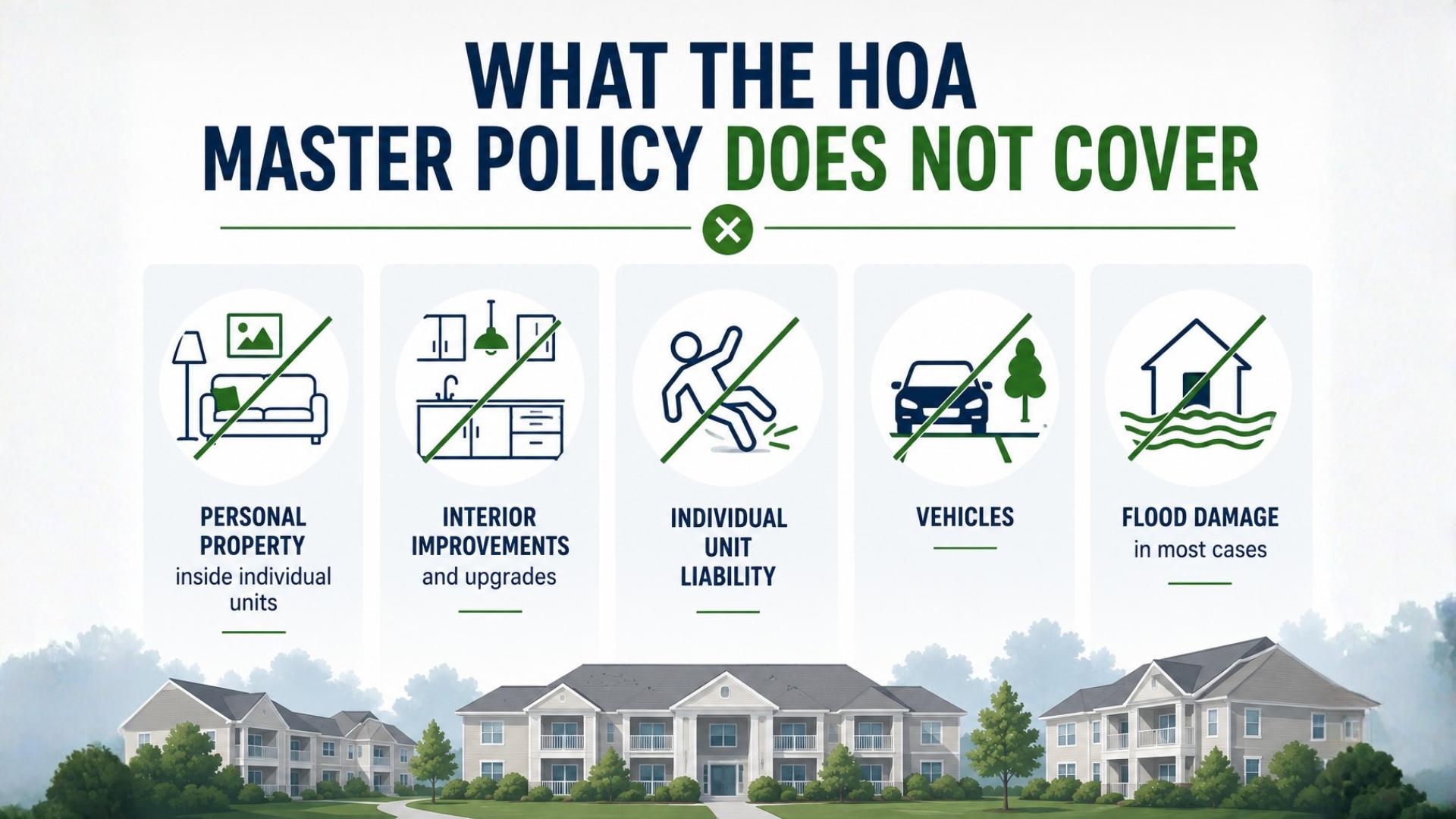
Understanding what the HOA's policy does not cover is just as important as understanding what it does. The most common sources of confusion and conflict after a loss are situations where a homeowner assumed the HOA's policy would respond and it did not.
Personal property inside individual units. The HOA's master policy does not cover a homeowner's furniture, electronics, clothing, appliances, or any other personal belongings inside their unit. If a pipe bursts and damages a homeowner's personal property, their own insurance policy is responsible for that loss.
Interior improvements and upgrades. If a homeowner has upgraded their kitchen cabinets, installed hardwood floors, or added custom fixtures since the unit was originally built, those improvements are not covered by the HOA's master policy in most cases. Whether those upgrades are covered depends on the type of master policy the HOA carries, which we explain in detail below.
Individual unit liability. If a guest is injured inside a homeowner's unit, or if a homeowner causes damage to a neighbor's unit, those claims fall to the homeowner's own policy, not the HOA's liability coverage.
Vehicles. The HOA's property policy does not cover damage to homeowners' vehicles, even if they are parked in a common area parking lot. A tree falling on a car in the HOA's parking lot is a claim on the vehicle owner's auto insurance, not the HOA's property policy.
Flood damage in most cases. Standard property policies, including HOA master policies, typically exclude flood damage. HOAs in flood zones need separate flood insurance for common areas, and homeowners need their own flood coverage for their units. This is a gap that catches many communities off guard after a significant weather event.
Who Covers Fixtures and Interior Improvements
One of the most frequently asked questions in condominium communities is who covers fixtures and interior improvements when something goes wrong. A homeowner installs new countertops and a custom tile backsplash. A water leak from the unit above causes damage. Whose insurance pays?
The answer depends on what type of master policy the HOA carries. There are two main structures.
Bare walls coverage means the HOA's policy covers only the building's structural elements: the framing, exterior walls, roof, and foundation. Everything inside the unit from the drywall inward is the homeowner's responsibility to insure. Under bare walls coverage, fixtures, flooring, cabinetry, and any improvements made by the homeowner or a previous owner are not covered by the HOA's policy.
All-in coverage (sometimes called all-inclusive or single entity coverage) means the HOA's policy extends to cover the original fixtures and finishes inside each unit as they were built by the developer. Built-in appliances, original flooring, cabinets, and plumbing fixtures would be covered. However, improvements made by individual homeowners beyond the original build-out are typically still the homeowner's responsibility.
Many HOA communities do not know which type of coverage they have. Boards should confirm this with their insurance agent and communicate it clearly to residents, because it directly affects what homeowners need to include in their own insurance policies.
Bare Walls versus All-In Coverage: A Practical Example
Here is a scenario that illustrates the difference. A pipe in a shared wall bursts and causes water damage to Unit 12. The original hardwood floors and kitchen cabinets are damaged. The homeowner also had custom tile installed after they moved in.
Under bare walls coverage: The HOA's policy pays to repair the wall and pipe. The hardwood floors, kitchen cabinets, and custom tile are all the homeowner's responsibility, covered by their own HO-6 policy.
Under all-in coverage: The HOA's policy pays for the wall, pipe, original hardwood floors, and original kitchen cabinets. The custom tile the homeowner added is still their responsibility.
In both cases, the homeowner's personal property (furniture, appliances they brought in, electronics) is their own responsibility regardless of the master policy type.
Can an HOA Require Homeowners to Carry Insurance
Yes, in most cases. HOA governing documents, typically the CC&Rs, can require homeowners to maintain a minimum level of individual insurance coverage as a condition of living in the community. This is increasingly common in condominium communities where the lines between HOA and individual unit coverage are most complex.
A requirement to carry insurance might specify that homeowners maintain an HO-6 policy with a minimum coverage amount, carry loss assessment coverage (explained below), or provide proof of insurance to the HOA upon request.
Whether your HOA can require homeowners to carry insurance depends on what your governing documents say. If your CC&Rs do not currently include an insurance requirement and your board wants to add one, that typically requires an amendment to the governing documents, which involves a homeowner vote. Consult your HOA attorney before making any changes to governing document requirements.
Even if your HOA does not require homeowners to carry insurance, boards should strongly encourage it. Homeowners without adequate individual coverage who experience a loss have fewer options and are more likely to look to the HOA for compensation they are not entitled to, which creates conflict and sometimes litigation.
What Is a Loss Assessment
A loss assessment is a charge the HOA passes on to individual homeowners to cover a shortfall between what the HOA's insurance pays out on a claim and the total cost of the loss. It can also be used to cover losses that fall below the HOA's deductible.
Here is a simple example. A storm causes $300,000 in damage to common area roofing. The HOA's property insurance policy has a $50,000 deductible. The policy pays $250,000 and the HOA must cover the remaining $50,000. If the HOA's reserves are not sufficient to cover that amount, the board may issue a special assessment to all homeowners to make up the difference.
Loss assessments can also arise from liability claims. If someone sues the HOA for an amount that exceeds the liability policy's coverage limits, the excess may be assessed to homeowners.
This is why loss assessment coverage matters for individual homeowners. An HO-6 policy with loss assessment coverage pays the homeowner's share of an HOA loss assessment up to the policy limit. Without it, a homeowner could receive a bill for thousands of dollars with little warning.
What Homeowners Should Carry
Every homeowner in an HOA community, and especially in a condominium, should carry their own individual insurance policy. The right coverage depends on the type of community and the HOA's master policy structure, but at minimum homeowners should consider the following.
An HO-6 policy is the standard individual insurance product for condominium owners. It covers personal property, interior improvements, and personal liability for incidents inside the unit. In a bare walls community, the HO-6 policy should be structured to cover all interior fixtures and finishes from the walls inward. In an all-in community, the HO-6 can be structured more narrowly around personal property and improvements the homeowner has made.
Loss assessment coverage is an add-on to the HO-6 policy that covers the homeowner's share of any loss assessment the HOA issues. Given that HOA deductibles can be substantial, this is one of the most practical and affordable additions a condo owner can make to their individual policy.
Flood insurance is worth considering for any homeowner in a flood-prone area, regardless of whether the HOA carries it for common areas. Individual unit flood coverage is separate from the HOA's flood policy.
Homeowners should review their individual policy at least annually, confirm it reflects the current master policy structure, and update it whenever they make significant improvements to their unit.
What This Means for Your Board
Boards have two responsibilities when it comes to the HOA versus homeowner insurance boundary. The first is making sure the HOA's own coverage is complete and current. The second is making sure residents understand where the HOA's coverage ends and their own begins.
The best boards communicate clearly about insurance at least once a year, typically at the annual meeting or in a community newsletter. A simple one-page summary of what the master policy covers, what type of coverage structure the HOA uses (bare walls or all-in), the current deductible amount, and what homeowners should carry themselves goes a long way toward preventing the confusion and conflict that follows a loss.
If your community does not have a clear written summary of this information, consider creating one and posting it in your HOA document library. It is one of the more useful things a board can do for residents and one of the simplest to produce.
For a complete checklist your board can use to review all HOA coverage annually, download the free HOA Insurance Review Checklist. It covers every policy type, coverage limit, exclusion, and vendor requirement in one structured review.


If you want simple, modern, and free to start, you are in the right place.
We run your community.
Set up a complete community platform in under an hour. No developer required. No credit card needed. No accounting degree required.