Build a free HOA website in minutes. No technical skills required.
HOA Pet Rules: What Boards Can Enforce and What Homeowners Need to Know

- What Pet Rules HOAs Can Legally Enforce
- Breed and Size Restrictions
- Emotional Support Animals and Service Animals
- When Pet Rules Get Broken: What Boards Should Do
- How to Write a Pet Policy That Actually Works
- Enforcing Pet Rules Fairly and Consistently
- What Homeowners Should Know
- How Technology Helps
Pets bring joy, companionship, and the occasional noise complaint. In HOA and condo communities, balancing pet ownership with community harmony means having clear, enforceable pet rules that everyone understands from the start.
HOA pet rules are one of the most common sources of disputes between boards and homeowners. They are also one of the areas where boards are most likely to run into legal trouble, particularly around emotional support animals and breed restrictions. This guide covers what boards can actually enforce, where the legal landmines are, and how to handle pet violations without turning neighbors into adversaries.

- About 66% of U.S. households own a pet, up from 56% in 1988, according to the American Pet Products Association.
- Dogs are the most common pet in HOA disputes, followed by cats and exotic animals.
- Pet-related complaints are among the top five most common HOA violation categories nationwide.
- Fair Housing Act complaints related to assistance animals have increased significantly over the past decade, making ESA policy one of the highest-risk areas for HOA boards.
What Pet Rules HOAs Can Legally Enforce
HOAs have broad authority to regulate pets within the community, but that authority has limits. Rules must be established in the governing documents, applied consistently, and cannot conflict with state or federal law.
Rules that HOAs can generally enforce include:
- Number limits. Restricting the number of pets per unit, such as a two-pet maximum, is enforceable in most states as long as the limit is in the CC&Rs or rules and regulations.
- Weight and size limits. Many communities set a weight ceiling, commonly 25 or 50 pounds. These are enforceable but create complications when pets grow beyond the limit after move-in, which boards need a policy for.
- Leash requirements. Requiring pets to be on a leash in all common areas is one of the most straightforward and enforceable pet rules.
- Waste disposal. Requiring owners to clean up after their pets and designating waste stations or disposal areas is standard and easy to enforce.
- Noise. Persistent barking or other animal noise that disturbs neighbors can be addressed under both pet rules and general nuisance provisions.
- Registration. Requiring homeowners to register pets with the HOA, including vaccination records, is common and gives the board a documented record of which animals are in the community.
- Exotic or prohibited species. Rules prohibiting farm animals, reptiles, or other non-traditional pets are generally enforceable.
Pet Policy Violation Notice Template
For situations involving more pets than allowed, unpermitted pet types, or failure to adhere to leash and waste disposal rules.
Breed and Size Restrictions
Breed restrictions are among the most controversial pet rules an HOA can adopt. Many communities prohibit specific breeds, most commonly dogs classified as aggressive or dangerous, including pit bulls, Rottweilers, Dobermans, and German Shepherds depending on the community.
Legally, breed restrictions in HOAs are generally enforceable as private contractual agreements as long as they are clearly written into the governing documents. They are not subject to the same constitutional limits that apply to government breed bans. However, several states have passed laws limiting or prohibiting breed-specific legislation, and some of those laws apply to HOAs. Colorado, for example, prohibits breed-specific rules in HOAs. Always check your state law before adopting or enforcing breed restrictions.
Size and weight limits raise a different practical problem. A homeowner who moves in with a 20-pound puppy may find themselves in violation two years later when the dog weighs 60 pounds. Boards need a written policy for this situation before it comes up, not after. Most communities handle it with a grandfathering provision: pets that were compliant at move-in are allowed to remain, but replacement pets must meet the current standard.
Emotional Support Animals and Service Animals
This is the area where HOA boards most commonly make costly mistakes. Emotional support animals (ESAs) and service animals are not pets under federal law, and the rules that apply to them are fundamentally different from your regular pet policy.
Service Animals
Under the Americans with Disabilities Act, a service animal is a dog (or in limited cases a miniature horse) trained to perform a specific task for a person with a disability. HOAs must allow service animals regardless of any no-pet policy, breed restriction, or size limit. Boards cannot require documentation or certification for service animals, though they can ask two questions: is this a service animal required because of a disability, and what work or task has the dog been trained to perform.
Emotional Support Animals
ESAs are governed by the Fair Housing Act, not the ADA. Under the FHA, a person with a disability may request a reasonable accommodation to keep an emotional support animal even if the community has a no-pet policy or restrictions that would otherwise apply. The key word is request: the homeowner must submit a written request and provide documentation from a licensed healthcare provider confirming the disability-related need.
Boards can and should have a written ESA accommodation request process. What boards cannot do is automatically deny ESA requests, apply pet fees or deposits to ESAs, enforce breed or weight restrictions against ESAs, or retaliate against homeowners who submit ESA requests.
The line between a legitimate ESA and an attempt to circumvent pet rules is a genuine challenge for boards. HUD guidance allows boards to request reliable documentation from a healthcare provider and to follow up if documentation appears fraudulent. What boards should not do is make that determination without legal guidance. When ESA requests are unclear or contested, consult your HOA attorney before responding.
When Pet Rules Get Broken: What Boards Should Do
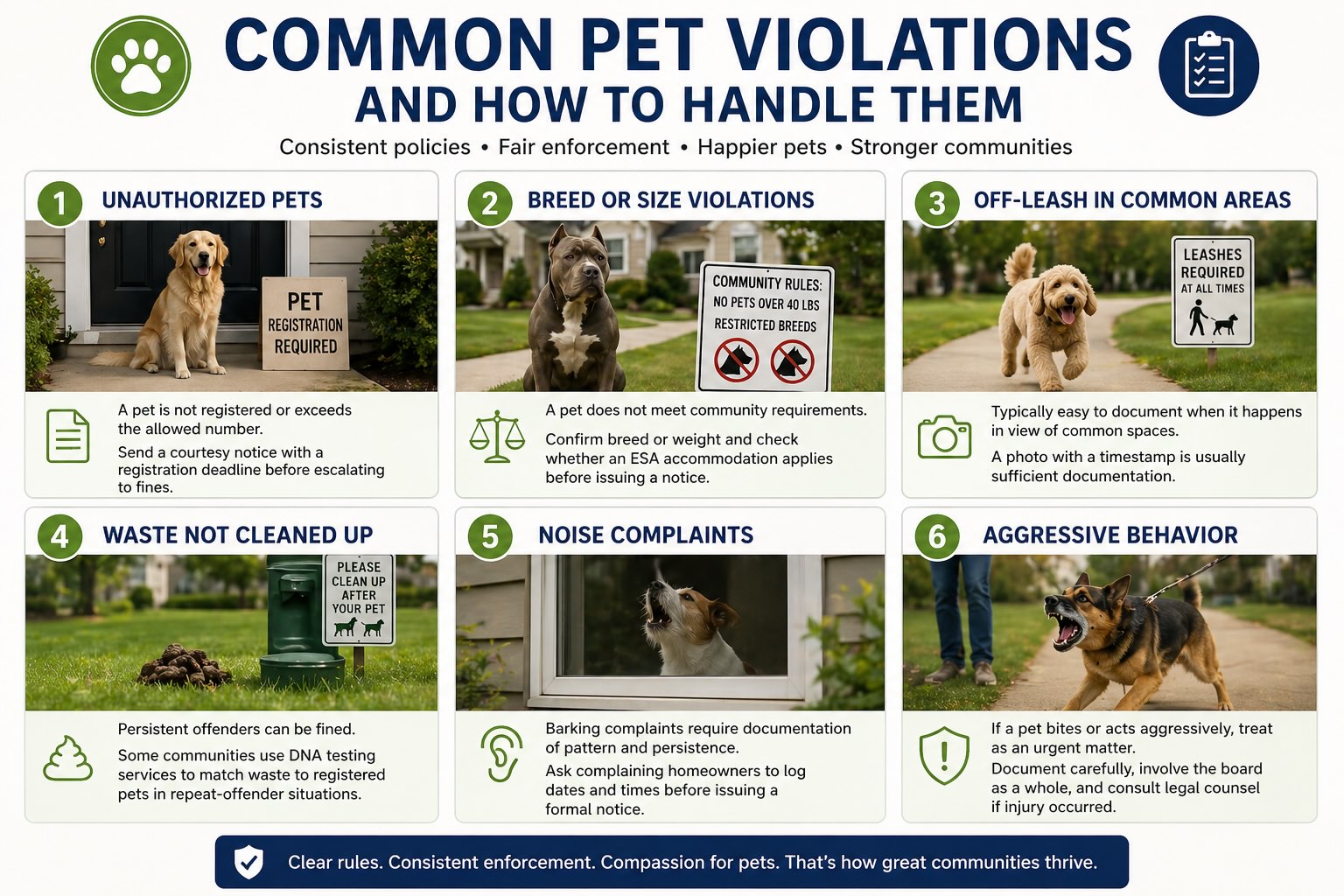
The most frequently cited pet violations in HOA communities fall into a predictable set of categories. Knowing what to expect makes it easier to have consistent policies in place before incidents happen.
- Unauthorized pets. A homeowner keeps a pet that was never registered or that exceeds the allowed number. Address with a courtesy notice and a registration deadline before escalating to fines.
- Breed or size violations. A pet does not meet community requirements. Before issuing a notice, confirm the breed or weight and check whether an ESA accommodation applies.
- Off-leash in common areas. One of the easier violations to document since it typically happens in view of common spaces. A photo with a timestamp is usually sufficient documentation.
- Waste not cleaned up. Persistent offenders in this category can be addressed with fines. Some communities use DNA testing services to match waste to registered pets in repeat-offender situations, though this approach works best in larger communities.
- Noise complaints. Barking complaints require documentation of pattern and persistence, not just a single incident report. Ask complaining homeowners to log dates and times before issuing a formal notice.
- Aggressive behavior. If a pet has bitten a resident or acted aggressively toward people or other animals, treat this as an urgent matter. Document carefully, involve the board as a whole, and consult legal counsel if injury occurred.
For all of these, the enforcement process follows the same structure as any other violation: written notice, cure period, hearing if the homeowner requests one, then fines if unresolved. Our complete guide to HOA violations covers that process in detail.
How to Write a Pet Policy That Actually Works
A good pet policy is specific enough to be enforceable but flexible enough to handle edge cases without requiring a board vote every time. Here is what a well-written pet policy covers:
- Permitted pet types. List what is allowed, not just what is prohibited. "Dogs and cats only" is clearer than a long list of prohibited species.
- Number limits. State the maximum per unit clearly, including whether multiple unit households have a higher limit.
- Weight and breed restrictions. If your community has them, state them explicitly. Include the grandfathering language if applicable.
- Registration requirements. Specify what documentation is required (vaccination records, photo), when it must be submitted, and what happens if a homeowner does not register a pet.
- Leash and common area rules. Be specific about which areas require leashes and whether there are designated off-leash areas.
- Waste disposal. State the expectation and the consequence for noncompliance.
- Noise and nuisance. Define what constitutes a nuisance and how complaints are handled.
- Accommodation process. Include a brief statement that homeowners with disabilities may request a reasonable accommodation for assistance animals and explain how to submit a request.
- Consequences for violations. Reference your fine schedule so homeowners know what noncompliance costs.
If your community's current pet policy is vague, outdated, or missing any of these elements, reviewing your governing documents with your HOA attorney is a good first step before making any changes.
Enforcing Pet Rules Fairly and Consistently
Pet violations are emotionally charged in a way that parking or landscaping violations usually are not. People have deep attachments to their animals. A board that handles pet enforcement heavy-handedly will generate conflict and resentment even when it is technically in the right.
A few principles that help:
- Lead with education, not punishment. Most first-time pet violations happen because the homeowner did not fully read the pet policy, not because they are deliberately defiant. A courtesy notice that explains the rule and gives a reasonable deadline to register or comply resolves most cases without conflict.
- Document everything. Photos, dates, and specific descriptions of the violation. This matters if the homeowner disputes the notice or requests a hearing.
- Apply rules equally. Selective enforcement of pet rules is a fast path to losing a dispute. If the rule applies, it applies to every unit. Board members' pets are not exempt.
- Check for ESA status before escalating. Before issuing a second notice or imposing a fine for a breed or size violation, confirm that no accommodation request is pending or on file.
- Keep a record of every registered pet and every accommodation request. This documentation is your protection if a homeowner challenges enforcement.
For boards dealing with repeat violations or escalating situations, our article on addressing repeat rule violations covers the escalation framework in detail.
What Homeowners Should Know
If you are a homeowner who has received a pet violation notice, or you are thinking about getting a pet in an HOA community, here is what matters most.
- Read the pet policy before you get a pet. Your governing documents or the HOA website should have the current rules. Asking the board before move-in is always a good idea.
- Register your pet. Most HOAs require it and failure to register is itself a violation even if the pet otherwise complies with community rules.
- If you have a disability-related need for an animal, submit a formal request. Your HOA is required to consider reasonable accommodation requests. Submit in writing and include documentation from a healthcare provider.
- Respond to violation notices in writing. If you disagree with a notice or need more time, put it in writing. This protects you if the situation escalates.
- You have the right to a hearing. Before any fine is imposed, you can request to appear before the board and present your side. Use it if you believe the notice was issued in error.
How Technology Helps Boards Manage Pet Rules
Keeping track of registered pets, outstanding violations, and accommodation requests across a community of any size is difficult to do on paper. Boards that manage this manually tend to end up with incomplete records, which creates problems when violations are disputed.
A platform like Neighborhood.online gives boards a central place to store pet registrations, track active violations, and maintain documentation of accommodation requests. When a homeowner disputes a fine and asks for the board's records, having everything organized and timestamped in one place is the difference between a five-minute conversation and a stressful scramble through email threads.
Neighborhood.online gives your board one place to track pet registrations, log violations, and store accommodation requests. Set up your community in minutes.
Start Your Free Demo
References
- American Pet Products Association. (2024). APPA national pet owners survey 2023-2024. https://www.americanpetproducts.org/research.asp
- U.S. Department of Housing and Urban Development. (2020). Assessing a person's request to have an animal as a reasonable accommodation under the Fair Housing Act. HUD FHEO-2020-01. https://www.hud.gov/sites/dfiles/PA/documents/HUDAsstAnimalNC1-28-2020.pdf
- U.S. Department of Justice. (2024). Frequently asked questions about service animals and the ADA. ADA.gov. https://www.ada.gov/resources/service-animals-faqs/
- U.S. Department of Housing and Urban Development. (2023). Fair Housing Act overview. https://www.hud.gov/program_offices/fair_housing_equal_opp/fair_housing_act_overview
- Colorado General Assembly. (2023). HB23-1279: Prohibit breed-specific legislation. https://leg.colorado.gov/bills/hb23-1279
- Community Associations Institute. (2023). Best practices report: Community association governance. Foundation for Community Association Research. https://www.caionline.org/LearningEvents/Research/Pages/BestPractices.aspx
- Nolo. (2024). HOA rules about pets: What's allowed and what's not. https://www.nolo.com/legal-encyclopedia/hoa-rules-about-pets.html