Build Your HOA Website Free
Neighborhood.online gives your community a modern website, document storage, and communication tools in minutes. No technical skills required.
HOA Violations: The Complete Board Guide

12 min read
In This Guide
- What Is an HOA Violation?
- The Most Common HOA Violations
- How the Violation Process Works
- Fines: What Boards Can Charge and How
- Writing Violation Notices That Actually Work
- Consistent Enforcement: The Board's Biggest Challenge
- What Homeowners Should Know
- How Technology Makes Violations Easier to Manage
HOA violations are one of the most uncomfortable parts of running a homeowners association. Nobody joined the board to tell a neighbor their lawn is too long or their fence is the wrong color. But here you are, and it comes with the job.
Done right, HOA violation enforcement protects property values, keeps the community looking its best, and makes sure everyone lives by the same set of rules. Done poorly, it creates conflict, exposes the board to legal risk, and makes neighbors into adversaries.
This guide covers everything your board needs to know about HOA violations: what they are, the most common types, how the enforcement process works, how fines work, and how to handle the whole thing in a way that keeps your community together rather than dividing it.
What Is an HOA Violation?
An HOA violation is any action, or failure to act, by a homeowner that conflicts with the community's governing documents. Those governing documents typically include the CC&Rs (Covenants, Conditions, and Restrictions), the bylaws, and any separately adopted rules and regulations.
In plain terms: if your community has a rule saying no basketball hoops in the driveway, and a homeowner installs one, that is a violation.
Violations are not criminal matters. They are contractual ones. When a homeowner buys into an HOA community, they agree to follow the rules in writing. The HOA has the authority to enforce those rules, send notices, and in most states, impose fines when violations go unresolved.
Most states require HOAs to follow a specific process before fines can be issued. That process varies by state, but it generally starts with written notice and an opportunity to cure, meaning the homeowner gets a reasonable window to fix the problem before any penalty is applied. If you want a deeper look at how CC&Rs work and what rules an HOA can actually enforce, our guide to CC&Rs covers that well.
The Most Common HOA Violations
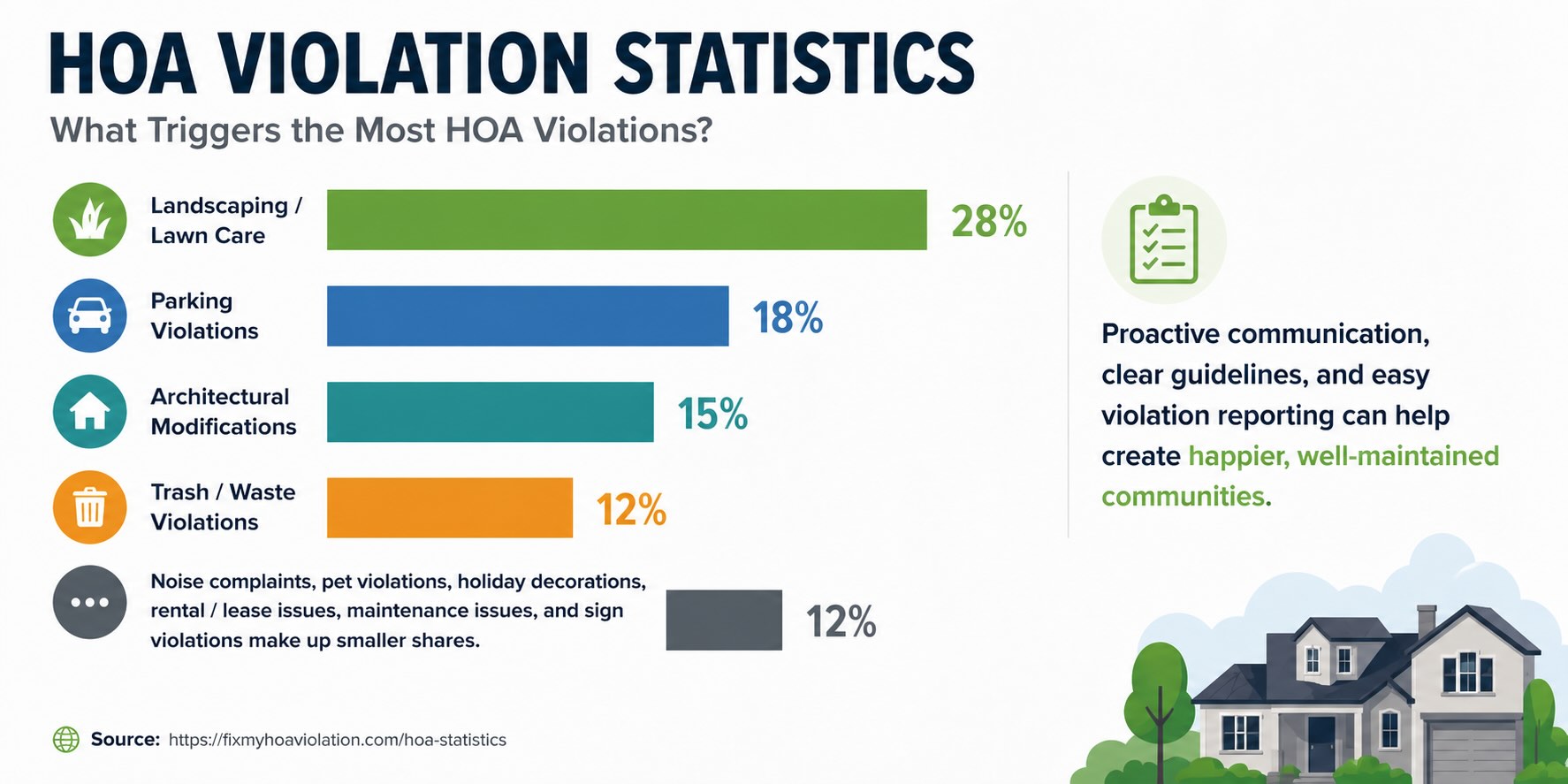
Most violations fall into a handful of predictable categories. If you are setting up a violation tracking system or training a new board member, these are the areas to focus on first.
Landscaping and Lawn Maintenance
This is the most common category by far. Overgrown grass, dead plants, weeds in visible areas, unapproved trees or shrubs, and flower beds that have gone to seed all fall here. Most communities set a maximum grass height (often 6 inches) and require regular upkeep of landscaping visible from the street.
Parking
Parking violations include cars parked in prohibited areas, vehicles blocking fire lanes, boats or RVs stored in driveways longer than allowed, inoperable vehicles left outdoors, and commercial vehicles parked overnight. Parking is one of the more emotionally charged categories because it directly affects neighbors.
Exterior Appearance
Peeling paint, damaged fencing, broken gutters, and unsightly outdoor storage all fall into this category. Many communities require board or architectural committee approval before homeowners paint, add structures, or make changes to the exterior of their home. Doing that work without approval is itself a violation, separate from whether the result looks acceptable.
Noise
Persistent noise violations (loud parties, barking dogs, early-morning construction) are common in townhouse and condominium communities where homes share walls. Fines for noise violations vary widely. Typical HOA fines for noise violations range from $25 to $200 for a first offense, depending on the community's fine schedule and state law.
Pets
Pet violations include keeping prohibited breeds, exceeding the number of allowed pets, letting pets run off-leash in common areas, and failing to clean up after animals. Our guide to HOA pet rules goes deeper on this one.
Short-Term Rentals
Communities with rules against platforms like Airbnb or Vrbo have seen a rise in rental violations over the past several years. This is an area where many older governing documents are silent or ambiguous, which creates enforcement challenges. See our piece on enforcing Airbnb rules in your HOA for a practical walkthrough.
Trash and Recycling
Bins left at the curb outside of collection windows, trash stored in front of the home, and bulk waste left on the lawn are consistent violation sources. Most communities require bins to be out of sight except on designated collection days.
How the Violation Process Works
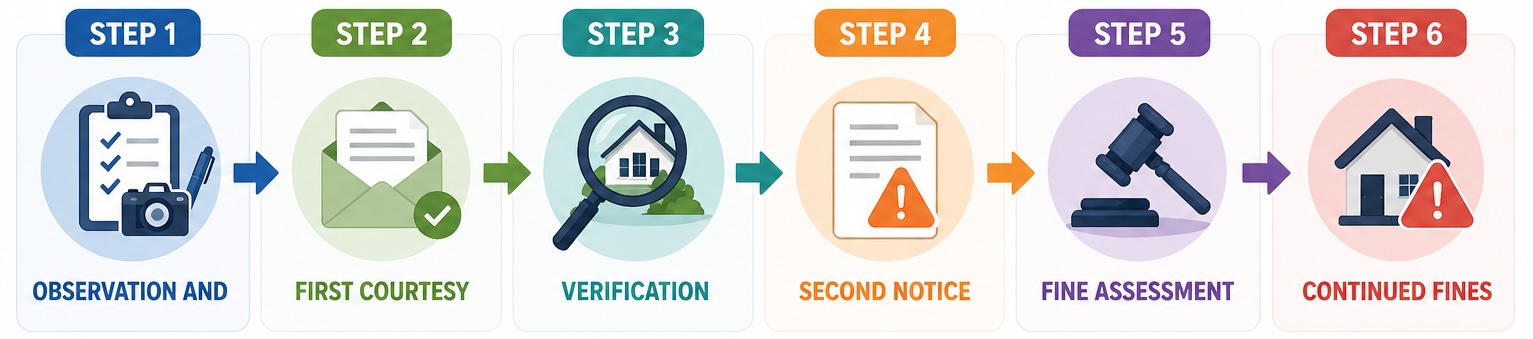
Most HOAs follow a tiered enforcement process. The exact steps vary depending on your state's HOA laws and your governing documents, but the general framework looks like this:
Not sure where to start?
Our violation letter templates walk you through each stage of the enforcement process.
- Step 1: Observation and documentation. A board member, property manager, or resident reports a potential violation. The board (or its designee) documents it with notes, photos, and a date. No notice goes out yet.
- Step 2: First courtesy notice. The homeowner receives a written notice describing the violation, the rule it violates (with the specific CC&R or bylaw section cited), and a reasonable timeframe to correct it. Fourteen to thirty days is typical for non-urgent violations.
- Step 3: Verification. After the correction window closes, the board verifies whether the violation has been resolved. If it has, the matter is closed and documented. If not, the process continues.
- Step 4: Second notice or fine notice. A second written notice informs the homeowner that the violation has not been corrected and that a fine will be assessed if it is not resolved within a new window, often 10 to 14 additional days.
- Step 5: Fine assessment and hearing. If the violation persists, the board imposes the applicable fine. Most states require the homeowner to be given the opportunity to appear before the board (a hearing) before the fine is levied. In Florida, for example, Florida Statute 720.305 requires a hearing before a fining committee before any fine over $50 takes effect.
- Step 6: Continued fines and escalation. For ongoing violations, fines may be assessed on a daily or per-occurrence basis up to the maximum allowed by the community's fine schedule and applicable state law. In serious or unresolved cases, the HOA may place a lien on the property.
The key principle throughout this process is due process. Homeowners have the right to know what the violation is, have time to fix it, and respond before any financial penalty is applied. Skipping steps does not save time. It creates grounds for the homeowner to challenge the fine and potentially expose the board to liability.
Fines: What Boards Can Charge and How
HOA fines are a tool for compliance, not a revenue stream. Boards that treat them as the latter tend to end up in disputes, and sometimes in court.
Are HOA Fines Enforceable?
Yes, in most states, HOA fines are legally enforceable as long as the board follows the proper process. The fine must be authorized by the governing documents, assessed after proper notice, and consistent with the community's published fine schedule. A fine issued without proper notice or for a violation not covered by the governing documents is much harder to enforce and easy to challenge.
Unpaid fines can eventually be added to a homeowner's account, reported to a collections agency, or in some states, secured by a lien on the property. However, most states restrict or prohibit HOAs from foreclosing solely due to unpaid fines (as opposed to unpaid assessments). Check your state's statutes before taking escalated collection action.
How Much Can HOAs Fine?
Fine limits vary by state and by what your governing documents allow. A few examples:
- California: A new law effective in 2025 caps HOA fines at $100 per violation for most first offenses, with specific requirements for notice and an opportunity to cure before the fine can be assessed.
- Florida: Fines may not exceed $100 per violation per day, and total fines may not exceed $1,000 for a single violation without a specific provision in the governing documents allowing more.
- Texas: Fine authority must be expressly authorized in the declaration. Without that language, fines may not be enforceable.
Beyond what state law allows, your community also needs a published fine schedule, a document that spells out exactly what each type of violation costs and how fines escalate over time. Without that schedule, inconsistent fining creates legal exposure.
What Happens If a Homeowner Does Not Pay?
Unpaid fines typically accrue on the homeowner's account along with any interest or late fees allowed by the governing documents. The board can report the balance to a collections agency, pursue small claims court for smaller amounts, or in some states and situations, place a lien on the property. Before escalating, make sure you have complete documentation of every notice sent, every cure period offered, and the homeowner's opportunity to be heard.
Download our free violation letter templates, including first notice, second notice, and final notice language
Writing Violation Notices That Actually Work
The way you write a violation notice determines whether the homeowner sees it as a reasonable reminder from a neighbor or an adversarial demand from a bureaucracy. Most violation notices fail not because they are wrong but because they are cold.
What Every Violation Notice Must Include
Regardless of tone, a compliant violation notice needs to include:
- The homeowner's name and property address
- The date of the notice
- A clear description of the violation
- The specific rule being violated, cited by section
- What the homeowner needs to do to resolve it
- The deadline for resolution
- Contact information for questions or to dispute the notice
Some states have additional requirements. Florida, for example, requires notices to be sent to the homeowner's address of record. Texas Property Code Section 209.006 specifies what must be included in a notice before a fine can be imposed.
Tone Matters More Than You Think
The most effective violation notices are firm, specific, and respectful. They explain the rule clearly, give the homeowner a fair window to fix the problem, and leave room for the homeowner to respond if there is a misunderstanding. A notice that opens with "You are in violation of Section 4.2(b)" lands differently than one that opens with "We noticed your lawn has grown past the community's maintenance guidelines. Here is what needs to happen before [date]."
Both convey the same information. The second one is far less likely to generate a hostile response or a dispute. For a deeper look at tone, timing, and ready-to-use templates, see our guide to writing violation notices that reduce conflict.
This is technically correct but reads like a legal threat. Most homeowners who receive a letter like this go immediately on the defensive.
A better approach
Dear [Homeowner Name],
We hope you are well. This is a friendly reminder about a community guideline that needs your attention at [Property Address].
The item we noticed:
[Describe the violation and the authority for claiming it is a violation clearly and simply. Example: A vehicle is parked on the front lawn, which is not permitted under Section 4.2 of the Community Rules.]
This covers the same legal ground and gives you the same paper trail. It also sounds like it was written by a person.
Consistent Enforcement: The Board's Biggest Challenge
Selective enforcement is one of the most common legal risks HOA boards face, and it is almost always unintentional. It happens when the board enforces a rule against one homeowner but not another who is doing the same thing, or when enforcement is applied inconsistently over time.
Courts have found that selective enforcement can void a fine entirely, and in some cases, has been used as the basis for discrimination claims under the Fair Housing Act. The risk is real and worth taking seriously.
How to Enforce Consistently
- Use a written fine schedule and apply it the same way every time. If the first offense for a parking violation is a $50 fine, that applies to every homeowner equally, every time.
- Document every violation the same way: date, description, photos, the rule cited. If you can only demonstrate enforcement for some homeowners, a dispute will not go well.
- Conduct inspections systematically. Whether you inspect every property monthly or only respond to complaints, apply the same standard to everyone. Targeting specific properties creates exposure.
- Recuse board members from enforcement decisions that involve their immediate neighbors or people they have a personal dispute with.
- Keep records for at least three years. If a homeowner disputes a fine or challenges enforcement, you want documentation that shows a consistent pattern.
If your board is struggling with inconsistent enforcement or unclear rules, our piece on HOA selective enforcement covers the legal landscape and practical strategies in more detail.
What If a Board Member Violates the Rules?
Board members are homeowners too, and they are subject to the same rules as everyone else. A board member who is in violation should receive the same notice any other homeowner would receive. The rest of the board handles the enforcement, and the board member in question recuses themselves from any vote related to their own violation. This is uncomfortable but necessary. A board that exempts itself from its own rules will lose homeowner trust quickly and face claims of selective enforcement.
What Homeowners Should Know
If you are a homeowner who has just received a violation notice, here is the short version of what you need to know.
- You have rights. You are entitled to notice, a reasonable window to fix the problem, and the opportunity to be heard before any fine is imposed. If your board is skipping those steps, that is worth raising.
- Read the notice carefully. Find out exactly which rule is being cited and whether the description matches your situation. Sometimes notices go out based on incomplete information or a misidentified property.
- Respond in writing. If you disagree with the violation or need more time, respond in writing, not just verbally. This protects you if the situation escalates.
- You can dispute it. Most HOAs have a formal dispute or appeal process. If you believe the notice was issued in error or the rule itself is being applied unfairly, you can request a hearing. Our guide on responding to an HOA violation letter walks through how to do this constructively.
- Ignoring it will not make it go away. Unresolved violations lead to fines. Unpaid fines lead to collections. Responding promptly, even if you disagree, is almost always the better path.
How Technology Makes Violations Easier to Manage
Managing violations manually, using spreadsheets, email threads, and paper files, works fine for a small community, but it gets complicated fast. When you are tracking 30 open violations across 200 homes, a spreadsheet does not tell you which ones are overdue, which homeowners have a history of repeat violations, or whether you sent the second notice for Unit 114.
Platforms like Neighborhood.online give boards a central place to communicate common violations, store documentation like photos and notice copies.
Putting It All Together
HOA violations are not the most enjoyable part of community governance, but they are one of the most important. A community that enforces its rules fairly and consistently protects property values, reduces neighbor conflicts, and builds trust between the board and homeowners. One that enforces selectively, skips due process, or ignores violations creates the exact problems it was trying to prevent.
The fundamentals are simple: know your rules, document everything, communicate clearly, and treat every homeowner the same way. The board that gets those four things right handles violations without drama and spends more of its time on the things that actually make a neighborhood a good place to live.
References
- California Legislative Information. (2024). Assembly Bill 2460: Common interest developments: association governance: fines and penalties. California State Legislature. https://leginfo.legislature.ca.gov/faces/billNavClient.xhtml?bill_id=202320240AB2460
- Community Associations Institute. (2023). Statistical review for U.S. homeowners associations, condominium communities, and housing cooperatives. CAI Research Foundation. https://www.caionline.org/LearningEvents/Research/Pages/StatisticalReview.aspx
- Florida Legislature. (2024). Florida Statutes § 720.305: Member rights; meetings of members; voting and election procedures; amendments. The Florida Senate. https://www.flsenate.gov/Laws/Statutes/2024/720.305
- Florida Legislature. (2024). Florida Statutes § 718.303: Obligations of owners and occupants; remedies. The Florida Senate. https://www.flsenate.gov/Laws/Statutes/2024/718.303
- Texas Legislature Online. (2023). Texas Property Code § 209.006: Notice required before enforcement action. Texas Legislature. https://statutes.capitol.texas.gov/Docs/PR/htm/PR.209.htm
- Texas Legislature Online. (2023). Texas Property Code § 209.0056: Fine policy. Texas Legislature. https://statutes.capitol.texas.gov/Docs/PR/htm/PR.209.htm
- U.S. Department of Housing and Urban Development. (2023). Fair Housing Act: Prohibited conduct and exemptions. HUD. https://www.hud.gov/program_offices/fair_housing_equal_opp/fair_housing_act_overview
- Foundation for Community Association Research. (2022). Best practices report: Community association governance. Community Associations Institute. https://www.caionline.org/LearningEvents/Research/Pages/BestPractices.aspx
- Arizona Revised Statutes. (2023). A.R.S. § 33-1803: Penalties for violation of prohibition; notice and opportunity to be heard. Arizona State Legislature. https://www.azleg.gov/ars/33/01803.htm
Want a plug-and-play starting point?
Download our free violation notice templates and adapt them to your community's fine schedule.


If you want simple, modern, and free to start, you are in the right place.
We run your community.
Set up a complete community platform in under an hour. No developer required. No credit card needed. No accounting degree required.