Build Your HOA Website Free
Neighborhood.online gives your community a modern website, document storage, and communication tools in minutes. No technical skills required.
Georgia HOA Law SB406 2026: What Board Members Need to Know

Running an HOA in Georgia just got a little more complicated, and a lot more accountable. In 2026, Georgia lawmakers passed the first universal HOA rules in state history. Governor Brian Kemp signed the Georgia Property Owners' Bill of Rights Act, known as SB406, into law on May 12, 2026. If you serve on an HOA board in Georgia, this new Georgia HOA law is not something you can set aside. It affects how you register your association, how you handle dues, how you enforce rules, and what rights your homeowners now have by law. Most provisions take effect January 2027, giving you time to prepare, but not to ignore it.
This post answers the questions boards are asking right now, using the actual bill language, not just the headlines.
What Is SB406 in Georgia?
SB406 is the Senate Bill that became the Georgia Property Owners' Bill of Rights Act. It is the first statewide law to govern homeowners associations uniformly across Georgia. The bill was sponsored by Senator Matt Brass (R-Newnan) and co-sponsored by Senator Donzella James (D-Atlanta), who had been working on HOA oversight legislation for five years. The Georgia Senate passed it unanimously in March 2026, and Governor Kemp signed it into law on May 12. The bulk of the law takes effect January 2027 to give the Secretary of State's office time to set up the necessary infrastructure.
Here is what the law actually does, pulled directly from the bill text:
Registration with the Secretary of State is now required. Every HOA operating under the Georgia Property Owners' Association Act must register annually with the Secretary of State. Registration requires submitting the association's name, address, and officer information, along with a financial statement dated no more than one year prior to filing. The annual fee is $100. Registration statements expire December 31 each year and must be renewed.
Unregistered associations lose their enforcement tools. An HOA that does not register cannot collect fines or fees, issue liens, or initiate foreclosure proceedings. There is an opt-out provision, but it comes at a steep price: associations that file written notice electing not to register are classified as nonregistered property owners' associations and are permanently prohibited from collecting fines or fees.
Records must be kept for 10 years. All records related to dues, assessments, fines, fees, liens, and foreclosures must be maintained for a minimum of 10 years at an office located in Georgia. The Secretary of State can examine these records at any time.
The foreclosure threshold has been raised. Under the old law, an HOA could pursue foreclosure once a homeowner owed $2,000 in unpaid assessments. Under SB406, the minimum is now the lesser of $4,000 or 12 months of dues in arrears, and that amount cannot be less than $2,000. The bill specifies that no portion of that amount may include collection fees or fines. Fines and fees do not count toward the foreclosure threshold. The lien for assessments also now lapses after six years rather than the previous four years.
A five-person State Review Board has been created. The State Board for Review of Complaints Regarding Property Owners' Associations is established within the Secretary of State's office, with five members appointed by the Governor (three), the President of the Senate (one), and the Speaker of the House (one). Members must be HOA members themselves, and no two may belong to the same association. The board meets at least quarterly, and meetings are open to the public virtually.
Homeowners can now file formal complaints. Any resident who believes they have been damaged by their HOA's action or inaction may file a written complaint with the board within 180 days of the incident. The board investigates and can hold hearings, impose civil fines, and issue cease and desist orders. If a settlement is not reached within 15 days of the board's conclusions, any party can bring an action to enforce the claim.
Payment application order is now mandated by law. The law sets the priority for how HOA payments must be applied: dues first, then fees, then fines. Associations cannot apply a payment to fines while leaving dues unpaid, a tactic that had been used to keep homeowners perpetually delinquent.
For the full text of the law as passed by the Senate, the bill is available on the Georgia General Assembly legislation page. The enrolled Senate text used for this post is available here.
What Is the Homeowners Bill of Rights in Georgia?
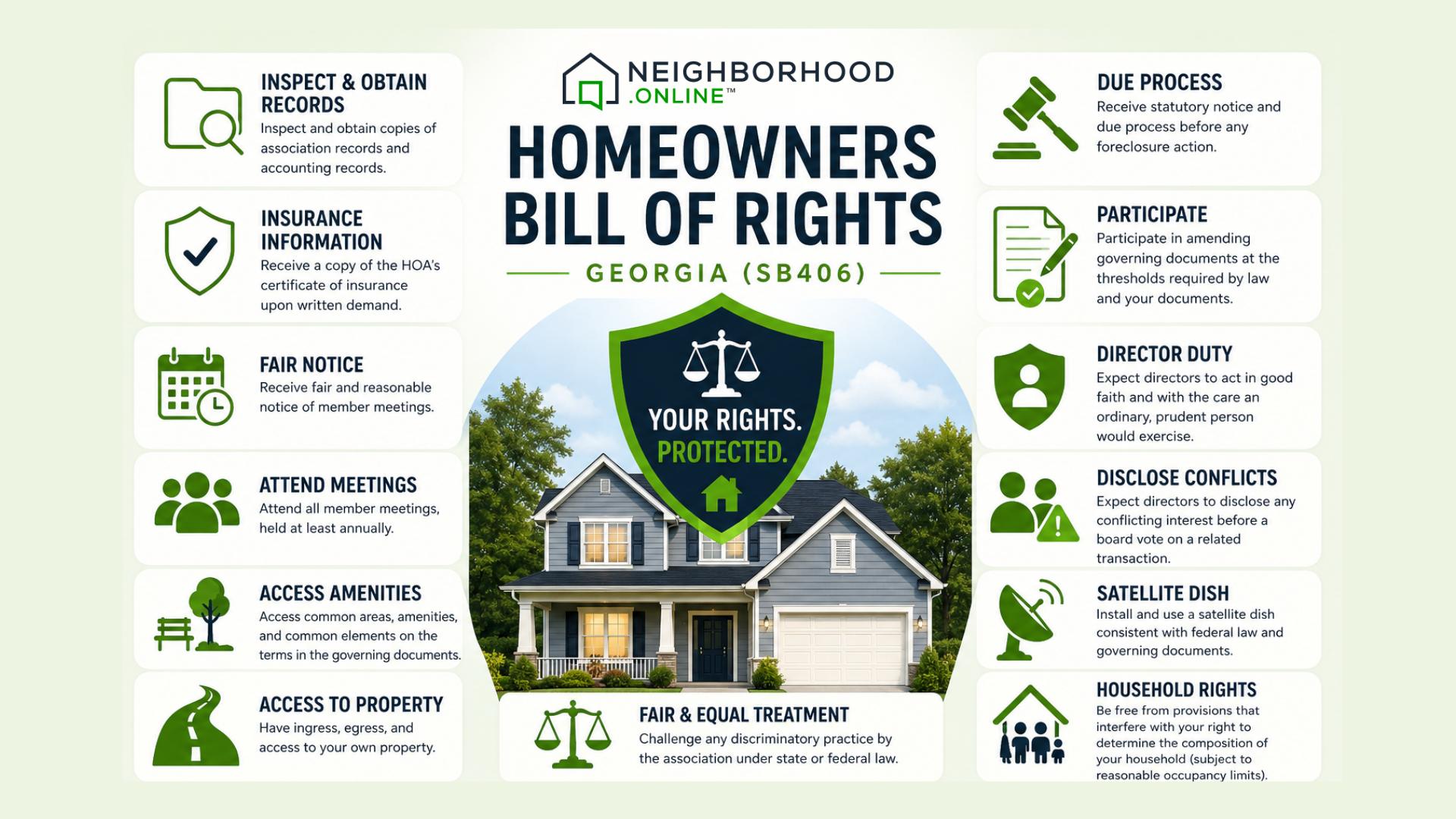
The Homeowners Bill of Rights is a specific section of SB406, found at Code Section 43-17A-7. Before this legislation, homeowner rights in Georgia varied entirely by what each community's governing documents said. Now there is a statewide legal floor. Every owner in a Georgia HOA has the right to:
- Inspect and obtain copies of the association's records, accounting records, and other records upon written demand, consistent with governing documents and state law
- Receive, upon written demand, a copy of the HOA's certificate of insurance for coverage that applies to the owner
- Receive fair and reasonable notice of member meetings, consistent with governing documents
- Attend all member meetings, which must be held at least annually
- Access common areas, amenities, and common elements on the terms in the governing documents
- Have ingress, egress, and access to their own property
- Receive statutory notice and due process before any foreclosure action is taken against their property
- Participate in amending governing documents at the thresholds required by law and the governing documents
- Expect directors to act in good faith and with the care an ordinary, prudent person would exercise
- Expect directors to disclose any conflicting interest before a board vote on a related transaction
- Install and use a satellite dish consistent with the federal Telecommunications Act of 1996, the Over-the-Air Reception Devices Rule, and governing documents
- Be free from governing document provisions that interfere with their right to determine the composition of their household, subject to reasonable occupancy limits
- Challenge any discriminatory practice by the association under state or federal law
For HOA boards, these are no longer just best practices. They are legal obligations. A homeowner who is denied record access or excluded from a meeting now has a formal state mechanism to escalate the complaint to the Review Board. Clear and consistent HOA communication practices are the simplest way to stay ahead of this.
What Are the Rights of a Homeowner in Georgia?
Beyond the new HOA-specific protections in SB406, Georgia homeowners have a range of legal rights worth understanding.
Property rights. Georgia homeowners have the right to use, enjoy, and exclude others from their property. This includes the right to ingress and egress, which SB406 now explicitly protects within the HOA context.
Satellite dish rights. The new law codifies a homeowner's right to install a satellite dish in compliance with federal law. HOA governing documents cannot prohibit this outright, only regulate installation in ways that comply with federal rules.
Anti-discrimination rights. The Homeowners Bill of Rights explicitly protects owners' right to challenge discriminatory practices by their association under state or federal law, including fair housing protections.
Property tax rights. Georgia homeowners have the right to appeal their property tax assessment each year within 45 days of the mailing date of the annual Notice of Assessment. Governor Kemp also signed Senate Bill 33 in May 2026, which caps annual property tax valuation increases at the rate of inflation for qualifying homesteads. More on that in the tax section below.
Enforcement rights. Before any HOA fine or lien can move toward foreclosure, the law now mandates specific notice requirements, a 30-day opportunity to pay, and clear documentation of fees. A judge must also make a reasonableness finding before attorney's fees can be awarded in a collection case. Good HOA financial transparency practices help boards demonstrate compliance at every step.
What Is the New Tax Law in Georgia 2026?
While SB406 covers HOA governance, Georgia homeowners are also dealing with two other major laws signed by Governor Kemp in May 2026 that directly affect household finances.
Senate Bill 33, the Homeownership Opportunity and Market Equalization Act of 2026, addresses rising property taxes. The law caps annual increases to taxable property values at the rate of inflation for qualifying homesteads, making a statewide version of the floating homestead exemption permanent and mandatory. It also creates a new Local Homestead Option Sales Tax (LHOST), which allows local governments to place a 1% sales tax measure on local ballots beginning in 2028. If approved by voters, revenue from that tax can only be used to offset property taxes for qualifying homeowners. The law has drawn constitutional challenges from some legislators who argue that revenue-raising bills must originate in the House, not the Senate, so boards should monitor developments.
House Bill 463, the Georgia Economic Growth and Tax Relief Act of 2026, cuts the state income tax rate from 5.19% to 4.99% effective January 1, 2026, with provisions for annual reductions of 0.125% until the rate reaches 3.99%, provided the state meets specific revenue targets. The standard deduction for married couples filing jointly rises from $24,000 to $30,000 with annual increases, and the per-dependent deduction increases from $4,000 to $5,000. The law also creates a temporary income tax exemption on the first $1,750 in overtime pay and cash tips through 2028.
For HOA boards, the practical takeaway is that your homeowners are going to be more financially engaged in 2026 and 2027 than they have been in years. If your community is also navigating dues increases or special assessments alongside these changes, proactive communication is essential.
What Is the 7-Year Fence Law in Georgia?
This comes up often in neighborhood disputes, so it deserves a plain explanation.
Georgia does not have a law specifically called the 7-year fence law. What Georgia does have is an adverse possession statute that includes a seven-year provision. Under Georgia Code Section 44-5-164, a person who possesses real property under written evidence of title, called color of title, for seven continuous years can establish legal ownership by prescription. Without written evidence of title, the standard adverse possession period in Georgia is 20 years.
The fence connection comes from Georgia Code Section 44-5-161, which states that acquiescence by adjoining landowners for seven years, through acts or declarations, can be sufficient to establish a dividing line. In practical terms: if a fence has stood in a particular location for seven years and both neighbors have treated it as the property line without dispute, a court may recognize that line as legally established, even if a new survey shows it differs slightly from the recorded boundary.
What this means for HOA communities. Disputes over fence locations within planned communities are typically governed by the HOA's governing documents first. Your CC&Rs, plat map, and any recorded easements take precedence. However, the seven-year acquiescence principle can still apply in disputes between individual homeowners within your community, which is why boards sometimes get drawn into these conversations even when they are not technically a party. If a boundary dispute arises, encourage the homeowners involved to consult a Georgia real estate attorney and get a survey done before seven years pass.
How HOA Boards Should Respond to SB406
Here is a practical compliance checklist based on what the law actually requires.
Register with the Secretary of State before January 2027. The Secretary of State's office is building out the registration infrastructure now. Watch for guidance on the specific forms and process. Set a calendar reminder for Q4 2026 to complete your registration, gather your prior year financial statement, and pay the $100 fee.
Appoint someone responsible for records retention. The 10-year records requirement is specific. Dues, assessments, fines, fees, liens, and foreclosure records all need to be maintained at a Georgia address. Designate a board member or property manager as the records custodian and make sure the address is documented for the Secretary of State.
Review and update your collections policy. Your written policy must reflect the new foreclosure threshold: the lesser of $4,000 or 12 months of dues in arrears, with a minimum of $2,000, and fines and fees cannot count toward that threshold. If your current policy does not reflect this, update it before January 2027. This is also a good time to document your payment application order: dues first, then fees, then fines.
Audit your enforcement procedures. Before any fine is issued, what notices go out? How much time does the homeowner get to respond? Is everything in writing? Walk through a hypothetical violation start to finish and make sure each step is documented. The complaint process through the new Review Board means enforcement missteps now have a clear escalation path.
Prepare to share the Homeowners Bill of Rights with your community. When the law takes effect, homeowners will have rights they may not know about yet. Getting ahead of that with clear communication builds trust and reduces the number of residents who discover their rights through a dispute rather than through your board.
How Technology Can Help
One thing SB406 makes very clear is that informal HOA management is a liability. When enforcement actions, financial records, and meeting notices live in email threads and someone's personal filing cabinet, it is nearly impossible to demonstrate compliance when you need to.
Platforms like Neighborhood.online are built for exactly this situation. Centralized document storage means your financial statements, meeting minutes, governing documents, and updated policies are accessible and dated, not scattered across board members' personal accounts. Built-in communication tools create a documented record of notices sent to homeowners, which matters considerably when a dispute reaches the Review Board and you need to show that proper notice was given. If your community is still running on informal systems, the compliance requirements in SB406 are a clear reason to get organized before the January 2027 deadline.
Conclusion
SB406 is not a reason to panic. It is a reason to get organized. Georgia has created the first real statewide framework for HOA accountability, and most of what it requires is what thoughtful boards should already be doing: keeping records, giving proper notice, applying payments fairly, and respecting homeowners' rights to information and participation.
Three things to do before the end of 2026:
- Prepare your registration materials for the Secretary of State's office
- Review your collections policy, enforcement procedures, and records retention practices against what the law now requires
- Share the Homeowners Bill of Rights with your community proactively, in plain language, before they read about it somewhere else
The full text of SB406 is available on the Georgia General Assembly legislation page. Additional coverage can be found at Atlanta News First, WCTV, and Realtor.com.