Build Your HOA Website Free
Running an HOA is a big job for a volunteer.
Neighborhood.online gives your community a modern website, document storage, and communication tools in minutes.
No technical skills required.
The HOA President’s Responsibilities

Set Up Your Free HOA Website in Minutes
Give your community a home base online. Share announcements, post documents, and keep homeowners informed with a free Neighborhood.online website built specifically for HOAs.
Create Your Free WebsiteIf you recently became an HOA board president, you may already be wondering what exactly you signed up for. The HOA board president responsibilities are broader than most people expect, and the learning curve can feel steep when you are a volunteer trying to balance this role alongside a full-time job and a regular life.
The good news is that this role does not require you to be a lawyer, an accountant, or a professional property manager. It does require you to be organized, fair, and willing to communicate clearly with your neighbors. This guide walks you through what the job actually involves, why it matters, and how to handle it without burning out.
What the HOA Board President Role Actually Is
Think of the HOA board president as the person who keeps everything moving. While the board as a whole makes decisions, the president makes sure those decisions get made in an orderly way. They run the meetings, sign the documents, represent the community when needed, and make sure the rest of the board is working together effectively.
A useful comparison: the president operates a bit like a CEO, but without the salary. The board is like a small executive team, and the president is responsible for keeping that team focused and functional.
Here is what that looks like in practice. Imagine Maplewood HOA has 80 homes. The board has five members. When a vendor submits a contract for new landscaping, the president reviews it with the board, signs it once approved, and follows up to make sure the work gets done. When two neighbors have a dispute about a fence that crosses a property line, the president is usually the one who steps in to mediate or direct the situation through the right process. When dues need to go up by 8 percent next year, the president works with the treasurer to communicate that news to homeowners in a way that does not cause a meltdown at the next meeting.
Why These Responsibilities Matter for Your HOA
A lot of what can go wrong in an HOA traces back to unclear or absent leadership at the top. When the president is disengaged, meetings drift, decisions stall, and homeowners stop trusting the board. When the president overreaches, acting unilaterally or skipping the rest of the board, you end up with legal exposure and unhappy neighbors.
Some of the most common problems boards run into include:
- Meetings that have no clear agenda and run for two hours without reaching any decisions
- Contracts signed without proper board approval
- Governing documents that are rarely consulted, leading to inconsistent rule enforcement
- Homeowners who feel left out of the loop and become adversarial
- Financial oversight gaps when the president and treasurer are not communicating regularly
None of these problems are inevitable. They tend to happen when the president does not have a clear sense of the role or lacks simple systems to stay on top of things. Understanding the scope of your responsibilities is the first step toward running a community that actually works well.
It is also worth noting that the president is distinct from the treasurer. Many new board members blur these roles. The president oversees the big picture of financial health, signs off on major decisions, and collaborates with the treasurer, but does not typically manage the day-to-day accounting or dues collection. If you want a clear breakdown of how those two roles divide responsibility, the guide on HOA board responsibilities and leadership roles is a useful reference.
Keep Your Whole Community in the Loop
Homeowners trust boards that communicate clearly. A free Neighborhood.online website makes it easy to share meeting minutes, post updates, and give residents one place to find everything they need.
Build Your Free HOA WebsiteHow HOA Board Presidents Should Handle Their Key Duties
Here is a practical breakdown of the core responsibilities and how to approach each one.
Running Meetings Well
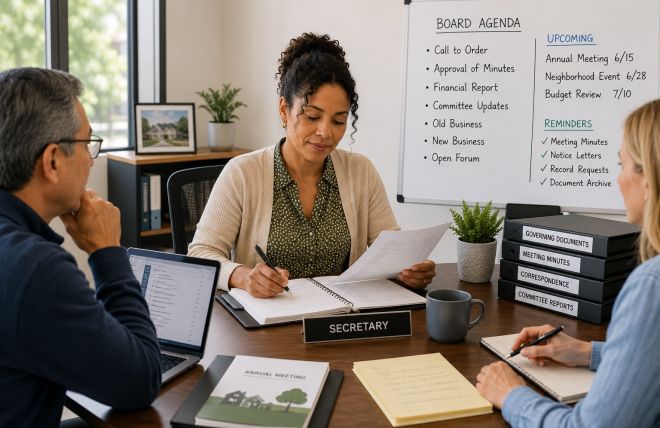
The president sets the agenda before every meeting and distributes it to board members in advance. A well-run meeting has a time limit, covers only agenda items, and ends with clear action items assigned to specific people. If you are looking for a starting point, a structured HOA meeting agenda template can save you a lot of time and help keep things on track.
Aim for meetings that last 60 to 90 minutes. Anything longer usually means the agenda was not focused enough or the discussion is getting off track.
Overseeing Financial Health
You do not need to be an accountant, but you do need to pay attention. Review the financial reports your treasurer prepares each month. Ask questions if something looks off. Before signing off on a major expenditure, make sure the full board has weighed in.
One of the biggest financial risks for HOA presidents is approving expenses without proper documentation or board votes. Even if something seems like a routine purchase, following the right process protects you personally and protects the community. Understanding the difference between your operating fund and your reserve fund is a good place to start. The Operating vs. Reserve Fund Classifier resource can help your board get clear on which dollars go where.
Signing Contracts and Legal Documents
As president, you will sign vendor contracts, legal agreements, and financial documents. Before signing anything significant, make sure two things are true: the board has voted to approve it, and you have reviewed it with legal counsel if it involves anything unusual. A routine landscaping contract is different from a multi-year service agreement with complex termination clauses.
Upholding the Governing Documents
Your HOA has a set of rules, typically called CC&Rs, bylaws, and rules and regulations. Your job is to enforce them consistently. The fastest way to lose homeowner trust is to apply rules selectively, which is why it matters to have those documents accessible and to consult them regularly. If your community's governing documents are hard to find or out of date, that is something worth addressing early in your tenure.
Communicating With Homeowners
Many board presidents underestimate how much of the job is communication. Homeowners who feel informed are far easier to work with than homeowners who feel ignored. Even a brief monthly update, whether by email, your community website, or a posted notice, goes a long way. When you have a difficult message to share, like a dues increase or a special assessment, clear and early communication prevents most of the backlash.
How Technology Can Help HOA Presidents Stay on Top of Their Role
Running an HOA still involves a lot of paperwork, emails, and chasing people down for information. Technology can take a meaningful amount of that off your plate.
Platforms like Neighborhood.online are built specifically for HOA boards and give you a central place to store governing documents, post announcements, collect dues, and keep homeowners informed. Instead of digging through email threads to find the last approved budget or the current vendor contract, everything lives in one place that board members and homeowners can access any time.
Some of the features that make the most difference for board presidents include document storage for governing documents and meeting minutes, communication tools that let you send updates to all homeowners without needing everyone's personal email address, and online dues collection that reduces the friction of getting payments in on time. For a volunteer role that already takes more time than most people expect, these tools can make the difference between feeling overwhelmed and feeling like you actually have a handle on things.
Conclusion
The HOA board president role carries real responsibility, but it is manageable when you understand what it involves and have simple systems in place. Your core job is to keep the board focused, enforce the rules fairly, communicate openly with homeowners, and make sure the community's finances are on solid ground.
Start by getting your governing documents organized and accessible. Build a meeting routine that keeps things moving. Stay in close contact with your treasurer. And when you are not sure about a legal or financial decision, ask for help before signing anything.
A well-run HOA makes the whole neighborhood better. That starts with a board president who understands their role and takes it seriously without taking it personally.

Frequently Asked Questions
How does the HOA President handle disputes within the community?
The HOA President plays a crucial role in mediating disputes to maintain a harmonious community. Key steps include:
- Listening to both parties to fully understand the issue before taking action.
- Referring to the governing documents (CC&Rs, bylaws, policies) to determine if a rule violation exists.
- Encouraging compromise and open communication.
- Working with the board or legal counsel for complex disputes.
What are the key differences between the roles of the HOA President and Treasurer?
| Responsibility | President | Treasurer |
|---|---|---|
| Leadership & Decision-Making | Leads board meetings, oversees HOA operations, represents the HOA | Provides financial insights but does not typically lead meetings |
| Financial Management | Oversees financial planning but does not handle day-to-day transactions | Manages the budget, collects dues, tracks expenses, and maintains financial reports |
| Legal & Contractual Duties | Signs contracts and ensures compliance with governing documents | Works with accountants, auditors, and tax professionals |
| Dispute Resolution | Mediates conflicts between homeowners and the HOA | Addresses financial disputes, such as unpaid dues |
How does the HOA President ensure compliance with governing documents?
By working closely with legal counsel and the board, the President ensures that all HOA actions align with bylaws, CC&Rs, and state laws. Regularly reviewing and updating governing documents also helps maintain compliance.
What strategies can an HOA President use to build community engagement?
Hosting town halls, social events, and educational meetings encourages resident involvement. Keeping open lines of communication through newsletters, websites, and social media also helps residents stay engaged and informed.
How does the HOA President collaborate with a management company?
If the HOA employs a management company, the President works as the main point of contact, ensuring that the company follows board directives, handles financials efficiently, and maintains community standards.
The HOA President plays a vital leadership role in ensuring the smooth operation of the community. From financial oversight to dispute resolution, the President must balance authority with collaboration to create a well-managed and engaged neighborhood.
📥 Download Our Free HOA Board Meeting Agenda Template to keep your HOA meetings structured and productive! 🔗
By understanding and embracing these responsibilities, an HOA President can create a stronger, more cohesive community that benefits all homeowners. 🚀
If you want simple, modern, and free to start, you are in the right place.
We run your community.
Set up a complete community platform in under an hour. No developer required. No credit card needed. No accounting degree required.