Build Your HOA Website Free
Neighborhood.online gives your community a modern website, document storage, and communication tools in minutes. No technical skills required.
HOA Airbnb Rules: Can Your HOA Restrict Short-Term Rentals?

Short-term rentals through platforms like Airbnb and Vrbo have changed the way people use their homes. For HOA boards, that change has created a genuinely difficult enforcement problem. Homeowners want the income. Neighbors want the quiet enjoyment they signed up for. And the legal landscape around what HOAs can actually do about it varies significantly depending on where you live.
HOA Airbnb rules are one of the most contested areas of community governance right now. This guide covers what boards can legally do, where the authority comes from, how state laws complicate things, and how to build and enforce a short-term rental policy that holds up.
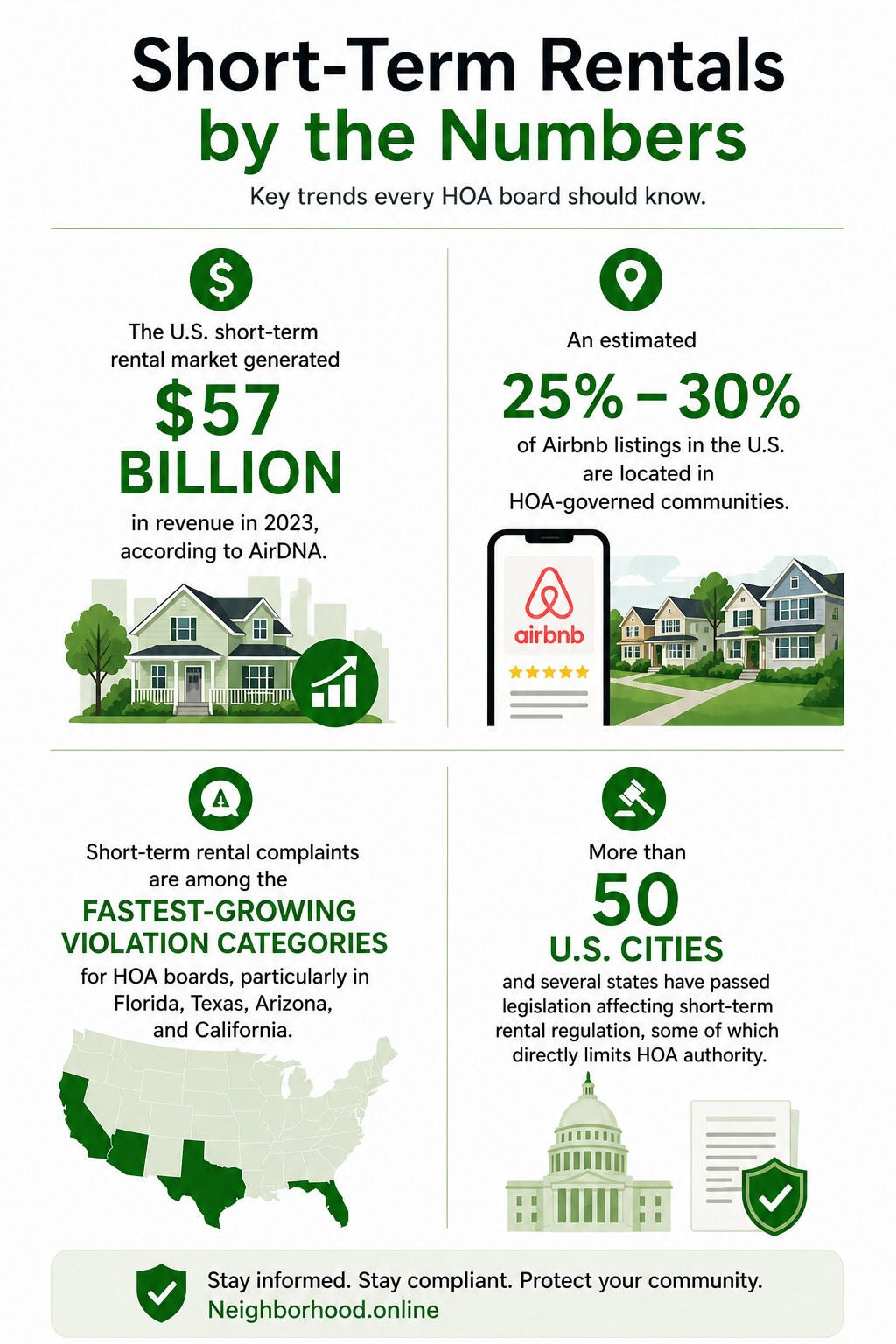
- The U.S. short-term rental market generated approximately $57 billion in revenue in 2023, according to AirDNA.
- An estimated 25% to 30% of Airbnb listings in the U.S. are located in HOA-governed communities.
- Short-term rental complaints are among the fastest-growing violation categories for HOA boards, particularly in Florida, Texas, Arizona, and California.
- More than 50 U.S. cities and several states have passed legislation affecting short-term rental regulation, some of which directly limits HOA authority.
Can an HOA Ban Airbnb?
The short answer is: it depends on what your governing documents say and what state you are in.
HOAs derive their authority from their governing documents, primarily the CC&Rs. If the CC&Rs restrict or prohibit short-term rentals, that restriction is generally enforceable as a private contractual agreement. Courts in most states have upheld HOA short-term rental bans when they are clearly written into the CC&Rs and properly recorded.
The key distinction is between restricting and prohibiting. An HOA can:
- Prohibit all short-term rentals below a minimum stay duration, such as 30 or 90 days, if that language is in the CC&Rs.
- Restrict how rentals work without banning them outright, by requiring registration, limiting the number of guests, or setting safety requirements.
- Require owner occupancy for a minimum period before a unit can be rented.
What an HOA generally cannot do is impose rental restrictions that are not grounded in the governing documents. A board vote is not enough on its own. If the CC&Rs do not address short-term rentals, the board's authority to restrict them is much weaker and more vulnerable to legal challenge. More on that below.
Every short-term rental restriction your board wants to enforce needs to trace back to a specific provision in your governing documents. Board-adopted rules that contradict or go beyond what the CC&Rs authorize are not enforceable. See our guide to CC&Rs for a full breakdown of how governing document authority works.
State Laws That Limit HOA Authority
This is the part most HOA boards do not know about until it is too late. Several states have passed laws that preempt or limit local and private restrictions on short-term rentals, and some of those laws affect HOAs directly.
Arizona
Arizona has one of the most homeowner-friendly short-term rental laws in the country. Arizona Revised Statutes Section 33-1806.01 prohibits HOAs from banning short-term rentals entirely, though HOAs can still adopt reasonable regulations around noise, parking, trash, and other impacts. If your Arizona HOA has a blanket short-term rental ban in its CC&Rs, it may not be enforceable under current state law.
Florida
Florida law under Section 509.032 limits the ability of local governments to regulate short-term rentals, but HOA restrictions recorded in CC&Rs before July 1, 2011 are generally grandfathered and enforceable. Restrictions adopted after that date face more scrutiny. Florida HOAs should review their CC&R amendment history carefully before taking enforcement action.
Texas
Texas Property Code Section 202.1015 prohibits HOAs from banning short-term rentals unless the restriction was in the original declaration or was added by a vote of homeowners. Board-only rule changes attempting to prohibit Airbnb are not enforceable in Texas without a homeowner vote to amend the CC&Rs.
California
California does not have a statewide preemption law for HOAs, but many cities have their own short-term rental ordinances that HOAs must navigate alongside their own rules. HOAs in California generally retain the ability to restrict short-term rentals through their CC&Rs.
If your HOA is in Arizona, Florida, or Texas, do not assume your short-term rental restrictions are enforceable without checking current state law first. Laws in this area are changing quickly. Consult your HOA attorney before issuing violation notices for rental violations.
What If Your CC&Rs Are Silent on Short-Term Rentals?
Many HOA governing documents were written before platforms like Airbnb existed. If your CC&Rs do not mention short-term rentals, minimum stay requirements, or rental restrictions, your enforcement options are limited but not zero.
Boards in this situation can typically enforce related rules that do exist, even if there is no explicit rental ban. For example:
- Nuisance provisions. Most CC&Rs prohibit uses that constitute a nuisance to neighbors. Noise, parking congestion, and excessive guest traffic from short-term rentals can all be addressed under nuisance language even without an explicit rental restriction.
- Commercial use restrictions. Many CC&Rs restrict properties to residential use only. Boards have argued successfully in some states that operating a short-term rental constitutes a commercial use of a residential property, making it a CC&R violation even without specific rental language.
- Guest and occupancy policies. Existing guest limits and occupancy rules can be applied to short-term rental guests the same as any other visitor.
These approaches are not as clean as an explicit rental restriction, and they are more vulnerable to challenge. The right long-term solution is to amend the CC&Rs to address short-term rentals directly.
How to Write an Enforceable Short-Term Rental Policy
Whether you are adding language to your CC&Rs or adopting a supplemental rules document, a well-written short-term rental policy should cover the following:
- Minimum stay duration. State clearly the shortest stay permitted, for example no rentals of fewer than 30 consecutive days. This is the most common and cleanest way to address Airbnb without banning rentals outright.
- Registration requirement. Require homeowners to register any rental arrangement with the HOA, including the platform being used, contact information for the guest, and expected arrival and departure dates.
- Guest conduct. State that guests are subject to all community rules and that the homeowner is responsible for guest compliance. A guest who violates community rules is the homeowner's violation to answer for.
- Occupancy limits. Set a maximum number of guests per unit tied to the number of bedrooms, not the total square footage.
- Common area access. Clarify which common areas guests may access and any restrictions that apply.
- Parking. Address how many vehicles guests may bring and where they may park.
- Noise and quiet hours. Reference existing noise rules explicitly so there is no ambiguity about whether they apply to rental guests.
- Consequences for violations. Reference your fine schedule and state that repeated violations may result in escalating fines or suspension of rental privileges.
Need to send a violation notice for an unauthorized short-term rental or rental-related rule breach? Download our free violation notice templates as a starting point.
Download the Violation Notice Templates
Amending Your CC&Rs to Address Rentals
If your CC&Rs are silent on short-term rentals, amending them is the most reliable path to enforceable restrictions. The amendment process is not fast or easy, but it is the right long-term move for communities that want real authority over this issue.
Most CC&Rs require a supermajority of homeowners, typically 67% to 75% of all owners, to approve an amendment. That threshold applies to all owners, not just those who vote. Getting there requires a clear communication strategy, multiple rounds of outreach, and often a community meeting where homeowners can ask questions before the vote.
A few things that help the process go smoothly:
- Frame the amendment as protecting property values and community quality, not as punishing homeowners who want rental income.
- Be specific about what will and will not be allowed. A minimum stay requirement is easier to get support for than an outright ban.
- Have the proposed language reviewed by your HOA attorney before circulating it to homeowners. Poorly drafted CC&R language creates enforcement problems later.
- Give homeowners plenty of time to review and ask questions. Rushed amendments often fail to reach the required vote threshold.
For a full walkthrough of the governing document amendment process, our guide on HOA violation enforcement covers how governing document authority flows from CC&Rs through board-adopted rules.
Enforcing Short-Term Rental Violations
Assuming your CC&Rs authorize the restriction you are enforcing and state law does not preempt it, the enforcement process for short-term rental violations follows the same structure as any other HOA violation.
- Document the violation. Screenshot the listing from Airbnb or Vrbo, note the dates, and document any related complaints from neighbors. This is your evidence if the homeowner disputes the notice.
- Send a written notice. The notice should cite the specific CC&R provision being violated, describe the violation clearly, and give a reasonable deadline to come into compliance.
- Follow up. Check whether the listing has been removed or the rental has been brought into compliance after the cure period. If not, proceed to a second notice and fine schedule.
- Offer a hearing. Before imposing a fine, give the homeowner the opportunity to appear before the board. They may have information that affects the outcome, such as a rental that was booked before the rule was adopted.
- Apply fines consistently. Selective enforcement of rental violations is the same legal risk as selective enforcement of any other rule. If one homeowner gets a warning, all homeowners in the same situation get a warning.
One practical challenge with short-term rental enforcement is that boards often find out about violations from neighbors rather than through systematic monitoring. Some communities use services that scan platforms like Airbnb for listings within a specific address range. Others rely on the community to self-report. Either way, having a clear, published policy makes it much easier to act when a violation is identified. For more on the full HOA violations process, see our complete guide to HOA violations.
Real World Case Study: A Florida Condo Community
A large condominium complex in Wellen Park, Florida faced growing complaints about security and wear on common facilities as Airbnb turnover increased. The condo board responded by implementing a structured short-term rental policy rather than attempting an outright ban.
The policy included a six-month minimum stay requirement, a mandatory background check for all hosts and guests, and clear rules about common area access. Safety requirements were updated to require functional smoke detectors, fire extinguishers, and a written safety protocol document provided to each guest at check-in.
After implementation, security-related incidents dropped noticeably and resident satisfaction improved. Longer minimum stays meant guests were better integrated into the community rather than cycling through on weekend trips. The board's decision to regulate rather than prohibit also meant the policy was more likely to survive legal challenge under Florida law.
The key to their success was specificity. Vague policies generate disputes. Specific policies, reviewed by legal counsel and clearly communicated to all residents, give boards the tools they need to enforce consistently and fairly.
How Technology Helps Boards Manage Short-Term Rentals
Tracking short-term rental compliance manually is difficult. Boards that rely on email threads and spreadsheets to manage rental registrations and violation records tend to end up with gaps in documentation that hurt them when violations are disputed.
A platform like Neighborhood.online gives communities a central place to store rental registrations, track the status of active violations, and document every step of the enforcement process. That organized record is your best protection when a homeowner pushes back on a fine or threatens legal action.
Ready to Simplify HOA Management?
Neighborhood.online gives your board the tools to manage violations, communicate with homeowners, and store documents in one place. No management company required.
Start Your Free Website Today
References
- AirDNA. (2024). U.S. short-term rental market report 2023. https://www.airdna.co/blog/us-short-term-rental-market-report
- Arizona State Legislature. (2023). A.R.S. § 33-1806.01: Rental of dwelling unit; prohibition; applicability. https://www.azleg.gov/ars/33/01806-01.htm
- Florida Legislature. (2024). Florida Statutes § 509.032: Duties of division. The Florida Senate. https://www.flsenate.gov/Laws/Statutes/2024/509.032
- Texas Legislature Online. (2023). Texas Property Code § 202.1015: Regulation of residential rental of property. https://statutes.capitol.texas.gov/Docs/PR/htm/PR.202.htm
- Community Associations Institute. (2023). Best practices report: Community association governance. Foundation for Community Association Research. https://www.caionline.org/LearningEvents/Research/Pages/BestPractices.aspx
- Nolo. (2024). HOA rules about short-term rentals. https://www.nolo.com/legal-encyclopedia/hoa-rules-about-short-term-rentals.html
- National Conference of State Legislatures. (2024). Short-term rental legislation database. https://www.ncsl.org/financial-services/short-term-rental-legislation-database


If you want simple, modern, and free to start, you are in the right place.
We run your community.
Set up a complete community platform in under an hour. No developer required. No credit card needed. No accounting degree required.